
A life-saving medical vehicle is not just a van with a siren; it's a mobile ICU that must survive 50-degree heat without a single rattle. When you invest in a professional toyota hiace ambulance conversion, you aren't just buying a vehicle. You're commissioning a precision-engineered environment where every weld and cabinet mount is a matter of life and death. You understand that in the high-stakes world of emergency response, equipment failure isn't an option. Standard interiors often fail under the intense vibration and heat of the UAE, leading to costly downtime and safety risks.
Discover how professional engineering and custom fabrication transform the Toyota Hiace into a high-performance, life-saving medical vehicle that exceeds expectations. We'll break down the technical specifications of the H300 series, the necessity of EN 1789 compliance, and why precision metalwork is the foundation of a reliable fleet. This guide provides a clear look at configuring Type A, B, and C units that deliver long-term durability for the most demanding missions. You'll learn how to ensure your medical transport stays operational when every second counts.
Key Takeaways
- Learn why the Toyota Hiace platform remains the preferred choice for national medical fleets operating in extreme high-temperature environments.
- Understand the technical differences between BLS and ALS configurations to select the right toyota hiace ambulance conversion for your specific emergency response needs.
- Discover how in-house laser cutting and CNC machining eliminate interior rattles and ensure long-term structural durability under heavy operational stress.
- Gain insights into international EN 1789 safety standards and the specialized engineering required for armored medical vehicles in high-risk zones.
- Explore how a unified fleet design streamlines maintenance and training while meeting strict regional health department regulations.
The Toyota Hiace Advantage for National Medical Fleets
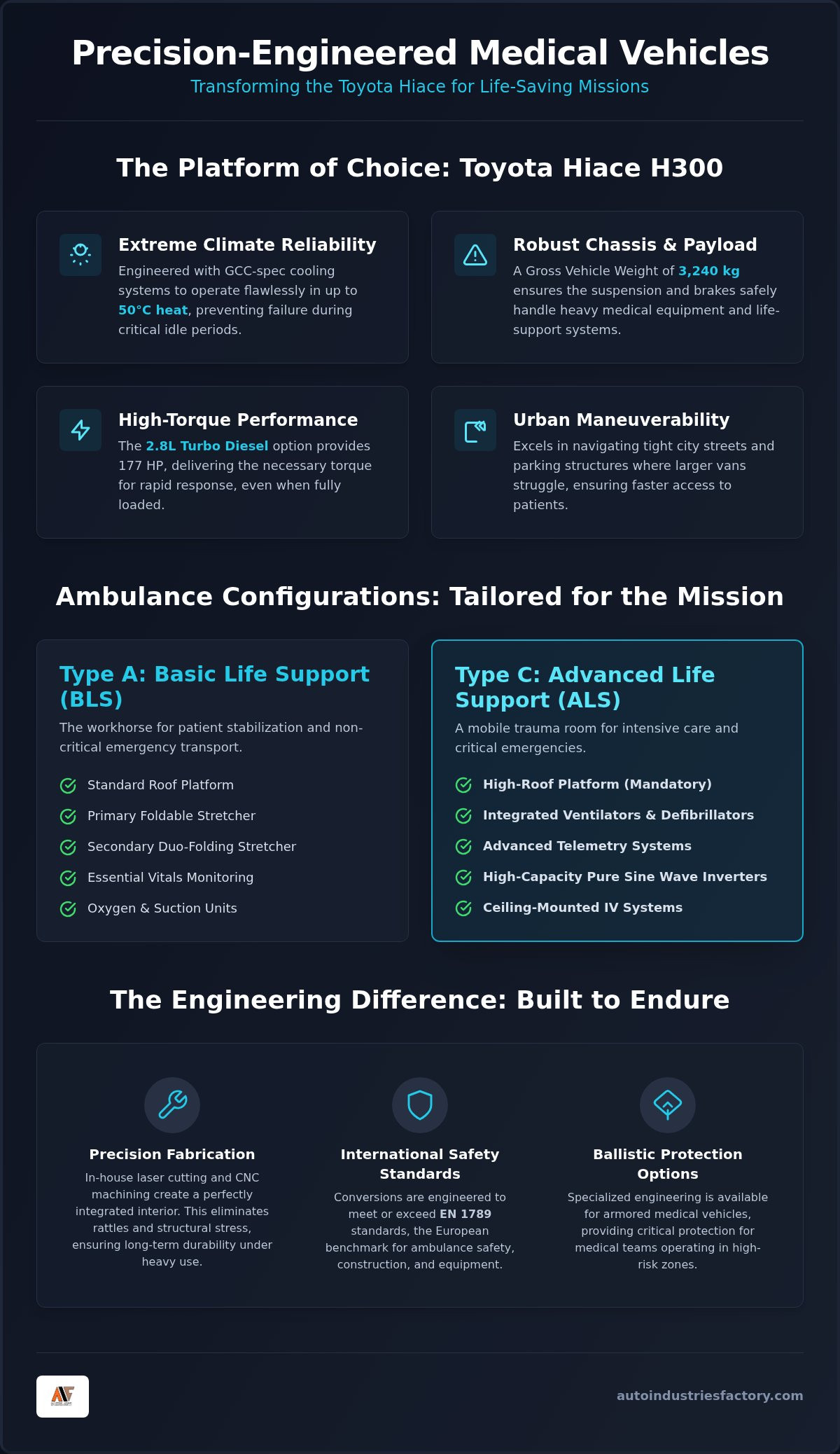
The Toyota Hiace H300 series stands as the primary choice for emergency response across the UAE. Its reputation for mechanical resilience isn't just marketing; it's a field-proven reality. When executing a toyota hiace ambulance conversion, the starting platform's quality determines the vehicle's ultimate lifespan. Unlike many passenger vans modified for medical use, the Hiace is engineered to handle the rigorous demands of 24/7 medical service without structural fatigue or frequent mechanical failure.
Reliability and Performance in Harsh Climates
Operating in 50-degree heat requires more than just a standard engine. The GCC-spec Hiace is equipped with cooling systems designed for the Middle East's extreme thermal loads. Fleet managers typically choose between the 2.7L petrol engine and the 2.8L turbo diesel. While the petrol variant is known for its simplicity, the 2.8L diesel provides the 177 HP and high torque necessary for rapid response when the vehicle is fully loaded with heavy medical equipment.
Ambulances often spend hours idling at emergency scenes or hospital bays. This puts immense strain on the cooling loop and the electrical system. A professional conversion addresses this by reinforcing the engine's ability to maintain peak performance during stationary operation. The H300 chassis supports a Gross Vehicle Weight of 3,240 kg, ensuring the suspension and brakes can handle the added weight of medical cabinetry, oxygen cylinders, and life-support systems without compromising safety.
Platform Versatility: Standard vs. High Roof
The choice of roof height defines the ambulance's medical capability. For Basic Life Support (BLS), a standard roof might suffice for patient transport. However, for Advanced Life Support (ALS) or Intensive Care units, the high-roof variant is mandatory. It provides the vertical clearance needed for paramedics to stand while performing life-saving procedures. This ergonomic advantage reduces staff fatigue and improves patient outcomes during critical transport phases.
While larger platforms like the GMC Savana offer more interior volume, the Hiace excels in urban maneuverability. It navigates tight streets and multi-story parking areas with ease while still providing a professional medical environment. The platform's design philosophy shares DNA with the Toyota HiMedic factory ambulance, a vehicle dedicated entirely to clinical excellence. Maintenance remains straightforward because spare parts are readily available throughout the country, ensuring your fleet stays on the road rather than in the workshop. For those managing large-scale operations, professional conversion services ensure these vehicles meet every national regulation.
For those requiring specific factory-original replacements to maintain their vehicles to the highest standards, sourcing through an OEM specialist like mihi.hu provides an additional layer of reliability for fleet maintenance.
Designing the Medical Interior: From BLS to ALS Configurations
Engineering a medical interior requires a deep understanding of clinical workflows. A high-quality toyota hiace ambulance conversion transforms a standard cargo space into a sterile, organized treatment room where every millimeter counts. Professional fabrication ensures that medical staff can reach oxygen regulators, suction units, and monitors without leaving their belted seats. Modern interiors are redesigned for safety and efficiency, minimizing the risk of injury to paramedics during high-speed transport. We focus on creating a workspace that remains quiet and stable, even when navigating the diverse road conditions found across the Emirates.
Basic Life Support (BLS) Configuration
BLS units focus on patient stabilization and transport. These configurations prioritize essential life-saving tools without the weight or complexity of intensive care hardware. Standard equipment includes a primary foldable stretcher and a secondary duo-folding stretcher for multi-patient scenarios. The electrical system supports basic vitals monitoring and high-intensity LED interior lighting. These vehicles are the workhorses of non-critical emergency response and inter-facility transfers. They provide a reliable platform for medical technicians to manage respiratory or cardiac issues while in transit to a hospital facility.
Advanced Life Support (ALS) and Intensive Care Units
ALS conversions are mobile trauma rooms. These units require integrated ventilators, defibrillators, and advanced telemetry systems. To power this mission-critical hardware, we install high-capacity pure sine wave inverters. These provide stable electricity even when the engine is under heavy load or idling in high-heat conditions. Ceiling-mounted IV tracks and reinforced flooring are standard, providing the stability needed for complex procedures. The integration of centralized oxygen therapy systems with multiple outlets allows for simultaneous treatment of complex respiratory cases.
Storage is where many generic conversions fail. Cheap plastic or wood cabinets rattle and degrade over time. We utilize precision-engineered metal lockers and medical cabinetry that are laser-cut for a perfect fit. This structural rigidity prevents noise and ensures that heavy equipment stays secure during rapid maneuvers. This level of durability is essential for national fleets that demand 24/7 availability. If you are planning a fleet upgrade, viewing our specialized conversion services can help you define the right technical roadmap for your organization. Proper interior design doesn't just look professional; it saves lives by making every action more efficient.
Advanced Fabrication: The Engineering Behind the Conversion
A high-performance medical vehicle is only as reliable as its weakest joint. While some converters rely on pre-fabricated plastic kits that rattle or crack under the UAE's intense heat, we prioritize structural durability through precision metalwork. Every toyota hiace ambulance conversion we execute begins with in-house design and laser cutting. This technology ensures that every cabinet, bracket, and reinforcement plate fits the H300 chassis with sub-millimeter accuracy. It's the difference between a temporary modification and a vehicle built for a ten-year service life.
Precision fabrication eliminates the common points of failure found in generic conversions. We utilize CNC machining to create specialized mounting hardware that secures heavy medical equipment. By handling all welding and painting in-house, we maintain total control over the finish and structural integrity of the interior. This master-craftsman approach ensures that the medical environment remains sterile, quiet, and capable of withstanding the vibrations of rapid emergency response. Custom metal cabinetry doesn't just look professional; it provides the impact resistance necessary to protect both staff and patients during transit.
Structural Integrity and Reinforcement
The roof of a standard Hiace isn't designed to support heavy-duty electric ventilators, high-intensity lighting, and air filtration systems. We solve this by fabricating internal structural ribs that distribute the load across the pillars. This reinforcement prevents roof sagging and ensures that ceiling-mounted IV tracks remain secure during sudden maneuvers. For the foundation, we use anti-bacterial and anti-slip flooring materials bonded to a precision-leveled subfloor. This creates a rattle-free environment that is easy to decontaminate after every mission. Every component is engineered to remain stable under the stress of high-speed cornering and emergency braking.
Custom Metalwork and Accessory Integration
External protection is just as critical as internal organization. We fabricate heavy-duty components that shield the vehicle's vital systems from impact and debris. Our engineering team designs and manufactures Custom Bull Bars and Bumpers: A Guide to Expert Fabrication that are specifically weighted to maintain the vehicle's center of gravity. These additions provide a platform for auxiliary lighting and sirens without compromising the front-end cooling efficiency.
- Laser-cut brackets: Secure oxygen cylinders and heavy monitors without the risk of shearing.
- Custom roof racks: Engineered for optimal aerodynamics while supporting high-output siren bars.
- Reinforced rear bumpers: Provide additional protection and a stable step for loading stretchers.
By integrating these custom-built solutions, we ensure the Toyota Hiace functions as a unified, mission-ready tool. This direct, no-nonsense approach to engineering guarantees that your fleet remains operational when it matters most.
Safety Standards and Ballistic Protection Options
Safety is the non-negotiable foundation of any emergency vehicle. When commissioning a toyota hiace ambulance conversion, compliance with the European standard EN 1789:2020 ensures the vehicle meets rigorous crash-test and structural requirements. This standard dictates everything from the strength of the medical cabinet mounts to the illumination levels in the patient compartment. It's about engineering a survival cell that protects the crew and patient during a high-impact event. For a deeper look at these requirements, see our Ambulance Conversion: The Complete Guide to Professional Medical Vehicles.
Compliance with International Medical Standards
Beyond structural strength, we focus on technical safety. Medical devices are highly sensitive to electromagnetic interference. We ensure every conversion maintains strict Electromagnetic Compatibility (EMC) to prevent vehicle systems from disrupting life-support monitors. Electrical safety is managed through pure sine wave inverters and dedicated circuit protection, ensuring a stable power supply for ventilators and defibrillators. Infection control is equally critical. We utilize non-porous, medical-grade materials that withstand harsh chemical disinfectants without degrading. This ensures the environment remains sterile for years of service. Proper ventilation systems are integrated to maintain positive pressure, preventing external contaminants from entering the patient area while managing the interior climate in extreme UAE heat.
Armored Ambulance Conversions
In high-risk zones, standard protection isn't enough. We provide armored solutions that integrate ballistic steel and transparent armor without compromising the vehicle's medical functionality. These conversions can reach CEN B6 levels, protecting occupants against high-powered rifle fire and explosive fragments. You can learn more about these specialized builds in our Car Armouring: A Complete Guide to Vehicle Ballistic Protection. Our fabrication process ensures the ballistic shielding is seamless, leaving no gaps in protection while maintaining the sterile medical interior required for patient care.
Adding armor increases the vehicle's mass significantly. We don't just add plates; we re-engineer the platform. This involves upgrading to heavy-duty suspension and high-performance braking systems to maintain the maneuverability required for emergency response. The goal is to balance maximum protection with the speed and agility necessary for urban and rural missions. Our engineering team ensures the armored toyota hiace ambulance conversion remains a responsive, life-saving tool even under the weight of ballistic shielding. To discuss your specific security and medical requirements, contact our engineering team for a technical consultation.
Optimizing Your Medical Fleet: Customization and Support
Managing a national medical fleet requires more than just high-quality vehicles; it demands a unified engineering standard. A consistent toyota hiace ambulance conversion across your entire organization simplifies everything from paramedic training to inventory management for medical consumables. When every vehicle in the fleet follows an identical ergonomic layout, medical staff can perform life-saving tasks instinctively, regardless of which unit they're operating. This standardization is a core component of operational excellence for UAE health departments and private medical providers who prioritize rapid response times and crew efficiency.
Specialized Fleet Solutions
We don't just build standard ambulances. Our engineering team adapts the Hiace platform for diverse mission profiles, including mobile clinics and remote rescue units for desert operations. These specialized builds require unique interior configurations while maintaining the structural integrity of the base vehicle. We also handle the application of high-visibility reflective livery, ensuring your fleet meets national safety branding standards for maximum visibility during emergency response. You can Explore our specialized vehicle conversion services to see how we tailor each build to specific regional health requirements.
Long-Term Maintenance and Reliability
A major pain point for fleet managers is the "rattle factor" and the difficulty of repairing generic plastic interiors that fail under stress. Our reliance on in-house metal fabrication and laser cutting at Auto Industries Factory LLC solves this problem. Since we manufacture the components ourselves, we can provide exact replacements for cabinetry or brackets years after the initial conversion. This in-house capability eliminates the need to source parts from third-party suppliers, drastically reducing vehicle downtime and maintenance costs.
Reliability extends beyond the hardware. We provide technical training for your maintenance staff, ensuring they understand the custom electrical systems and medical gas integrations. This knowledge transfer is vital for keeping a toyota hiace ambulance conversion in peak operational condition. Choosing a partner with complete in-house capabilities means you have a single point of contact for the entire lifecycle of the vehicle. It's a pragmatic, solution-oriented approach that protects your investment and ensures your fleet stays mission-ready.
Moving from a conceptual design to a national delivery is a streamlined process. We partner with you to finalize technical specifications that meet your specific operational needs. Once the design is locked, our factory moves into high-volume production, delivering mission-ready vehicles that are ready for immediate service. To begin optimizing your fleet, contact our technical team to request a comprehensive conversion quote. We are ready to deliver the engineering excellence your mission demands.
Deploying Mission-Ready Medical Solutions
A high-performance toyota hiace ambulance conversion is more than a vehicle; it's a strategic asset for national health networks. As discussed, the combination of Toyota’s mechanical resilience and precision-engineered interiors creates a platform that excels in the UAE’s extreme conditions. Every modification, from the structural reinforcement of ALS units to the ballistic integrity of armored medical vehicles, serves the dual purpose of crew safety and patient care. This level of engineering ensures that your mobile medical environment remains sterile and stable during the most critical missions.
Moving away from generic plastic kits toward custom metal fabrication ensures your fleet remains rattle-free and operational for a decade of service. Auto Industries Factory LLC provides the technical expertise and in-house manufacturing required to deliver these high-stakes solutions. With a proven track record in large-scale fleet transformations and specialized armor integration, we are the partner of choice for mission-critical medical transport. Contact Auto Industries Factory LLC for a Custom Ambulance Conversion Quote and ensure your fleet is built on a foundation of engineering excellence. Your team's life-saving work deserves a vehicle that never fails.
Frequently Asked Questions
What are the main types of Toyota Hiace ambulance conversions?
Conversions generally fall into three categories: Basic Life Support (BLS), Advanced Life Support (ALS), and specialized mobile clinics. BLS units focus on stabilization and transport, while ALS configurations include intensive care hardware. We'll also offer specialized mobile units for remote rescue. Each toyota hiace ambulance conversion is tailored to meet the specific mission profile and regional health department regulations, ensuring the vehicle operates as a high-performance medical tool.
Can a Toyota Hiace be converted into an armored ambulance?
Yes, the Toyota Hiace can be converted into an armored ambulance up to CEN B6 level. This process involves integrating ballistic steel and transparent armor to protect against high-powered rifle fire. We've re-engineered the chassis with upgraded suspension and braking systems to handle the significant weight increase. This ensures the vehicle maintains the maneuverability and speed required for emergency response in high-risk zones without compromising medical functionality.
What medical equipment is included in a standard BLS Hiace conversion?
A standard BLS conversion includes a primary foldable stretcher, a duo-folding secondary stretcher, and a centralized oxygen therapy system. We integrate suction units, portable first aid kits, and basic vital sign monitors. The interior's designed for ergonomic efficiency, allowing paramedics to access all essential tools from a belted position. All equipment's secured using laser-cut brackets to prevent movement during rapid maneuvers or emergency braking.
How long does the conversion process take for a Toyota Hiace?
The conversion timeline depends on the technical complexity and the number of vehicles in the order. A single standard BLS unit moves faster than a fleet of armored ALS vehicles. Our master craftsmen manage the entire process from initial design to final delivery. While we don't state fixed lead times, our in-house laser cutting and CNC machining capabilities ensure a streamlined production cycle that minimizes vehicle downtime for your organization.
Does a Hiace ambulance conversion meet EN 1789 standards?
Professional toyota hiace ambulance conversion projects are engineered to meet or exceed EN 1789 standards. This European regulation ensures the vehicle's structural integrity, medical equipment security, and electrical safety meet international benchmarks. We'll prioritize these standards to guarantee that every unit provides a survival cell for the crew and patient. Compliance is essential for national health fleets that demand the highest levels of safety and operational reliability.
Is the Toyota Hiace suitable for Advanced Life Support (ALS) configurations?
The high-roof Toyota Hiace H300 is perfectly suited for Advanced Life Support (ALS) configurations. The increased vertical clearance allows medical personnel to stand while performing critical procedures like intubation or advanced cardiac care. We'll reinforce the roof and floor to support heavy-duty ventilators, defibrillators, and multi-parameter monitors. This ergonomic advantage, combined with the Hiace's urban maneuverability, makes it a superior platform for intensive care transport.
What are the electrical requirements for a modern ambulance conversion?
Modern conversions require a robust electrical architecture to power sensitive medical hardware. We install high-capacity pure sine wave inverters that provide stable, flicker-free power even during engine idling. It's vital the system meets Electromagnetic Compatibility (EMC) standards to prevent interference with life-support devices. Dedicated circuit protection and heavy-duty wiring are essential to manage the high thermal loads caused by the UAE's extreme temperatures and 24/7 operational demands.
Why is custom metal fabrication better than plastic interior kits?
Custom metal fabrication is superior to plastic kits because it offers unmatched durability in high-heat environments. Plastic interiors often rattle, crack, or degrade under the intense vibration of emergency response. Our laser-cut metal cabinetry provides high impact resistance and is easier to repair or upgrade over time. It's an engineering-focused approach that ensures the medical environment remains quiet and stable, providing a professional workspace that lasts for the vehicle's entire service life.


