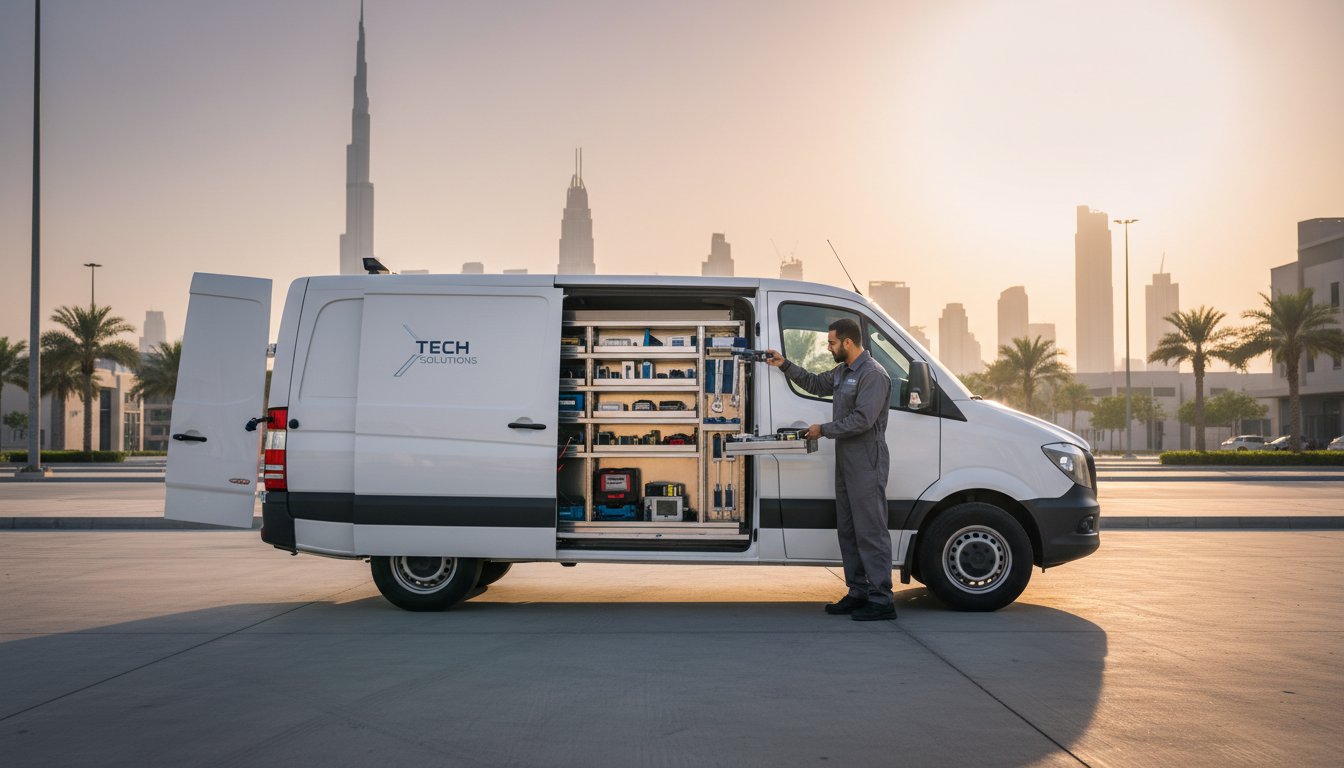
Last August, a fleet manager in Dubai South discovered that a 55,000 AED specialized sensor had melted inside a standard delivery van during a 48-degree peak afternoon. It wasn't just the hardware cost; it was the three days of lost revenue while the vehicle sat idle. You likely agree that generic shelving and one size fits all racks are a liability on UAE construction sites. When rattling brackets break or sensitive tools overheat, your bottom line takes the hit. Professional field service vehicle upfitting is no longer a luxury; it's a mission-critical requirement for any operator aiming for 100% uptime in the GCC.
This 2026 guide provides the engineering blueprint to build a durable, RTA-compliant fleet tailored for the UAE’s industrial zones. We'll show you how precision fabrication and advanced thermal management can increase technician billable hours by 18% through optimized layout organization. You'll learn how to protect your high-value assets from extreme heat and vibration, ensuring your mobile workshops are as rugged as the environments they serve. We'll cover everything from heavy-duty metalwork to climate-controlled storage solutions for your fleet.
Key Takeaways
- Understand how specialized structural modifications transform standard commercial vans into high-performance assets for the UAE’s critical utilities and telecom sectors.
- Discover the essential hardware required for efficient inventory management and integrated power solutions that keep your mobile workshop running in remote locations.
- Learn why custom-fabricated steel outperforms modular kits in long-term ROI by eliminating wasted space and reducing frequent maintenance costs.
- Master the engineering strategies needed for field service vehicle upfitting to withstand extreme desert heat, dust infiltration, and strict RTA regulations.
- Identify the technical benchmarks for selecting an upfitting partner capable of delivering military-grade precision and in-house manufacturing efficiency.
What is Field Service Vehicle Upfitting and Why Does Your UAE Fleet Need It?
Auto Industries Factory (AIF) specializes in field service vehicle upfitting, a process that goes far beyond simply adding racks to a van. It's the structural and functional engineering of a commercial vehicle to turn it into a high-efficiency mobile workshop. In the UAE's demanding environment, a standard factory truck is often just an empty shell. It lacks the organization, power systems, and climate resilience required for 24/7 operations in sectors like Telecom, HVAC, and Oil & Gas.
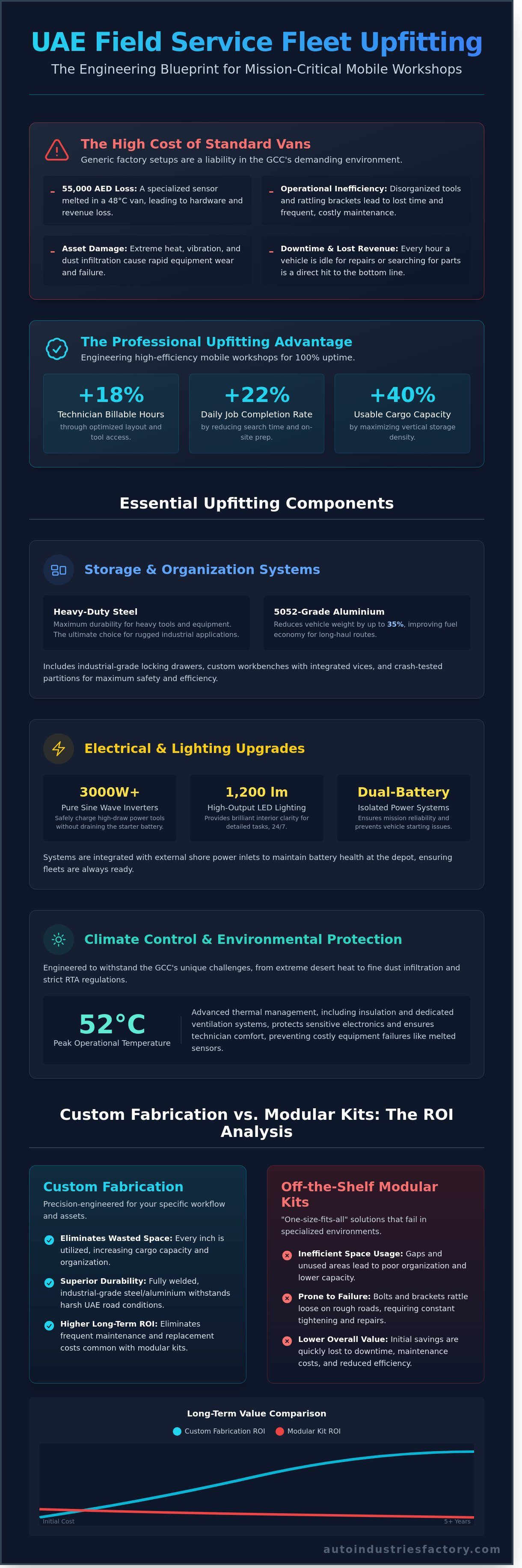
Relying on basic factory setups leads to rapid equipment wear and disorganized workflows. When a technician spends 15 minutes searching for a specific tool at a job site in Jumeirah or a remote desert location, that's lost revenue. Professional upfitting solves this by creating a dedicated place for every piece of gear. This precision increases fleet ROI by reducing vehicle downtime and boosting daily job completion rates by up to 22% for Dubai-based service providers.
The Core Objectives of Professional Upfitting
Effective upfitting focuses on three pillars: efficiency, protection, and professional presentation. We maximize storage density by utilizing vertical space, often increasing usable cargo capacity by 40% without exceeding the vehicle's payload limits. Safety is non-negotiable; we install crash-tested partitions and heavy-duty mounting systems that keep tools secure during sudden stops. Finally, your fleet is a moving billboard. Arriving at a high-profile Abu Dhabi project in a vehicle with a custom, organized interior builds immediate trust with your clients.
Upfitting vs. Standard Conversions
Basic conversions usually involve "off-the-shelf" shelving that rattles loose on rugged UAE roads. At AIF, we treat field service vehicle upfitting as a mission-critical engineering task. We apply the same ambulance conversion precision to our service fleets, ensuring every bolt and weld meets industrial standards. Our builds focus on "Mission Reliability," meaning your mobile workshop remains operational even after years of heavy use in desert conditions. We don't just add parts; we integrate systems like auxiliary power, specialized lighting, and climate-controlled tool storage to ensure your team is ready for any challenge.
Essential Components of a High-Performance Fleet Vehicle Customization
Auto Industries Factory (AIF) specializes in engineering solutions that survive the UAE's extreme conditions. Effective field service vehicle upfitting isn't just about adding shelves; it's about creating a mobile workshop that functions at peak efficiency when ambient temperatures hit 52°C. High-performance fleets require a strategic mix of organization, power, and protection to minimize downtime and maximize technician output.
Storage and Organization Systems
Choosing between steel and aluminium depends on your specific payload requirements. Steel offers maximum durability for heavy tools, while 5052-grade aluminium reduces vehicle weight by up to 35%, improving fuel economy during long hauls between Dubai and Abu Dhabi. We install drawer units with industrial-grade locking mechanisms to ensure inventory stays secure during sudden stops in Sharjah traffic. Custom workbenches with integrated 4-inch vices allow technicians to perform precision repairs on-site, which reduces the need for return trips to the warehouse.
Electrical and Lighting Upgrades
Standard vehicle alternators often struggle with the demands of modern field service vehicle upfitting. We integrate dual-battery systems and 3000W pure sine wave inverters to charge high-draw power tools safely without draining the primary starter battery. For 24/7 emergency operations, high-output LED interior lighting provides 1,200 lumens of clarity for detailed tasks. Exterior scene lighting is vital for remote Fujairah construction sites where natural light fades quickly; these systems include external shore power inlets to maintain battery health while the vehicle is parked at the depot.
Exterior Protection and Utility
Rugged environments demand structural reinforcements that go beyond factory specifications. The necessity of custom bull bars for fleet vehicles is clear when operating in desert regions where loose debris or wildlife pose constant risks to the radiator and engine bay. Heavy-duty roof racks rated for 150kg allow for the safe transport of ladders and 6-meter conduit pipes. Reinforced rear bumpers with integrated 3.5-ton towing capabilities ensure your fleet can recover other assets or haul additional equipment without compromising the vehicle's chassis integrity.
Climate Control and Ventilation
Sensitive diagnostic equipment and lithium-ion batteries fail when internal cabin temperatures exceed 60°C. We install solar-powered extraction fans and high-grade thermal insulation layers to protect your digital assets and expensive hardware. Maintaining a stable environment inside the van extends the lifespan of your tools by 40% compared to uninsulated vehicles. If you're looking to optimize your mobile operations for the summer months, you can explore our full range of specialized vehicle conversions to see how we handle these technical challenges.
Custom Fabrication vs. Modular Kits: The ROI Analysis
Selecting the right internal structure for your fleet is a decision that dictates the 10-year profitability of your mobile operations. While imported plastic or thin-gauge metal kits offer a lower initial price point, they rarely survive the 45°C to 50°C summer peaks common in Dubai and the Northern Emirates. Professional field service vehicle upfitting requires a focus on high-grade, custom-welded steel or heavy-duty aluminum to ensure the interior lasts as long as the vehicle's engine.
Standardized kits often result in 15% to 25% wasted volume because they don't account for the specific contours of the cargo area. In models like the Toyota Hiace or GMC Savana, "one-size-fits-all" shelving leaves gaps where tools can slide and rattle. Custom fabrication eliminates these inefficiencies by building around wheel arches and structural pillars. This precision allows a technician to carry 20% more inventory without upgrading to a larger, more expensive vehicle class. High-quality upfitting also protects the vehicle's original bodywork, which can increase the eventual resale value by 12% to 18% compared to fleets with damaged or poorly modified interiors.
The Durability Factor in the Middle East
Off-the-shelf kits frequently fail in the UAE due to extreme thermal expansion and constant sand ingress. Plastic joints become brittle and crack under UV exposure, while thin metal rails often warp when loaded to capacity. Auto Industries Factory (AIF) solves this through in-house powder-coating at our facility. This process provides a thick, corrosion-resistant barrier that prevents rust in coastal cities like Ras Al Khaimah. Custom fabrication ensures every millimetre of the cargo area is engineered for utility.
Tailored Workflows for Specific Trades
Efficiency depends on how well the layout matches the daily tasks of the technician. An electrician requires hundreds of small-part bins and secure cable reel holders, whereas a mobile tyre service unit needs reinforced flooring to support heavy compressors and mounting machines. AIF specializes in custom fabrication that integrates heavy equipment directly into the chassis. These ergonomic designs reduce technician movement by up to 30% during a typical 10-hour shift. By placing high-frequency tools within easy reach, you minimize physical fatigue and accelerate job completion times. This professional approach to field service vehicle upfitting turns a standard van into a high-performance mobile workshop.
Designing for the GCC: Overcoming Heat, Dust, and RTA Regulations
Operating a mobile fleet in the UAE requires engineering that survives 50°C summer peaks and relentless humidity. Standard field service vehicle upfitting often fails in this region because it ignores the extreme thermal load on both equipment and technicians. In Dubai, a van parked in direct sun can reach internal temperatures of 75°C within two hours. This heat destroys battery life, warps plastic storage, and renders electronic diagnostic tools useless. Successful upfitting in 2026 demands a "GCC-first" design philosophy that prioritizes climate resilience and strict legal compliance.
Heat and Dust Mitigation
We use high-performance, automotive-grade insulation to lower interior temperatures by up to 15 degrees Celsius compared to unshielded vans. This isn't just about comfort; it's about protecting your investment. High-CFM (Cubic Feet per Minute) ventilation systems are integrated to ensure constant airflow, preventing heat soak in cargo areas. To combat the fine desert silt that penetrates standard seals, we utilize specialized gaskets and IP67-rated enclosures for all electrical components. Every interior surface and exterior mount uses UV-resistant materials. Standard plastics often become brittle and crack within 12 to 18 months of UAE sun exposure, but our materials are rated for 10-year durability in high-UV environments.
Compliance and Safety Standards
Navigating the RTA’s rules on structural modifications is the most overlooked part of the upfitting process. Any change to the vehicle's chassis or weight distribution must pass rigorous inspections to remain road-legal. In Dubai, exceeding the Gross Vehicle Weight (GVW) by even 5% can lead to heavy fines and impoundment. We calculate payload margins with 100% precision to ensure your vehicle stays within legal limits while carrying all necessary gear. All electrical wiring follows strict safety codes to prevent vehicle fires, which are a leading cause of fleet loss in the region. You can learn more about us and how we maintain international safety benchmarks for every conversion we deliver.
Weight distribution is a critical safety factor. An unbalanced load increases braking distances by up to 25% and causes uneven tire wear. Our engineering team uses digital scales to ensure a 50/50 side-to-side balance. This keeps the center of gravity low, which is vital for vehicle stability during emergency maneuvers on the E11 or E311 highways. We don't just add shelves; we re-engineer the vehicle for the desert.
Ready to build a fleet that withstands the UAE climate? Consult with our expert fabrication team for a custom quote.
Selecting an Upfitting Partner: Why Auto Industries Factory Leads the UAE
Auto Industries Factory (AIF) specializes in high-performance vehicle conversions that bridge the gap between military-grade durability and commercial efficiency. Choosing a partner for field service vehicle upfitting requires more than just buying shelves; it demands an engineering mindset. We bring the same structural standards used in defense contracts to your service fleet, ensuring every modification handles the 50°C UAE summer heat and rugged terrain without failure.
Our facility in Ajman serves as a hub for precision engineering. We control the entire lifecycle of your build, from the initial CAD drawing to the final professional paint finish. This vertical integration allows us to maintain strict timelines and superior quality control that outsourced models cannot match. Whether you operate in the heart of Dubai or the remote oil fields of Abu Dhabi, our builds are engineered for maximum uptime.
Our Precision Fabrication Process
AIF utilizes advanced CNC laser cutting and press brake technology to achieve tolerances within 0.1mm. This precision ensures a flawless fit for every shelving unit, partition, and bracket we install. We apply heavy-duty welding techniques derived from our armoured personnel carrier experience to commercial projects. Every joint is reinforced to eliminate the rattles and structural fatigue common in standard builds. Our 12-point quality control protocol guarantees that your equipment remains secure during high-speed highway travel and off-road site access.
Comprehensive Fleet Solutions
We scale our operations to meet your specific business size. AIF manages everything from single-vehicle prototypes for local contractors to 100-unit fleet rollouts for national utility providers. Local manufacturing in the UAE means we reduce lead times by 25% to 40% compared to providers using imported modular kits. This proximity allows for direct support and rapid adjustments during the design phase. You can explore our full range of specialized services to see our work across the emergency, security, and commercial sectors.
The AIF consultation process is built on technical transparency. We move from your specific workflow requirements to a comprehensive 3D design before any metal is cut. This allows your team to verify ergonomics, weight distribution, and tool accessibility in a virtual environment. We've supported fleets across Ajman, Dubai, Abu Dhabi, and the Northern Emirates for years, providing a localized engineering partner that understands the unique demands of the Arabian Peninsula. Our goal is to ensure your field service vehicle upfitting investment delivers a measurable return through increased technician productivity and reduced vehicle wear.
Future-Proof Your Fleet with Precision Engineering
Maximizing fleet efficiency in the UAE requires more than standard kits. High-performance field service vehicle upfitting involves balancing 50-degree Celsius heat resistance with strict RTA safety standards. By choosing custom fabrication over modular sets, you'll secure a higher long-term ROI through 100% tailored storage and rugged durability. Auto Industries Factory (AIF) delivers this through our full in-house CNC and fabrication facility in Ajman. It's why we're trusted by the UAE government and commercial sectors for mission-critical deployments.
Our engineering expertise extends to high-spec ambulance and military conversions where reliability is non-negotiable. Whether you're managing a 5-vehicle utility team or a 100-unit commercial fleet, our specialists design solutions that withstand the GCC's harshest dust and terrain. Don't settle for off-the-shelf parts when you can have a fleet built for the specific demands of the 2026 market. We're ready to transform your vehicles into professional mobile workspaces that maximize your uptime and protect your crew.
Request a Free Estimate for Your Fleet Upfitting
Let's build a fleet that sets the standard for excellence across the Emirates.
Frequently Asked Questions
How long does a typical field service vehicle upfitting take in the UAE?
A standard field service vehicle upfitting typically takes between 7 and 14 business days to complete at our facility. Complex projects involving custom electrical systems or heavy-duty fabrication may require up to 21 days. We provide a detailed project timeline during the initial consultation so fleet managers can schedule downtime effectively. Our 2026 production schedule prioritizes rapid turnaround to ensure your service vehicles return to the road without unnecessary delays.
Will custom upfitting void my vehicle’s factory warranty?
Custom upfitting does not automatically void your factory warranty if the modifications comply with manufacturer guidelines and use non-invasive installation techniques. Auto Industries Factory (AIF) specializes in engineering solutions that protect the vehicle's structural integrity and engine components. While the original manufacturer won't cover the added equipment, our 12 month warranty on all fabrication ensures your investment is protected. We recommend checking with your dealer for their 2026 policy updates on aftermarket additions.
What are the most common RTA requirements for modified work vans?
The Road and Transport Authority (RTA) requires all modified vans to maintain a gross vehicle weight that doesn't exceed the manufacturer's limit by 1%. You must install a secure safety partition between the driver and the cargo area to pass the mandatory safety inspection. Additionally, any external branding or specialized lighting must meet RTA technical circular 42 standards. We handle the documentation process to ensure your field service vehicle upfitting meets 100% of the local compliance regulations.
Can you upfit existing vehicles in an older fleet, or must they be new?
We upfit both brand new 2026 models and existing fleet vehicles that are up to 7 years old. Our engineers assess the chassis condition of older vans to ensure they can support new heavy-duty shelving or specialized power systems. Retrofitting an older fleet can extend its operational life by 3 to 4 years. This approach provides a cost-effective alternative to purchasing a completely new fleet while still upgrading your technical capabilities and organization.
What materials are best for van shelving in the high heat of Abu Dhabi?
Powder-coated aluminum is the superior choice for Abu Dhabi's 50 degree Celsius summer heat because it resists thermal expansion and corrosion. Unlike plastic bins that warp or wood that cracks in low humidity, aluminum maintains its 100% structural rigidity over time. We also use galvanized steel for heavy-duty components that require high impact resistance. These materials ensure your internal storage systems don't degrade or rattle during long drives across the UAE desert terrain.
Do you provide 3D designs before the fabrication process begins?
Every project begins with a comprehensive 3D CAD design that provides a 360 degree view of the proposed interior and exterior modifications. This allows you to visualize the workflow and tool placement before we start the CNC laser cutting process. Clients receive these digital blueprints within 3 to 5 business days of the initial site visit. Final approval of the 3D model ensures that the finished vehicle matches your exact operational requirements and space constraints.
How does upfitting affect the fuel efficiency of my service vehicles?
A typical upfit can decrease fuel efficiency by 5% to 8% depending on the total weight of the added equipment and tools. We mitigate this by using lightweight materials that reduce the overall load by 30% compared to traditional steel racking. Our aerodynamic external ladder racks and low-profile toolboxes also help maintain better fuel economy at highway speeds. Proper weight distribution during the fabrication phase ensures the vehicle operates at peak efficiency during daily service calls.
Is it possible to transfer the upfitting equipment to a new vehicle later?
It's possible to transfer approximately 90% of your modular shelving and equipment to a new vehicle if the dimensions are compatible. Our bolt-on installation methods mean we don't rely on permanent welds that damage the vehicle's floor or walls. This modularity allows fleet owners to repurpose high-value assets when a vehicle reaches its 150,000 kilometer retirement mark. It's a sustainable strategy that lowers the long-term cost of fleet ownership across the UAE market.


