

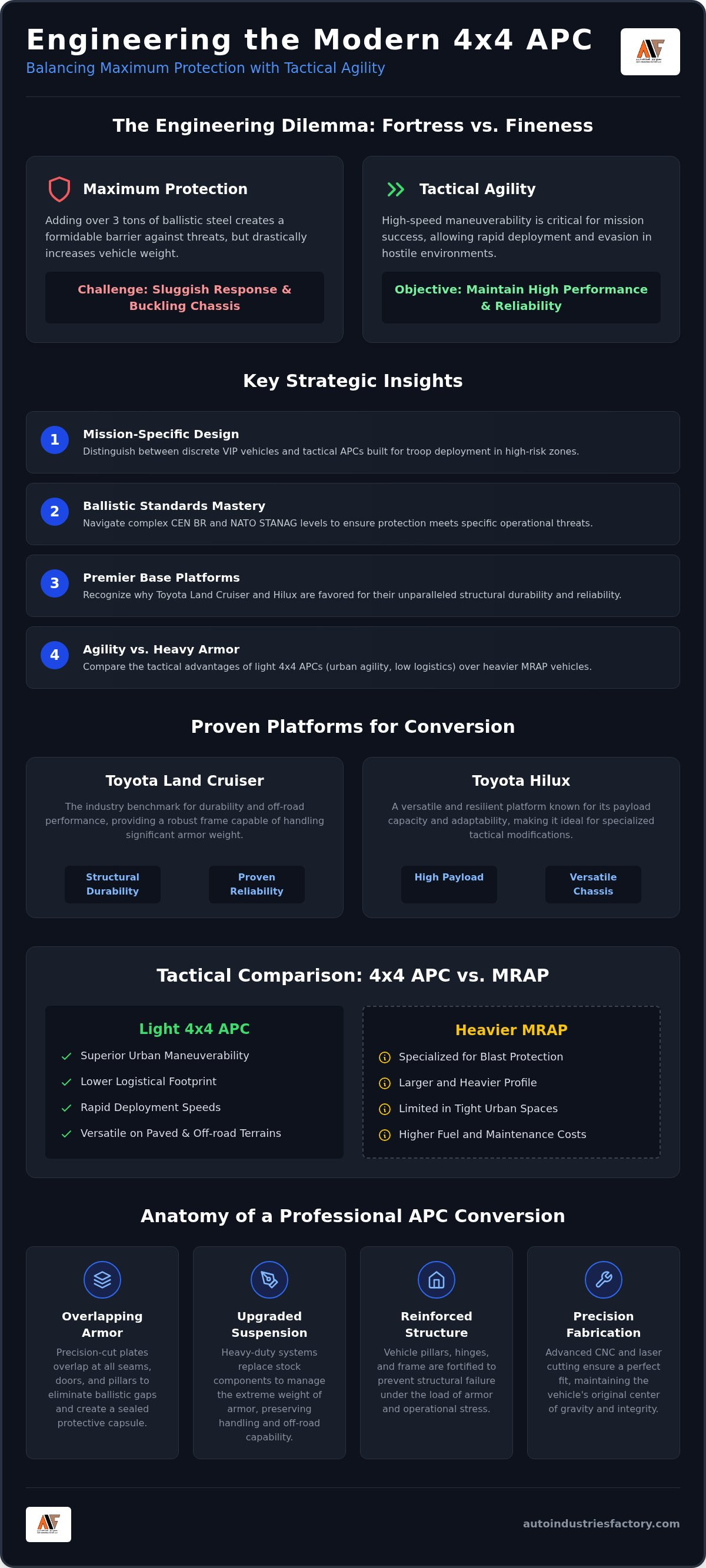
Adding three tons of ballistic steel to a vehicle usually destroys its performance, but in a high-stakes tactical environment, a sluggish response is just as life-threatening as a direct hit. You've likely seen how standard chassis buckle under the weight of heavy armor, leaving operators with a vehicle that's too slow to maneuver and too heavy to stop. Achieving the ideal balance between maximum protection and rapid agility is the ultimate engineering challenge for any 4x4 apc. It's not just about bolting on plates; it's about maintaining structural integrity while navigating complex international ballistic standards.
We understand that reliability in the field is non-negotiable. This guide explores how 4x4 Armored Personnel Carriers are engineered for maximum protection and tactical maneuverability in mission-critical environments. You'll learn the technical requirements for a successful build, why platforms like the Toyota Land Cruiser and Hilux remain industry favorites for conversion, and how to evaluate fabrication quality against CEN B6 or STANAG 4569 levels. We'll preview the precision engineering needed to ensure your fleet remains both a fortress and a high-performance tactical tool.
Key Takeaways
- Distinguish between standard commercial armored vehicles and mission-specific units designed for tactical troop deployment and high-risk environments.
- Navigate the complexities of international ballistic standards, including STANAG and BR levels, to ensure your fleet meets specific threat requirements.
- Identify why the Toyota Land Cruiser and Hilux are the premier base platforms for a high-performance 4x4 apc conversion due to their structural durability.
- Compare the tactical advantages of light 4x4 platforms over heavier MRAP vehicles, specifically regarding urban maneuverability and logistical footprints.
- Understand the critical role of precision in-house fabrication and reinforced suspension systems in maintaining vehicle agility after significant weight increases.
What is a 4x4 APC? Defining the Armored Personnel Carrier
A 4x4 apc isn't just a vehicle with reinforced glass; it's a specialized platform engineered for high-risk deployment. Unlike standard commercial armored vehicles that prioritize discrete protection for VIPs, an APC is built for tactical utility. It functions as a robust Infantry Mobility Vehicle (IMV), providing a mobile fortress for squads operating in hostile environments. In the UAE's demanding climate, these vehicles must withstand extreme heat and abrasive sand while maintaining ballistic integrity. We specialize in these vehicle modifications to ensure every weld and plate meets rigorous operational demands.
The choice of a 4x4 configuration is deliberate. It offers the perfect middle ground between heavy, slow-moving armored trucks and vulnerable standard SUVs. By utilizing proven platforms like the Toyota Land Cruiser or Hilux, engineers can maintain high speeds on paved roads while ensuring the torque and clearance needed for desert border security. This versatility makes them the primary choice for rapid response units that need to reach a location quickly without sacrificing personnel safety. The agility of these units is essential for navigating the complex urban layouts found in modern regional centers.
To better understand this concept, watch this technical review of a specialized tactical carrier:
Primary Roles of Modern 4x4 APCs
Modern tactical units rely on these platforms for several critical functions. First, they serve as the backbone for troop transport in high-risk zones, where small-arms fire is a constant threat. Law enforcement agencies also utilize them for tactical operations and riot control, where the vehicle acts as a physical barrier and a mobile command center. These vehicles are equally essential for border security, patrolling vast desert perimeters where reliability is a matter of survival. They're also vital for safe transport during medical evacuations in conflict zones. A properly converted unit provides a secure environment for medics to stabilize patients while moving through active engagement areas.
The Evolution of the Light Armored Vehicle
The industry has moved away from massive, fuel-hungry tracked vehicles toward agile wheeled platforms. This transition was made possible by breakthroughs in ballistic materials. Modern composite armor and high-tensile steel offer superior protection at a lower weight than traditional materials. These advancements allow a 4x4 apc to bridge the gap between civilian SUVs and heavy military trucks. It delivers the protection of a light tank with the maneuverability of a specialized pickup. At our facility, we use advanced laser cutting and CNC machining to ensure these light materials fit perfectly, maintaining the vehicle's original center of gravity. This evolution ensures that operators don't have to sacrifice speed for survivability, making these vehicles indispensable for modern security forces.
Ballistic Protection Levels and Armoring Engineering
Engineering a high-performance 4x4 apc requires more than just adding steel plates. It's a precise science of weight management and structural integrity. We utilize international standards like CEN B6, B7, and NATO STANAG 4569 to define the vehicle's survival envelope. While luxury armoring often focuses on concealment, tactical engineering prioritizes overlapping armor plates to eliminate ballistic gaps in the door pillars and hinges. This approach ensures that the vehicle remains a sealed fortress even under sustained fire. Modernization in this field is constant, as seen with the Army's new armored personnel carriers, which emphasize modularity and enhanced underbody protection over older, static designs.
The distinction between transparent and opaque armor is critical in APC design. Opaque armor consists of high-tensile ballistic steel and composite materials integrated into the body panels. Transparent armor refers to multi-layered ballistic glass that must provide the same protection level without distorting the driver's vision. Managing the weight of these materials is the primary engineering challenge. A B6 level package can add significant mass, but moving to B7 protection for armor-piercing rounds requires even denser materials that test the limits of the base chassis.
Understanding B6 vs. B7 Protection
Level B6 is the industry standard for most tactical units, designed to stop 7.62x51mm multi-hit rifle fire. If the mission threat profile includes armor-piercing (AP) rounds, B7 protection becomes mandatory. This higher level utilizes thicker ballistic steel and advanced ceramic composites. Because a B7 package can add over 1,500kg to the vehicle, it's not a simple bolt-on solution. We perform extensive cooling system upgrades to ensure the engine doesn't overheat while carrying this massive payload in the UAE's high-temperature environments.
Blast Protection and Floor Reinforcement
Survival in the field often depends on what's happening beneath the tires. We reinforce the floor with specialized blast-resistant materials to mitigate threats from DM51 grenades and light explosives. Unlike standard armored SUVs, a true Armoured Personnel Carrier (APC) incorporates structural reinforcements and blast-attenuating seats to absorb kinetic energy during an underbody detonation. This engineering prevents the shockwave from reaching the occupants, a feature that distinguishes a tactical build from a basic conversion.
Heavy armor is useless if the vehicle's mechanical components fail under the strain. We replace factory suspension with heavy-duty components specifically rated for the increased Gross Vehicle Weight. If you're designing a fleet for high-risk operations, you can explore our specialized vehicle modifications to see how we balance maximum protection with operational agility.
4X4 APC vs. MRAP: Choosing the Right Tactical Platform
Deciding between a 4x4 apc and a Mine-Resistant Ambush Protected (MRAP) vehicle isn't a matter of which has the most armor. It's a strategic choice based on the mission environment and logistical capacity. While MRAPs are engineered specifically to survive massive underbody IED blasts, their massive weight and high center of gravity make them a liability in many modern tactical scenarios. A 4x4 apc provides a more balanced solution. It offers the necessary ballistic protection for troop transport while maintaining the agility required to navigate complex terrains where a 15-ton truck would struggle or fail.
The cost-effectiveness of 4x4 conversions makes them the superior choice for large-scale fleet deployments. In the UAE, where security forces must manage both vast desert borders and dense urban centers, having a versatile fleet is critical. Converting proven platforms like the Toyota Land Cruiser allows agencies to deploy multiple units for the cost of a single specialized MRAP. This approach increases operational coverage without compromising the safety of the personnel inside. You'll find that for most patrolling and rapid response duties, the smaller footprint is a tactical advantage rather than a compromise.
Tactical Agility in Urban Environments
Urban operations demand precision and speed. An MRAP's width and height often prevent it from entering narrow alleyways, parking structures, or areas with restricted weight limits on bridges. A 4x4 apc maintains a profile similar to a standard civilian vehicle, allowing for low-profile operations and stealth when necessary. This smaller size doesn't just help with navigation; it improves acceleration and braking. In a high-threat situation, the ability to rapidly exit a kill zone or maneuver through traffic is often more valuable than having thicker steel that slows the vehicle down.
Logistics and Fleet Maintenance
The logistical footprint of a 4x4 platform is significantly lighter than that of a dedicated military vehicle. Because these units utilize common commercial chassis, spare parts are readily available through existing supply chains. This ensures higher vehicle uptime and simplifies maintenance for onsite technicians. Training is another key factor. Drivers who are already proficient with standard 4x4 vehicles can transition to an armored version with minimal additional instruction. If your mission requires the extreme protection levels found in heavier platforms, you should consult our Mine Resistant Vehicle Guide to understand the trade-offs in fabrication and deployment. For most regional security roles, the reliability and ease of support make the 4x4 the logical tactical choice.
Core Components of a Professional 4x4 APC Conversion
Transforming a standard commercial vehicle into a tactical 4x4 apc requires a total mechanical overhaul. It's not enough to simply bolt on armor plates; we must re-engineer the vehicle to handle the massive increase in Gross Vehicle Weight (GVW). Without these upgrades, the vehicle becomes a liability in the field, prone to suspension failure and brake fade. A professional conversion ensures the platform remains as reliable as it was on the showroom floor, even when carrying several tons of ballistic steel and a full squad of personnel.
The foundation of this process involves replacing factory suspension with heavy-duty coil springs, reinforced leaf springs, and high-performance dampers. We also upgrade the braking systems with larger, high-performance discs and calipers designed to dissipate heat rapidly. Additionally, run-flat tire systems are a non-negotiable requirement. These inserts allow the vehicle to travel at speeds up to 50 km/h for a distance of 50 kilometers even after the tires are completely deflated by gunfire or debris. We also integrate specialized fuel tank protection, using self-sealing materials or ballistic wraps to prevent catastrophic leaks during an engagement.
Platform Selection: Why the Land Cruiser and Hilux Lead
The Toyota Land Cruiser 70 and 300 series remain the industry gold standard for tactical conversions. Their ladder-frame chassis provide the necessary rigidity to support heavy armor without warping over time. For units requiring a more cost-effective or versatile troop carrier, the Toyota Hilux is an excellent alternative. These platforms are preferred because spare parts are readily available across the UAE and the wider region, ensuring that your fleet stays operational. You can learn more about how these platforms are optimized for law enforcement in our guide to Police Vehicle Modifications.
Tactical Hardware and Accessories
Custom fabrication is where a standard 4x4 apc becomes a mission-specific tool. We design and install custom bull bars and bumpers that provide essential radiator protection and improve approach angles for off-road maneuvers. Heavy-duty roof racks are often integrated to carry mission-essential gear or communication antennas. These components must be lightweight but incredibly durable to avoid raising the vehicle's center of gravity. For a deeper look at how we engineer these external components, view our guide on Custom Bull Bars and Bumpers.
Maintaining a tactical advantage requires precision engineering at every stage of the build. If you're ready to upgrade your fleet with mission-critical protection, explore our full range of specialized vehicle modifications to see how we deliver rugged, reliable solutions.
Precision Fabrication: The Auto Industries Factory Advantage
The survival of a crew depends on the quality of every single weld and the precision of every steel plate. At Auto Industries Factory LLC, we don't rely on third-party fabricators for our critical components. Every 4x4 apc we produce is the result of a rigorous in-house engineering process that begins with advanced digital design. By maintaining total control over the manufacturing chain, we ensure that ballistic materials are integrated without compromising the vehicle's original performance or safety systems.
We utilize high-precision laser cutting and CNC machining to achieve tolerances that manual methods simply can't match. This level of accuracy is vital for maintaining ballistic integrity; even a millimeter of misalignment in an armor plate can create a ballistic gap that compromises the entire cabin. Our master craftsmen then utilize certified welding techniques specifically designed for high-tensile ballistic steel. This prevents the crystallization or weakening of the metal that often occurs with standard welding, ensuring the armor remains effective even under repeated impacts.
In-House Engineering Excellence
Transforming a standard Toyota Land Cruiser or Hilux into a mission-ready unit requires a systematic approach to quality control. We monitor every stage of the fabrication process, from the initial structural reinforcement to the final painting. This comprehensive oversight allows us to address the unique weight distribution challenges inherent in armored vehicles. Our teams ensure that every modification enhances the vehicle's ruggedness while maintaining the technical precision required for high-speed tactical maneuvers. You can explore the full scope of our technical capabilities by viewing Our Services.
Built for Performance and Protection
Our commitment to excellence supports national security and military fleets across the region. We don't just provide vehicles; we deliver engineering solutions that withstand extreme desert environments. This includes applying specialized protective coatings and custom painting that resist corrosion and heat, ensuring your fleet remains operational in the harshest conditions. By combining master craftsmanship with advanced technology, we've positioned ourselves as a regional leader in specialized vehicle conversions. If you're looking to secure your next mission-critical asset, Contact Auto Industries Factory LLC for a specialized vehicle estimate and partner with an expert team that prioritizes precision and protection.
Deploying Superior Tactical Mobility
Achieving mission success requires a vehicle that doesn't force a compromise between safety and speed. You've seen how selecting the right base platform, like a Toyota Land Cruiser, and reinforcing it with precision-engineered ballistic materials creates a formidable 4x4 apc. True protection depends on the structural integrity of every weld and the reliability of upgraded suspension and braking systems. By focusing on these core technical requirements, you ensure your personnel are protected against modern ballistic threats without losing the agility needed for urban or desert environments.
As professional vehicle fabrication and conversion specialists, we bring expertise in high-performance platforms to every build. Our facility utilizes advanced in-house laser cutting and CNC machining to guarantee the exact fitment of life-saving components. We're ready to help you engineer a fleet that stands up to the most extreme UAE conditions. Request a Technical Consultation for Your 4x4 APC Fleet and take the first step toward a more secure operational future. We look forward to building a solution that meets your exact tactical specifications.
Frequently Asked Questions
What is the standard protection level for a 4x4 APC?
CEN B6 is the industry standard for a 4x4 apc, providing reliable protection against multi-hit 7.62x51mm rifle fire. For higher-risk tactical environments, we engineer units to B7 levels to stop armor-piercing rounds. These standards ensure the cabin remains a sealed survival cell. We prioritize overlapping armor plates at all door seams and pillars to eliminate ballistic gaps that could compromise the safety of the crew during a sustained engagement.
Can any 4x4 vehicle be converted into an APC?
Not every vehicle is suitable for this rigorous transformation. A successful conversion requires a robust ladder-frame chassis and a high Gross Vehicle Weight rating to support the added mass of ballistic steel. We focus on proven platforms like the Toyota Land Cruiser and Hilux because they offer the structural integrity needed to maintain performance after armoring. Attempting to convert a light-duty or unibody vehicle would lead to immediate mechanical failure and unsafe handling.
How does armoring affect the performance of a 4x4 vehicle?
Adding ballistic armor significantly increases a vehicle's weight, which can negatively impact acceleration, braking distance, and cornering stability. To counter these effects, we perform complete mechanical overhauls. This includes installing heavy-duty suspension systems and high-performance braking components designed to handle the increased load. Our engineering process ensures that the vehicle retains its tactical agility and off-road capability, preventing the sluggish response that often plagues poorly executed armored conversions.
What is the difference between an APC and a civilian armored SUV?
While a civilian armored SUV focuses on discreet protection for VIPs, a tactical unit is a mission-specific tool. These vehicles include features like gun ports, roof hatches for observers, and reinforced bumpers for obstacle clearance. The internal layout is optimized for troop transport rather than luxury. We also integrate heavy-duty roof racks and communication systems that aren't found on commercial armored vehicles, ensuring the unit is fully equipped for military or police deployment.
How long does the 4x4 APC conversion process typically take?
The timeline for a professional conversion depends on the complexity of the protection level and tactical requirements. Because we handle every stage in-house, from design and laser cutting to painting, we maintain a highly efficient workflow. A standard B6 conversion typically takes several weeks to complete. This timeframe allows our master craftsmen to ensure every weld and component meets our strict quality control standards before the vehicle is delivered for field service.
What maintenance is required for an armored 4x4 fleet?
Maintaining an armored fleet requires more frequent inspections than standard vehicles. You must prioritize the cooling system, brakes, and suspension components, as they operate under constant heavy stress. We recommend regular checks of the run-flat tire systems and door hinges, which bear the weight of heavy ballistic glass and steel. Consistent preventative maintenance ensures that your 4x4 apc units remain mission-ready and reliable throughout their operational lifespan in harsh desert environments.
Are custom 4x4 APCs blast-resistant?
We can engineer vehicles with specific blast-resistant features to mitigate threats from grenades and light explosives. This includes reinforcing the floor with specialized ballistic materials and installing blast-attenuating seats that absorb kinetic energy. While a 4x4 platform doesn't offer the same level of protection as a massive MRAP, these modifications significantly improve survivability during an underbody detonation. Our in-house design team tailors these reinforcements to meet the specific threat profile of your mission.
What tactical accessories can be added to an APC conversion?
We offer a wide range of custom-fabricated accessories to enhance tactical utility. This includes heavy-duty bull bars and brush guards for clearing obstacles, along with custom roof racks for mission-essential gear. Other options include high-intensity LED lighting, electric winches, and integrated communication masts. Every accessory we manufacture is designed to be rugged and reliable, ensuring it can withstand the extreme vibrations and heat common in regional security operations across the UAE.


