
In a high-threat environment, the difference between a successful medical evacuation and a secondary tragedy often comes down to the millimeters of certified steel between your crew and the incoming fire. You've likely seen how standard medical vehicles fail when the threat level spikes, making a specialized apc ambulance a necessity rather than an upgrade. It's a constant struggle to find a platform that offers BR6 or BR7 protection without sacrificing the payload capacity required for a full mobile trauma suite.
We understand that you need a solution that meets strict international standards like CEN 1063 while remaining agile enough for off-road extraction. This guide helps you discover how advanced ballistic protection and professional medical engineering combine to create life-saving vehicles for the most demanding missions. We'll break down the technical specs of armoured medical evacuation, explain the importance of structural reinforcement, and show how precision UAE-based fabrication delivers the rugged reliability your team depends on to save lives in the field.
Key Takeaways
- Understand the critical distinctions between CASEVAC and MEDEVAC to ensure your fleet deployment matches the specific threat level of the mission.
- Learn how to evaluate ballistic protection levels, specifically the differences between CEN BR6 and BR7 standards for a high-performance apc ambulance.
- Discover the ergonomic requirements for integrating Advanced Life Support (ALS) equipment while maintaining a secure, reinforced cabin structure.
- Identify essential procurement features like run-flat tyre systems and automatic fire suppression that keep the vehicle mobile under extreme duress.
- Explore how precision UAE-based fabrication and master craftsmanship provide turnkey solutions for mission-specific armoured medical units.
What is an APC Ambulance? Defining Tactical Casualty Evacuation (CASEVAC)
An apc ambulance is a precision-engineered vehicle built to survive where standard emergency units cannot. It provides a mobile, protected environment for medical crews to treat patients during extraction from active conflict zones or high-threat security environments. These vehicles are far more than just armoured boxes. They represent a fusion of tactical mobility and advanced medical engineering designed to keep both the patient and the crew alive under fire.
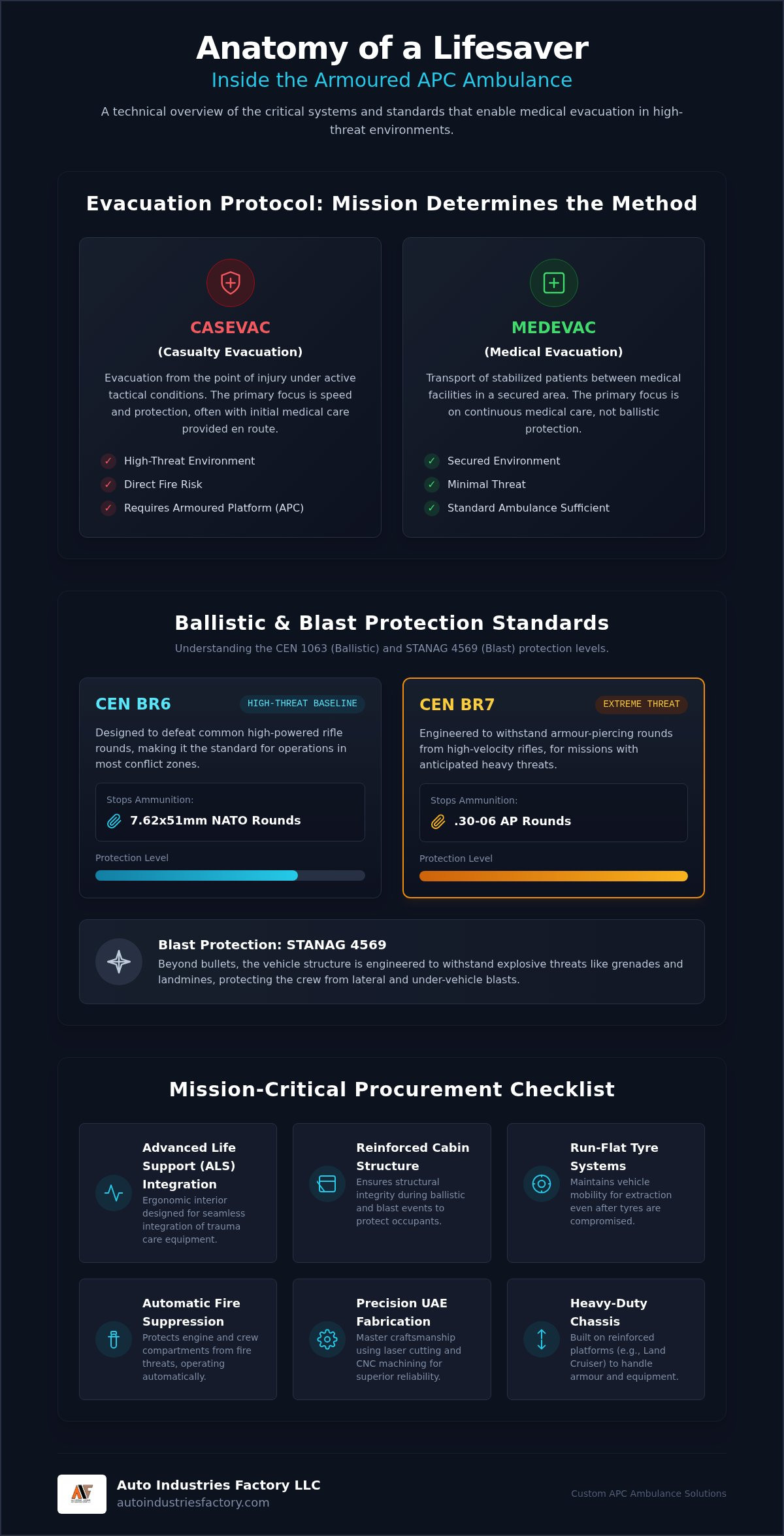
It's vital to distinguish between Casualty Evacuation (CASEVAC) and Medical Evacuation (MEDEVAC). CASEVAC involves moving casualties directly from the point of injury under tactical conditions, often with limited medical resources initially. An apc ambulance bridges this gap, providing a protected CASEVAC platform that functions as a mobile trauma center. Standard MEDEVAC usually occurs in secured areas where the threat of direct fire is minimal, making the ruggedness of an APC unnecessary for that specific stage of transport.
To better understand this concept, watch this helpful video:
Standard civilian ambulances are insufficient for frontline operations. Their thin aluminum or fiberglass bodies offer zero protection against small arms fire or explosive fragments. In contrast, tactical ambulance conversions utilize heavy-duty truck chassis, such as the Toyota Land Cruiser or GMC platforms. These are reinforced to handle the extreme weight of ballistic steel and specialized medical equipment while maintaining the off-road capability required for rescue missions.
The Evolution of Armoured Medical Transport
Armoured medical transport has come a long way from basic bolt-on steel plates that once compromised vehicle speed and suspension. Today, master craftsmen use in-house laser cutting and CNC machining to integrate ballistic glass and composite armoring seamlessly into the vehicle's frame. Modern engineering ensures high protection levels, like those seen in the Didgori Medevac Armoured Medical Evacuation Vehicle, without sacrificing the agility required for rapid extraction. This technology is no longer exclusive to the military; NGOs and private security firms now rely on these robust solutions for operations in volatile regions.
Primary Missions for APC Ambulances
These vehicles are indispensable for mission-critical roles. Frontline extraction in active conflict zones remains the primary use case, where the crew must navigate incoming fire to reach the wounded. They also provide secure transport for high-risk prisoners or VIPs who require medical attention while in transit. In many global disaster response scenarios, these units serve as reliable hubs in areas plagued by civil unrest, where standard emergency services cannot safely operate. By providing a secure, mobile trauma suite, they ensure that life-saving care starts the moment the patient is inside the cabin.
Ballistic Protection Levels and Engineering Standards
Selecting the right ballistic protection for an apc ambulance requires a deep understanding of international engineering standards. We primarily look at the CEN 1063/1522 framework to define vehicle resilience. BR6 is the baseline for high-threat environments, designed to stop 7.62x51mm NATO rounds. For missions where armor-piercing threats are likely, we engineer vehicles to BR7 standards. This level of protection requires specialized steel and glass capable of stopping .30-06 AP rounds from high-velocity rifles.
While CEN standards focus on kinetic energy, we also consult STANAG 4569 for blast protection. This standard categorizes threats ranging from hand grenades to anti-tank landmines. Ensuring the safety of the medical crew means engineering the vehicle to withstand lateral blasts and under-vehicle explosions. This level of technical rigor is similar to the U.S. Army's Armored Medical Evacuation Vehicle (AMEV) program, which emphasized survivability in contested spaces over standard transport. You can learn more about our car armouring capabilities in our detailed technical guide.
Precision engineering is critical during the fabrication process. We utilize 360-degree overlapping armoring. This technique ensures that every pillar, door seal, and junction is protected, effectively eliminating ballistic gaps where rounds could penetrate. Because these materials add significant weight, we perform extensive structural reinforcement. Without reinforcing the suspension, brakes, and chassis, the vehicle would suffer from rapid chassis fatigue. This would compromise its mission readiness and safety during high-speed extractions.
Transparent Armour: Ballistic Glass Specifications
Visibility is non-negotiable for the driver and medical team. We use multi-layered polycarbonate and glass compositions bonded together to provide maximum clarity while remaining resilient against multiple hits. Modern glass technology focuses on preventing "spalling," which occurs when the interior surface of the glass shatters into fragments upon impact. For BR6 protection, ballistic glass thickness is typically required to be approximately 40mm to ensure complete projectile containment.
Blast Protection and Floor Reinforcement
The floor is often the most vulnerable point in a conflict zone. We incorporate reinforced floor matting or specific plate geometries to mitigate the force of IEDs. This engineering redirects the blast wave away from the cabin. We also protect critical mechanical components like fuel tanks, batteries, and ECM modules. These are encased in ballistic steel to ensure the vehicle remains mobile after an incident. If you are planning a fleet upgrade, our team offers specialized vehicle conversion services tailored to your specific threat profile.
Optimising the Medical Interior: Advanced Life Support Layouts
Designing the interior of an apc ambulance requires a master craftsman’s approach to spatial efficiency. Unlike civilian models, the thick ballistic walls of an armored unit reduce available internal volume, making ergonomics the top priority for medical crews. We engineer layouts that allow paramedics to reach the patient's airway and torso while remaining securely strapped into crash-rated seating. This balance of safety and accessibility is vital during high-speed extractions where the vehicle may encounter rough terrain or evasive maneuvers.
Integration of Advanced Life Support (ALS) equipment involves more than just mounting hardware. Defibrillators, ventilators, and monitors must be positioned for immediate visibility and use. These systems are often modeled after the U.S. Army AMEV specifications, which prioritize treating life-threatening injuries while in transit. Oxygen delivery is another critical factor. We provide secure storage for high-capacity cylinders in reinforced cabinets, ensuring they don't become projectiles during a kinetic event. To maintain clinical standards in the field, we use antimicrobial, easy-clean surfaces that stand up to the rigors of tactical use.
Patient Capacity and Stretcher Systems
We offer flexible configurations tailored to mission requirements. Whether you need a single-patient trauma setup or a multi-casualty unit with bench seating, the layout remains focused on rapid intervention. Automatic loading systems are a significant tactical advantage, as they minimize the time the crew spends outside the vehicle during casualty pickup. You can explore our full range of ambulance conversion services to see how we adapt different platforms for these specific roles.
Electrical and Climate Control Systems
Maintaining the internal temperature of an apc ambulance in the UAE requires heavy-duty HVAC systems capable of maintaining a stable clinical environment in extreme desert heat. We install independent climate control for the medical cabin to ensure patient stability. The electrical architecture includes dual-battery systems and pure sine wave inverters to provide clean, uninterrupted power to sensitive medical electronics. For night operations, the interior features tactical lighting with blackout modes and high-intensity LED work lights that provide clear visibility without compromising the vehicle's position.
Procurement Checklist: Critical Features for Fleet Managers
Procuring an apc ambulance involves evaluating more than just ballistic thickness. A fleet manager's priority is operational availability. If a vehicle is immobilized due to a tyre puncture or mechanical failure, the armour becomes a trap rather than a shield. Your checklist must prioritize systems that ensure the vehicle can complete its mission and return to base under its own power. Reliability in high-stress environments isn't a luxury; it's a core engineering requirement.
- Run-flat tyre systems: These inserts are non-negotiable. They allow the vehicle to travel up to 50km at reduced speeds even after multiple hits or punctures, ensuring the crew can exit the "kill zone."
- Fire suppression systems: Automatic systems in the engine bay and manual overrides in the passenger cabin are essential for surviving IED flashes or fuel line compromises.
- Communication suites: Provisions for integrated VHF/UHF radios and satellite tracking ensure the crew remains connected with command centers in remote or jammed environments.
- Heavy-duty mechanical upgrades: Total vehicle weight increases significantly with armour. Upgraded suspension and high-performance braking systems are mandatory to handle the increased Gross Vehicle Weight Rating (GVWR) safely.
- Self-recovery equipment: Custom bull bars and heavy-duty winches are vital for navigating soft sand or debris-strewn urban environments.
Vehicle Platform Selection
Choosing between a van-based or truck-based platform depends on your primary theatre of operation. Van-based units offer more internal volume for complex medical procedures, while truck-based platforms like the Toyota Land Cruiser or GMC provide superior off-road agility. We recommend using widely available chassis to ensure that basic mechanical maintenance can be performed in remote areas without specialized tools. Read our guide to armoured personnel carriers to understand how different chassis roles impact vehicle performance.
Maintenance and After-Sales Support
A tactical vehicle is only as good as its maintenance schedule. Fleet managers must evaluate the long-term availability of spare parts for reinforced components like heavy-duty hinges and specialized glass. Operating a heavy-armoured tactical vehicle also requires specific crew training to handle the altered center of gravity and braking distances. To ensure continued protection, regular inspections of all ballistic seals and overlapping joints must be a mandatory part of your fleet’s preventative maintenance protocol. If you are ready to upgrade your tactical capabilities, request a technical consultation for your fleet today.
Custom APC Ambulance Solutions by Auto Industries Factory LLC
At Auto Industries Factory LLC, we take a master craftsman approach to every apc ambulance conversion. Our process begins with in-house laser cutting and CNC machining, ensuring that every piece of ballistic steel fits with surgical precision. This isn't just about bolting on plates; it's about deep structural reinforcement that maintains vehicle integrity over thousands of kilometers in harsh terrain. We specialize in transforming heavy-duty platforms like the Toyota Land Cruiser and GMC into mission-specific units that meet the rigorous demands of national security and military organizations. Our facility serves as a high-security manufacturing hub for the entire United Arab Emirates, delivering precision-engineered solutions that protect lives in the world's most volatile regions.
Quality control is the cornerstone of our fabrication process at Auto Industries Factory LLC. Every weld and ballistic joint undergoes rigorous inspection to ensure total adherence to international standards. We understand the high stakes involved in humanitarian and security missions where equipment failure is not an option. Our team provides turnkey solutions that encompass everything from the initial structural modification to custom medical cabinetry designed for specific life-saving protocols. By handling the entire lifecycle in-house, we eliminate the lead times and quality gaps often found with third-party fabricators who lack specialized armoring experience.
Turnkey Fabrication Capabilities
Our comprehensive design services ensure that your unique medical protocol requirements are met without compromise. We provide expert welding and structural reinforcement to extend the vehicle's operational lifespan under the constant stress of heavy armour. To maintain fleet uniformity and professional standards, we offer professional painting and livery services, delivering a finished product that's ready for immediate deployment upon delivery. This end-to-end control ensures that every apc ambulance leaving our floor meets the highest standards of master craftsmanship and mission-critical durability.
Partnering for High-Threat Success
Auto Industries Factory LLC works closely with fleet managers to deliver vehicles on time and to exact technical specifications. Our engineering team provides direct technical consultations to help you navigate the complexities of ballistic standards and interior layouts discussed in previous sections. We focus on providing robust, solution-oriented modifications that turn standard chassis into dependable lifesavers. If you're ready to secure a vehicle that protects both your crew and patients, Contact Auto Industries Factory LLC for a specialized vehicle estimate and start your procurement process today.
Securing the Future of Tactical Medical Evacuation
Choosing a mission-ready apc ambulance requires a technical focus on both ballistic survival and clinical efficiency. We've explored how certified protection levels like BR6 and BR7 must integrate with ergonomic Advanced Life Support layouts to save lives under fire. Real-world reliability comes from structural reinforcement and components like run-flat systems that ensure the vehicle returns home. These aren't just vehicles; they're mobile trauma centers engineered for the most volatile environments on the planet.
Auto Industries Factory LLC brings specialized military and police conversion experience to every project we undertake. Our master craftsmen utilize in-house CNC and laser cutting expertise to deliver ruggedized designs for national and international missions. We provide the engineering precision required to transform standard chassis into resilient lifesavers. If you're managing a fleet for high-threat zones, don't settle for standard modifications when lives are on the line. Take the next step toward a secure, high-performance fleet today.
Request a Technical Consultation for Your APC Ambulance Fleet. Secure your crew's safety with a vehicle from Auto Industries Factory LLC, built for the highest stakes.
Frequently Asked Questions
What is the difference between an APC ambulance and an armored SUV?
An APC ambulance is a purpose-built tactical unit with a reinforced chassis and a specialized medical cabin, whereas an armored SUV is typically a passenger vehicle with added protection. The APC variant is designed for high-threat casualty extraction (CASEVAC), featuring heavy-duty suspension and enough internal volume for paramedics to perform life-saving procedures while the vehicle is in motion. It's a specialized architecture that allows for a higher payload of medical gear.
Which ballistic protection level is recommended for ambulances in conflict zones?
For most high-threat environments, we recommend a minimum of BR6 protection according to CEN 1063 standards. This level is engineered to stop 7.62x51mm NATO rounds. In areas where armor-piercing threats are prevalent, upgrading to BR7 is necessary. These standards ensure that the medical crew and patients remain protected against small arms fire and explosive fragments during critical extraction missions. It's a vital requirement for ensuring safety in volatile regions across the globe.
Can an APC ambulance be equipped with Advanced Life Support (ALS) gear?
Yes, every apc ambulance we fabricate is designed to accommodate full Advanced Life Support (ALS) equipment. This includes integrated mounts for defibrillators, ventilators, and patient monitors. We customize the medical cabinetry and oxygen delivery systems to ensure that all gear is secure during tactical maneuvers while remaining easily accessible to the medical team for immediate patient intervention. Our master craftsmen ensure the interior layout supports rapid clinical response without compromise during mission-critical transport.
How does the weight of armoring affect the ambulance's performance?
Adding ballistic steel and glass significantly increases the vehicle's Gross Vehicle Weight Rating (GVWR). To maintain performance, we perform extensive structural reinforcement on the chassis, suspension, and braking systems. This engineering ensures the vehicle remains agile and stable during off-road extractions. Without these specific upgrades, the added weight would lead to rapid mechanical fatigue and compromised handling in high-stress situations. We don't sacrifice mobility for protection during the complex conversion process.
Are run-flat tyres standard on APC ambulances?
We consider run-flat tyre systems a mandatory feature for any vehicle operating in a high-threat zone. These specialized inserts allow the vehicle to continue moving for up to 50km even after the tyres have been punctured by bullets or shrapnel. It's the most critical factor in ensuring the crew can escape a danger zone and reach a secure medical facility. This feature is a cornerstone of our ruggedized tactical designs for humanitarian and security missions alike.
What vehicle platforms are best suited for APC ambulance conversions?
Heavy-duty platforms like the Toyota Land Cruiser and GMC chassis are the most reliable choices for an apc ambulance. These vehicles offer the structural integrity needed to support heavy armour and the off-road capability required for frontline rescue. We also specialize in box-type and extended roof conversions on these platforms to provide the necessary internal height and volume for advanced medical care. These platforms are chosen for their worldwide parts availability and durability.
How long does the conversion process for an APC ambulance typically take?
The timeline for a full tactical conversion depends on the specific ballistic level and medical equipment requirements. Because we handle all design, laser cutting, and fabrication in-house, we can optimize the production schedule to meet mission-critical deadlines. It's a comprehensive build process that includes structural reinforcement, ballistic integration, and rigorous quality control testing before the vehicle is deployed. We work closely with fleet managers to provide accurate estimates based on their specific technical requirements.
Do you provide international shipping for armoured medical vehicles?
While we are a leading UAE-based manufacturer, our solutions are designed for both national and international high-security fleet requirements. We work with professional logistics partners to ensure that our specialized vehicles reach their destination securely and in compliance with all transport regulations. Our turnkey service includes the final painting and livery, ensuring the units are ready for immediate service upon arrival at their operational theatre. We don't limit our engineering expertise to the local market.


