
Every extra kilogram of dead weight on your specialized fleet is a direct tax on your operational efficiency. While steel has long been the default for ruggedness, it often forces fleet managers to choose between protection and payload. In the demanding UAE environment, where humidity accelerates corrosion and strict 65-tonne weight limits are enforced, the choice of material is mission-critical. This is where advanced aluminum vehicle body fabrication changes the equation. By switching to high-grade aluminum, you don't just reduce weight; you eliminate the rot of rust and slash fuel consumption.
We understand that specialized vehicles like ambulances, safari trucks, and police units require uncompromising durability. This guide reveals how precision engineering and industrial-scale fabrication optimize your fleet's performance and ROI. You'll discover the technical processes that define high-performance builds, from CNC machining to structural reinforcement. We also provide a roadmap for identifying a reliable fabricator capable of meeting Euro 6B standards while delivering the rugged reliability your mission demands.
Key Takeaways
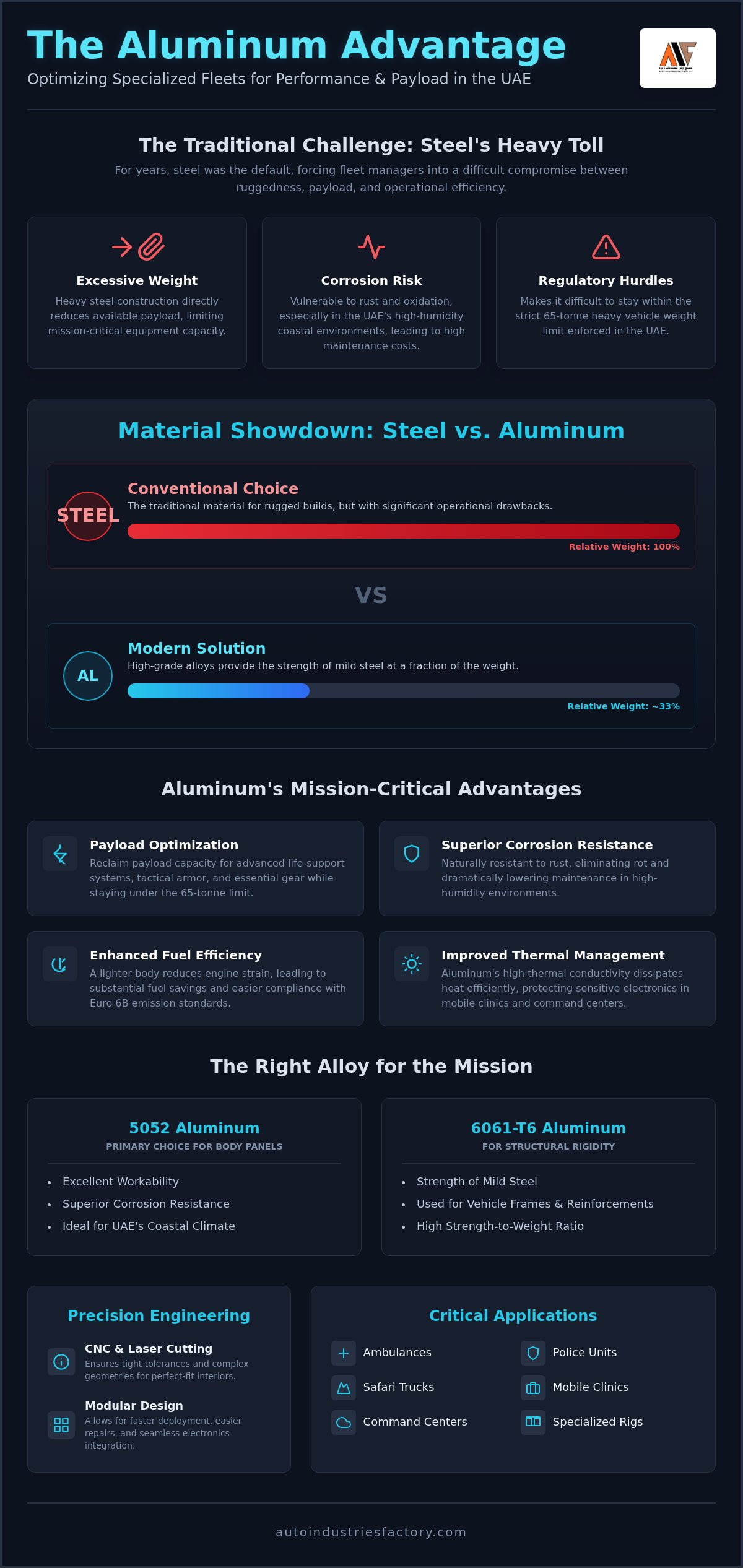
- Learn how aluminum helps fleets stay within the UAE’s 65-tonne heavy vehicle weight limit while significantly increasing mission-critical payload.
- Discover why aluminum vehicle body fabrication is the superior choice for resisting corrosion in high-humidity coastal environments across the Emirates.
- Understand the precision of in-house CNC machining and laser cutting for creating complex medical interiors and reinforced structural components.
- Explore specialized conversions for high-performance platforms like the Toyota Land Cruiser and GMC, specifically tailored for safari and emergency services.
- Identify the ROI advantages of choosing a one-stop-shop fabricator that maintains full control over design, precision cutting, and final finishing.
Understanding Aluminum Vehicle Body Fabrication
Aluminum vehicle body fabrication is the process of shaping alloy sheets into mission-critical structural components. This industrial discipline has evolved from a niche application into a standard requirement for high-performance specialized fleets. For years, carbon steel was the default choice for rugged builds, but its weight and vulnerability to oxidation created significant operational hurdles. Modern engineering now favors aluminum alloys to solve these challenges, providing a foundation that's both lightweight and exceptionally durable.
Specialized fleets, particularly ambulances and police units, are leading this shift. These vehicles carry heavy medical equipment, communication arrays, and tactical gear that push standard chassis limits. By utilizing aluminum, fleet managers can reclaim payload capacity that would otherwise be lost to a heavy steel body. This transition isn't just about weight; it's about precision. Advanced fabrication allows for tighter tolerances and more complex geometries, ensuring every millimeter of the vehicle interior is optimized for the mission at hand.
Core Materials: Aluminum Grades for Vehicle Bodies
Not all aluminum is created equal. In the factory, we prioritize specific alloys based on their functional role. 5052 aluminum is our primary choice for body panels and enclosures. It offers excellent workability and superior resistance to corrosion, making it ideal for the UAE's high-humidity coastal environments. When the build requires structural rigidity, we turn to 6061-T6 aluminum. This grade is frequently used for reinforcements and the foundational vehicle frame because it provides the strength of mild steel at roughly one-third the weight.
The strength-to-weight ratio is the deciding factor for most fleet operators. Aluminum allows us to use thicker plates than steel for better dent resistance while still maintaining a lower overall curb weight. This physical advantage directly translates to reduced wear on brakes, tires, and suspension systems, lowering the long-term maintenance costs for the entire fleet.
The Evolution of Specialized Vehicle Manufacturing
Manufacturing has moved toward modular aluminum designs that allow for faster deployment and easier repairs. Unlike welded steel structures that are difficult to modify, aluminum components can be designed for rapid assembly and integration. This modularity is essential for modern vehicles that require extensive electronics integration. Lightweight bodies reduce the mechanical strain on the engine, allowing for more efficient power distribution to sensitive medical devices or high-output sirens and lights. Precision in aluminum vehicle body fabrication ensures that these complex systems fit perfectly within the structural shell, creating a unified, high-performance solution for emergency and tactical responders.
Technical Advantages of Aluminum for Specialized Fleets
Choosing aluminum is a strategic engineering decision that directly impacts the Total Cost of Ownership (TCO). In the UAE, where heavy vehicle regulations enforce a strict 65-tonne limit, every saved kilogram is a kilogram gained for life-saving medical equipment or tactical armor. High-performance aluminum vehicle body fabrication allows specialized fleets to operate at peak efficiency without exceeding legal weight thresholds. This material choice doesn't just save weight; it enhances the entire vehicle's mechanical ecosystem.
Thermal conductivity is a critical but often overlooked advantage. Aluminum dissipates heat significantly better than steel. For mobile clinics or command centers packed with sensitive communication arrays, this natural heat sink effect reduces the load on air conditioning units. It protects expensive electronics from the intense Arabian sun, ensuring mission-critical systems don't fail when they're needed most. If you're looking to upgrade your fleet, our specialized modification services provide the technical roadmap for this transition.
Payload Optimization and Fuel Efficiency
Reducing the dead weight of the vehicle body allows for a massive increase in functional payload. For ambulances, this means the ability to carry advanced life-support systems and oxygen supplies that would otherwise overtax a steel-bodied chassis. This weight reduction also supports compliance with Euro 6B emission standards by lowering the engine's workload. Over thousands of kilometers, national fleets see substantial fuel savings, which offsets the initial investment in premium materials. A lighter body puts less strain on the suspension and braking systems. You'll notice fewer replacements of brake pads and shock absorbers, leading to more time on the road and less time in the workshop.
Durability in Extreme Operating Conditions
The UAE’s coastal humidity and saline air are brutal on traditional steel bodies. Aluminum naturally forms a protective oxide layer that acts as a permanent barrier against corrosion. This is why safari vehicles and off-road expedition trucks rely on aluminum; they can navigate harsh environments without the risk of structural rot. Maintaining structural integrity requires adhering to rigorous automotive welding standards, which ensures that every joint remains secure under extreme vibrations.
Beyond the immediate performance gains, aluminum significantly boosts the resale value of the fleet. A body that doesn't rust or degrade over five to ten years is a far more attractive asset on the secondary market. By investing in precision aluminum vehicle body fabrication, you're securing the longevity of your mission-critical vehicles while ensuring they remain robust enough for the most demanding safari tours or emergency responses.
The Engineering Process: CNC, Laser Cutting, and Welding
High-stakes vehicle conversions demand an integrated engineering ecosystem. Every project begins with detailed CAD modeling. This digital blueprint allows us to simulate the placement of oxygen tanks, tactical racks, or safari seating to ensure weight distribution is balanced across the chassis. Whether we're transforming a Toyota Land Cruiser or a GMC platform, precision in the design phase prevents costly errors during the physical build. This phase is the foundation of high-performance aluminum vehicle body fabrication, ensuring every component serves a specific mission-critical purpose.
Precision Cutting with Industrial Lasers
Laser cutting is non-negotiable for zero-defect manufacturing. It allows for intricate designs in medical cabinet systems and mounting brackets that manual saws simply cannot replicate. Our in-house laser technology ensures that every cut is clean and accurate to the millimeter. Once the sheets are cut, CNC bending takes over. This process transforms flat aluminum into rigid, seamless components for box-type bodies. This level of accuracy ensures that modular partitions fit perfectly every time, eliminating the rattles and structural weak points common in lower-quality builds.
Mastering the Aluminum Weld
Welding aluminum is significantly more complex than working with steel. The material's high thermal conductivity and lower melting point mean it dissipates heat rapidly, making it prone to warping or burn-through if not handled by an expert. We utilize specialized techniques to manage thermal expansion and prevent structural fatigue during the aluminum vehicle body fabrication process.
- TIG (Tungsten Inert Gas) Welding: We prefer TIG for high-strength medical interiors and visible seams. It offers superior control and a clean, aesthetic finish that doesn't require heavy grinding, maintaining the material's integrity.
- MIG (Metal Inert Gas) Welding: This is our go-to for larger structural frames. It provides the speed and deep penetration required to handle high-stress loads in off-road and emergency environments.
Every weld undergoes rigorous inspection because a single hairline fracture can compromise the safety of the entire crew. Once the structural work is complete, we move to the integration of electrical and mission systems. This involves routing heavy-duty wiring for sirens, medical monitors, or off-road lighting through pre-cut CNC channels. By keeping our metal cutting and bending in-house, we ensure that every component is built to the exact specifications required for the vehicle's final mission.
Critical Applications: From Ambulances to Safari Trucks
Industrial-scale aluminum vehicle body fabrication isn't merely about shaping metal; it's about creating a specialized environment that survives the harshest operating conditions. While standard automotive manufacturing focuses on passenger comfort, specialized conversions prioritize structural integrity and mission-specific utility. In the UAE, where vehicles must withstand extreme heat and saline coastal air, the application of aluminum alloys is a necessity for fleet longevity. From emergency response units to rugged desert tour trucks, the engineering must be flawless from the chassis up.
Mobile command centers and workshops represent the pinnacle of this fabrication process. These units require a complete transformation where the original body is often replaced by a custom-engineered aluminum shell. This allows for a perfectly square interior, maximizing storage for tactical gear or specialized tools. By using lightweight alloys, we ensure these heavy-duty units remain maneuverable in urban environments while staying well within the UAE's 65-tonne heavy vehicle weight limits. If you need a custom solution for your fleet, explore our specialized conversion services to see how we transform standard platforms into mission-ready assets.
Ambulance and Medical Vehicle Bodies
Fabricating box-type ambulances requires a deep understanding of medical ergonomics and safety standards. We design lightweight medical compartments that offer maximum interior volume, allowing paramedics enough space to perform life-saving procedures. Unlike standard van conversions, a custom aluminum box allows for the seamless integration of oxygen, electrical, and suction systems directly into the walls. This flush-mount approach prevents equipment from becoming a projectile during high-speed transit. For a deeper dive into these technical requirements, read our Ambulance Conversion Guide.
Off-Road and Safari Expeditions
The UAE's safari industry demands vehicles that can endure relentless vibrations and high-impact desert driving. We focus on the Toyota Land Cruiser LC70 and Hilux platforms, reinforcing them with custom aluminum vehicle body fabrication techniques. Aluminum is the superior choice for roof racks, bull bars, and protective canopies because it won't rust after exposure to desert humidity or coastal spray. These modifications don't just add protection; they're engineered to maintain a low center of gravity for better stability on steep dunes. For more on optimizing off-road performance, check out our guide to Safari Vehicle Conversions.
Military and police units also benefit from these lightweight reinforcements. By using high-grade alloys, we can add structural brush guards and bull bars in bulk quantities without compromising the vehicle's acceleration or braking distance. This balance of protection and performance is what defines a professional-grade conversion in the modern industrial landscape.
Choosing a Fabrication Partner: The Auto Industries Factory Edge
Selecting a partner for your fleet isn't just a procurement decision; it's a safety commitment. Many providers outsource critical steps like laser cutting or specialized painting, which creates gaps in quality control and accountability. High-performance aluminum vehicle body fabrication requires a seamless workflow where every technician is accountable for the previous stage. In the UAE, where specialized units face extreme thermal stress and high-intensity operational demands, a fragmented supply chain is a liability. We advocate for a single-source approach that maintains full control from the first CAD drawing to the final delivery.
Customization is the core of specialized fleet management. No two missions are identical, and a fabricator must be agile enough to adapt. Whether you're managing a fleet of ambulances or tactical units across the country, your builds must meet rigorous national standards. Professional finishing is also vital. Aluminum requires specific etching primers and high-durability coatings to ensure paint adhesion in the Arabian heat. Without this expertise, even the best structural build will succumb to surface degradation within months.
Complete In-House Fabrication Solutions
We provide a comprehensive ecosystem for fleet transformations. By keeping Auto Industries Factory LLC services entirely in-house, we eliminate the delays and communication errors associated with subcontractors. Our facility handles everything: initial design, precision laser cutting, CNC machining, and specialized welding. This vertical integration allows us to tackle complex fleet conversions with speed and precision. If you're planning a new build or a fleet-wide upgrade, our engineers provide detailed technical estimates that map out every structural reinforcement and mission system integration required for your specific platform.
Quality Assurance and Mission Readiness
Structural durability is non-negotiable for emergency and law enforcement units. Our testing protocols simulate the high-stress loads these vehicles encounter during high-speed responses or off-road pursuits. Expert craftsmanship ensures that every joint and bracket is built to protect the personnel inside. This focus on rugged reliability is why we're a trusted partner for sensitive government and private sector projects. For those managing tactical fleets, our Police Vehicle Modifications guide outlines the specific upfitting standards we maintain to ensure every unit is mission-ready from day one. We don't just build bodies; we engineer mobile environments that perform under pressure.
Optimize Your Fleet for the Future of Specialized Missions
The transition to aluminum is more than a weight-saving measure; it's a strategic investment in the longevity and performance of your specialized fleet. By leveraging high-performance aluminum vehicle body fabrication, you ensure your units stay within the UAE’s 65-tonne weight limits while maximizing payload for life-saving equipment or tactical armor. Precision engineering through in-house laser cutting and CNC machining eliminates structural weak points, providing a robust foundation that survives the Emirates' harsh coastal humidity and extreme heat.
Don't leave the integrity of your mission-critical vehicles to chance. Auto Industries Factory LLC provides complete in-house design and fabrication solutions, specializing in high-performance Toyota and GMC fleet conversions. Our proven track record in national ambulance and military builds ensures that every unit we deliver is engineered for maximum durability and safety. Take the first step toward a more efficient, reliable fleet today. Request a custom fabrication quote from Auto Industries Factory and partner with the master craftsmen of specialized vehicle manufacturing. Your mission deserves nothing less than precision-built excellence.
Frequently Asked Questions
Is aluminum strong enough for military and police vehicle bodies?
Yes, high-grade aluminum alloys provide the structural integrity required for heavy-duty military and police applications. By using 6061-T6 for the foundational frame, we achieve a strength profile comparable to mild steel while reducing total mass. This allows tactical units to carry additional armor or equipment without compromising the vehicle's maneuverability or acceleration during high-speed responses. It's a proven solution for rugged mission environments.
How much weight can be saved by using an aluminum body instead of steel?
You can typically save up to 40% to 50% of the body's weight by choosing aluminum over traditional carbon steel. In the context of the UAE's 65-tonne heavy vehicle limit, this reduction is vital for maximizing payload. A lighter body also helps fleets meet Euro 6B emission standards by reducing the engine's mechanical load, leading to lower fuel consumption across thousands of kilometers.
Does aluminum vehicle fabrication require special maintenance?
No, aluminum requires less maintenance than steel because it doesn't rust. The material naturally forms a protective oxide layer that shields it from the UAE’s saline air and high humidity. While you don't need to worry about structural rot, professional aluminum vehicle body fabrication ensures that all joints and seams are sealed correctly, requiring only standard inspections of fasteners and mounting points during routine service.
Can aluminum bodies be repaired easily after a collision?
Yes, aluminum bodies are fully repairable, though they require a technician trained in specialized welding and pulling techniques. Because aluminum dissipates heat quickly and doesn't have the shape memory of steel, repairs must be handled by an expert facility. Modular aluminum designs often allow for the replacement of individual panels or structural sections, which can be faster than traditional cut and weld repairs on steel frames.
What is the lifespan of an aluminum ambulance body compared to steel?
An aluminum ambulance body often lasts twice as long as a steel equivalent in coastal environments. While a steel body may show signs of structural corrosion within five years, a high-quality aluminum build remains structurally sound for a decade or more. This longevity allows fleet managers to remount the aluminum body onto a new chassis, significantly improving the long-term return on investment for emergency services.
Is aluminum fabrication more expensive than steel for specialized vehicles?
The upfront investment for aluminum vehicle body fabrication is higher due to material costs and the specialized labor required for precision welding. However, the total cost of ownership is lower. You'll see immediate savings in fuel consumption and reduced wear on brakes and tires. Over the vehicle's lifespan, the lack of rust repairs and higher resale value often make aluminum the more economical choice.
Which aluminum grades are best for off-road safari vehicle conversions?
We recommend 5052-H32 for body panels and 6061-T6 for structural components like roof racks and bull bars. 5052 offers the best resistance to the corrosive desert humidity and salt spray found in the UAE. For high-stress areas like the chassis reinforcements on a Toyota Land Cruiser, 6061-T6 provides the necessary rigidity to endure the constant vibrations and impacts of dune bashing.
Does an aluminum body affect the vehicle’s electronics or communication systems?
An aluminum body does not negatively impact electronics; it can actually act as a superior electromagnetic shield for sensitive communication gear. Aluminum's high conductivity helps ground the vehicle's electrical systems more effectively than steel. This is particularly beneficial for mobile command centers and ambulances that rely on high-output radios and medical monitors that must remain free from external electromagnetic interference.


