
Can a generic bolt-on accessory truly protect a tactical crew during an off-road pursuit or keep a box-type ambulance stable during a high-speed emergency across the country? For specialized fleets, the difference between a successful mission and a catastrophic structural failure often comes down to the quality of the steel vehicle body fabrication. You've likely seen how inferior builds succumb to corrosion and vibration in the UAE's extreme heat and salt-heavy air. It's a frustrating reality that compromises safety and drains budgets through constant repairs.
We understand that your vehicles need to be more than just transport; they're mobile command centers and life-saving environments. This article covers the technical essentials of high-performance engineering, moving from raw material selection to the precision of CNC machining. You'll learn how bespoke fabrication ensures a perfect fit for mission-critical conversions, maximizing vehicle lifespan and crew protection. We'll break down the structural requirements for armored units and specialized safari builds to ensure your fleet remains reliable when the stakes are highest.
Key Takeaways
- Steel is the industry benchmark for mission-critical fleets. It provides the structural integrity needed for high-performance ambulance and police conversions.
- Precision CNC machining and laser cutting are essential in steel vehicle body fabrication. These technologies ensure perfect fitment for custom bull bars and heavy-duty roof racks.
- Engineering-led fabrication protects crews by reinforcing critical stress points during off-road and tactical maneuvers.
- A complete in-house process, from 3D modeling to protective painting, prevents corrosion and ensures long-term durability in the UAE's harsh climate.
- Selecting a partner with specific expertise in GMC and Toyota platforms ensures modifications don't compromise the vehicle's original engineering foundation.
The Role of Steel Fabrication in Specialized Vehicle Conversions
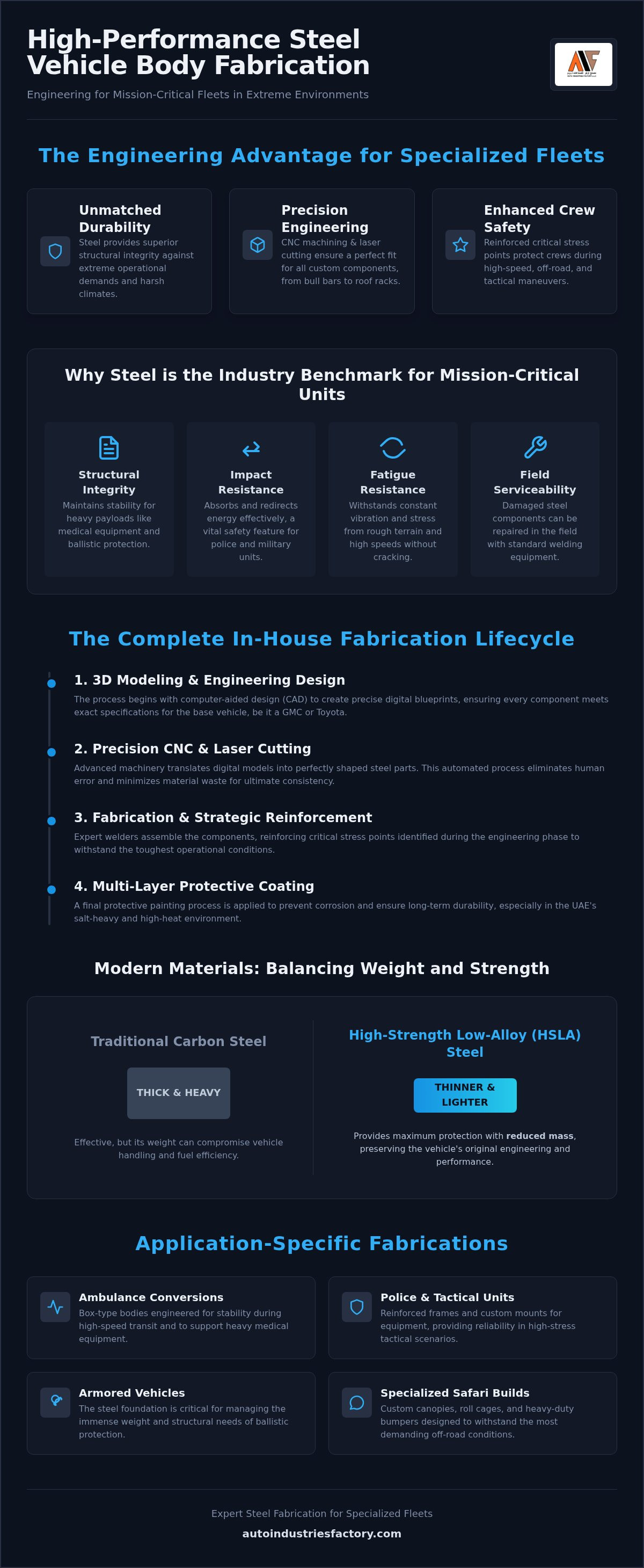
Steel vehicle body fabrication is a specialized engineering discipline. It isn't just about cutting metal; it's about transforming a standard chassis into a mission-ready asset capable of withstanding extreme operational demands. In the UAE, vehicles face unique challenges, from intense thermal cycles to abrasive desert sand. The structural foundation must be uncompromising. While aluminum and composites have their place in consumer cars, steel remains the industry benchmark for specialized fleets. It offers superior fatigue resistance, higher tensile strength, and a level of durability that lighter materials simply can't match.
High-performance conversions often rely on body-on-frame construction to manage the heavy payloads required for medical equipment or ballistic protection. The quality of the fabrication directly impacts the vehicle's operational longevity. A poorly fabricated body will develop stress cracks and rattles within months. A precision-engineered steel body maintains its integrity for years, protecting the sensitive equipment inside and the crew operating it. This robustness is why steel is the primary choice for ambulance, police, and military units across the region.
Why Steel is Essential for Mission-Critical Units
Reliability is the priority for emergency services and tactical teams. Steel provides unmatched structural integrity under high-stress loads. This ensures a box-type ambulance body remains stable during high-speed emergency responses. For police and military modifications, steel's impact resistance is a vital safety feature. It absorbs and redirects energy more effectively than many alternatives. Another key advantage is field-serviceability. If a steel bumper or canopy is damaged in a remote off-road scenario, it can often be repaired with standard welding equipment. This keeps the fleet in the field rather than stuck in a workshop waiting for specialized parts.
Balancing Weight and Strength in Modern Fabrication
Modern engineering has eliminated the traditional weight drawbacks of using steel. We utilize advancements in high-strength low-alloy (HSLA) steels to provide maximum protection with reduced mass. These materials allow for thinner profiles that maintain the same protective qualities as thicker, heavier carbon steel. Precision design ensures that structural reinforcement is only added to high-stress zones. This approach preserves the handling and fuel efficiency of the base vehicle, whether it's a GMC Sierra or a Toyota Land Cruiser. By using computer-aided design, we minimize unnecessary weight gain while maximizing the safety of every conversion.
Advanced Manufacturing: CNC Machining and Laser Cutting
The transition from manual metalwork to computer-controlled precision has redefined the standards of steel vehicle body fabrication. We no longer rely on traditional hand-cutting methods that invite human error and structural inconsistencies. Instead, our facility utilizes advanced automation to ensure every cut and bend aligns perfectly with the original 3D engineering models. This digital workflow is essential for creating high-performance vehicles that must perform under extreme stress. By integrating automated systems, we provide a level of consistency that is impossible to achieve through manual labor alone, ensuring that every unit in a fleet meets the same rigorous specifications.
Automated fabrication doesn't just improve quality; it streamlines the entire production lifecycle. Digital nesting software optimizes material usage, which significantly reduces waste and lowers the environmental footprint of our operations. This efficiency allows us to shorten lead times for urgent fleet orders. Rapid production cycles are vital for organizations that need to deploy mission-critical assets quickly without sacrificing engineering integrity.
Precision Laser Cutting for Vehicle Bodies
Laser cutting technology is the primary tool for shaping the complex geometries required in modern specialized fleets. We use it to process Advanced High-Strength Steels (AHSS), which are essential for maintaining safety while reducing overall vehicle mass. The process is remarkably clean. It minimizes heat-affected zones, ensuring the steel retains its original tensile strength along every edge. For large-scale Ambulance Conversions, this consistency means every internal bracket and external panel fits seamlessly. This precision prevents the rattles and structural weaknesses often found in generic, hand-fitted bodies.
CNC Machining for Specialized Accessories
High-tolerance mechanical parts require the surgical precision of CNC machining. We utilize this technology to fabricate heavy-duty mounting systems for Custom Bull Bars and Bumpers. These components must interface perfectly with the vehicle's frame to ensure maximum energy absorption during an impact. CNC milling and turning allow us to create modular accessories that are both rugged and easy to install in the field. Whether we're producing specialized brackets for medical oxygen tanks or reinforced hinges for tactical doors, the result is a part that performs reliably under pressure. If you require high-precision engineering for your fleet, our metal cutting and bending solutions provide the reliable foundation your vehicles need.
Application-Specific Fabrication for Diverse Fleets
A "one size fits all" approach is a recipe for failure in the specialized vehicle sector. Each mission, whether it's a high-speed medical evacuation or a tactical police response, places unique stresses on the vehicle's frame. High-quality steel vehicle body fabrication addresses these specific needs by tailoring the structural reinforcement to the application. In the UAE's demanding environments, generic accessories often shake loose or fail under load. We focus on building integrated solutions that become a permanent, reliable part of the vehicle's architecture.
Engineering for specific applications ensures that every modification enhances the vehicle's performance. It isn't just about adding parts; it's about optimizing the platform for its intended role. This specialized approach is what separates a standard truck from a mission-critical asset capable of 24/7 operation in harsh climates.
Emergency and Medical Vehicle Fabrication
Designing a box-type ambulance body requires a deep understanding of weight distribution and interior volume. We fabricate these units to maximize space for life-saving equipment without compromising the vehicle's stability. For extended roof conversions on GMC and Toyota platforms, the original structure is reinforced to support the additional height and weight of medical systems. Every medical mount is integrated directly into the steel chassis to ensure oxygen tanks and monitors stay secure during rapid transit. Adhering to professional automotive steel fabrication guidelines ensures that these modifications don't just add space, but maintain the vehicle's crash-test integrity.
Tactical and Off-Road Steel Modifications
Tactical operations demand extreme ruggedness. Our work includes Police Vehicle Modifications where reinforced steel push bars and internal cages provide essential protection for officers. For higher-threat scenarios, we fabricate heavy-duty Armoured Personnel Carrier body panels designed to withstand ballistic impacts. This same level of engineering excellence applies to the tourism sector. Safari Vehicle Conversions require reinforced suspensions and custom chassis work to handle the constant vibration of desert dunes. We build custom metal canopies and roof racks for Toyota Hilux and Land Cruiser pickups, providing secure storage that won't buckle under the weight of expedition gear. This specialized steel vehicle body fabrication ensures that whether the vehicle is in a city chase or a desert safari, it performs with absolute reliability.
The Fabrication Lifecycle: From Design to Protective Coating
Successful steel vehicle body fabrication follows a rigorous, four-phase lifecycle. Each stage is critical for ensuring the final unit can withstand the tactical and environmental demands of the UAE. We don't rely on guesswork. Our process is a linear progression from digital precision to environmental protection, ensuring that every modification enhances the vehicle's structural foundation rather than compromising it.
It begins with engineering design and 3D modeling. We use advanced CAD software to map every bracket, mounting point, and structural rib to the vehicle's specific chassis. This phase allows us to simulate stress loads and ensure perfect fitment before the first piece of steel is even cut. Once the design is validated, we move to material selection and precision cutting. By using high-grade alloys and laser cutting technology, we transform raw sheets into components with sub-millimeter accuracy. This prevents the fitment issues common with generic accessories and ensures that the added weight is distributed correctly across the vehicle's frame.
Welding Standards and Structural Assembly
Structural integrity depends entirely on the quality of the bond. We utilize TIG and MIG welding techniques specifically chosen based on the material thickness and the required joint strength. For specialized vehicle bodies, weld penetration must be absolute to prevent fatigue failure in high-vibration environments. Our master welders focus on heat control to avoid warping the steel, maintaining the precise dimensions established during the design phase. We subject our structural welds to rigorous stress-testing protocols that simulate years of extreme off-road vibration to ensure zero-failure performance in desert conditions.
Protective Coatings and Professional Painting
The final phase is about survival in the UAE's harsh climate. Intense heat and coastal salinity will quickly degrade raw metal if it isn't treated correctly. We begin with meticulous surface preparation, including degreasing and abrasive sanding, to ensure maximum adhesion. We then apply high-performance specialized primers to combat corrosion at the molecular level. Beyond protection, we offer complete vehicle color change services. This allows for seamless fleet branding for police, military, or private safari operators. Our painting process ensures a finish that is as functional as it is aesthetic, providing a durable barrier against sand abrasion and UV radiation. If you're ready to start your next fleet project, explore our complete fabrication and painting solutions to see how we can reinforce your operations.
Selecting a Steel Fabrication Partner for Your Fleet
Choosing a partner for steel vehicle body fabrication is a strategic decision that directly impacts the safety and operational lifespan of your specialized fleet. You don't just need a welder; you need an engineering firm that understands the high stakes of mission-critical conversions. Evaluating a provider's in-house capabilities is the first step. When a facility controls every stage-from initial 3D modeling to the final protective coating-they eliminate the communication gaps that occur when work is outsourced to multiple vendors. This unified approach ensures that the structural integrity of a box-type ambulance or a tactical unit remains consistent from the chassis up.
Experience with specific vehicle platforms is equally vital. A fabricator who understands the nuances of a Toyota Land Cruiser or a GMC Sierra chassis knows exactly where to place reinforcements without compromising the manufacturer's original safety ratings. They understand the load-bearing limits and electrical integration points unique to these models. In addition, checking for engineering certifications and rigorous quality control measures provides the documented proof that your vehicles will perform under pressure. Ask about their welding standards and how they stress-test their structural assemblies for high-vibration environments.
The In-House Advantage: Design to Delivery
Integrated services are the backbone of efficient fleet modification. When the same team that designs the CAD model also operates the laser cutting and CNC machinery, the margin for error disappears. This streamlined workflow significantly reduces build times, which is essential for large-scale police or medical fleet deployments. Custom design consultations allow you to tailor every bracket and reinforcement to your specific mission requirements. You can visit Auto Industries Factory LLC to explore our end-to-end fabrication solutions and see how our integrated approach protects your investment.
Reliability in Extreme Conditions
Our builds have a proven track record in national desert and off-road environments. We've successfully delivered specialized units for ambulance and military deployments where failure isn't an option. These case studies demonstrate that our steel vehicle body fabrication can withstand the abrasive sand and intense thermal cycles of the region. Whether you're reinforcing a single safari truck or requesting a custom estimate for bulk accessory fabrication, choose a partner that prioritizes mission-specific survivability. Reliability isn't a feature; it's the result of uncompromising engineering.
Engineering Your Fleet for Maximum Survivability
Precision steel vehicle body fabrication is more than a manufacturing process; it's the structural insurance policy for your mission-critical operations. You've seen how advanced CNC machining and laser cutting provide the high-tolerance fitment needed for ambulances and tactical units. By maintaining a complete in-house lifecycle, we ensure every weld and protective coating is optimized for the UAE's extreme desert environments. This integrated approach eliminates the risks of structural fatigue and corrosion that plague generic modifications. Structural integrity is non-negotiable.
As a national leader in UAE vehicle conversions, Auto Industries Factory LLC provides specialized engineering for high-stakes industries like EMS and the military. Our expert team utilizes in-house CNC and laser fabrication to deliver rugged, reliable solutions that protect your crew and your investment. Don't leave your fleet's integrity to chance when lives are on the line. We're ready to help you deploy vehicles that stand up to the toughest challenges in the region.
Request a Technical Consultation for Your Fleet Conversion
Frequently Asked Questions
What are the benefits of steel over aluminum for vehicle body fabrication?
Steel offers superior tensile strength and fatigue resistance compared to aluminum. This makes it the better choice for high-stress applications like safari conversions or tactical units. Aluminum is lighter but more prone to cracking under constant vibration. Steel components are also easier to repair in remote areas with standard welding equipment. This field-serviceability is vital for fleets operating far from specialized workshops in the UAE desert.
Can you customize steel bull bars for any vehicle model?
We can customize steel bull bars for any vehicle platform including the Toyota Land Cruiser, Hilux, and GMC Sierra. Our in-house laser cutting and CNC machining allow us to create precise mounting brackets that interface perfectly with the vehicle's frame. This ensures maximum energy absorption during an impact. We provide these solutions in bulk quantities for large fleets or as one-off custom designs for specialized mission requirements.
How does steel fabrication impact a vehicle's payload capacity?
Steel is denser than aluminum but modern steel vehicle body fabrication utilizes high-strength low-alloy (HSLA) steels to minimize weight gain. These advanced materials allow us to use thinner profiles that provide the same structural protection as thicker carbon steel. We carefully calculate the weight of every modification to ensure the vehicle remains within its Gross Vehicle Weight Rating, preserving handling, braking performance, and long-term suspension health.
What types of steel are used for armored vehicle conversions?
Armored vehicle conversions utilize specialized ballistic steel and hardened alloys designed to resist high-velocity impacts. These materials are processed using high-precision laser cutting to ensure tight tolerances and eliminate gaps in protection. We integrate these reinforced panels into the vehicle's internal structure or as external armor. This engineering ensures the unit provides maximum crew safety while maintaining the structural integrity required for tactical maneuvers in high-threat environments.
Is custom steel fabrication cost-effective for large fleets?
Custom steel fabrication is highly cost-effective for large fleets because it significantly reduces long-term maintenance and replacement costs. While the initial investment might be higher than generic kits, the durability of professional steel vehicle body fabrication ensures a longer operational lifespan. Our in-house production capabilities allow us to provide competitive pricing for bulk orders of bull bars, canopies, and specialized ambulance bodies, delivering better value over the vehicle's lifecycle.
How do you protect steel vehicle bodies from corrosion in high-heat environments?
We protect steel bodies through a multi-stage process involving chemical degreasing, high-performance primers, and specialized protective coatings. These coatings are specifically formulated to withstand the UAE's intense UV radiation and high humidity. Our professional painting services provide an additional barrier against sand abrasion and salt-heavy air. This comprehensive surface treatment prevents oxidation and ensures the structural integrity of your fleet remains intact for years of service in harsh climates.
What is the typical lead time for a custom ambulance body build?
Lead times for a custom ambulance body build vary based on the complexity of the medical systems and structural reinforcements required. An in-house design and fabrication process typically allows for faster turnaround because we control every stage of production. Most standard box-type or extended roof conversions are completed within a few weeks. We provide detailed timelines during the initial consultation to ensure your fleet deployment schedules are met with precision.
Do custom steel modifications affect the vehicle's original manufacturer warranty?
Custom modifications can affect the manufacturer's warranty on the specific parts altered or the areas directly impacted by the new weight. It's essential to check with your local UAE vehicle dealer regarding their specific policy on aftermarket conversions. We design our modifications to work within the vehicle's original engineering limits to minimize risks. Many fleet managers find the operational benefits of a specialized conversion far outweigh the potential warranty limitations on modified components.


