
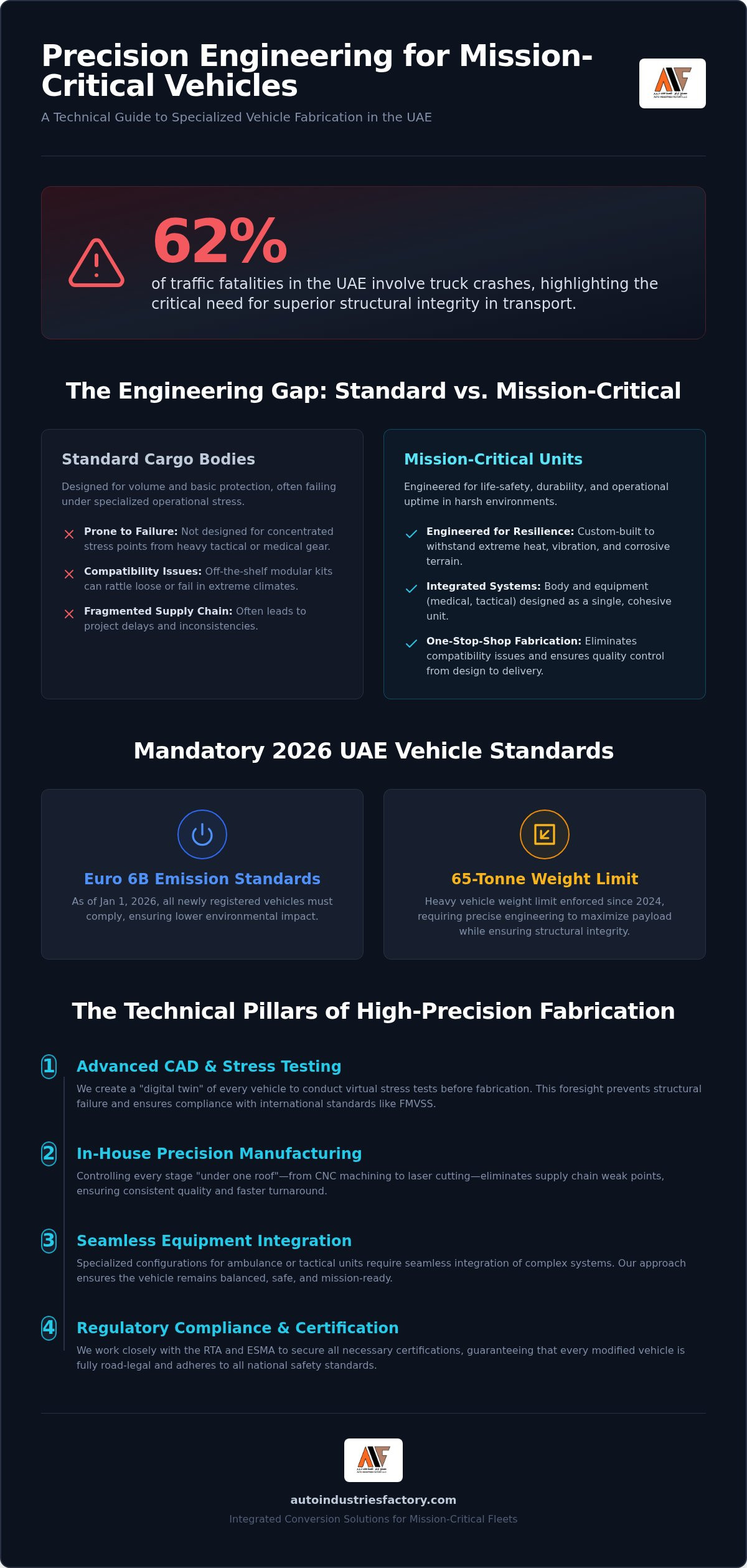
Truck crashes account for 62% of traffic fatalities in the UAE, a stark reminder that when it comes to mission-critical transport, structural integrity isn't just a preference; it's a life-saving requirement. In the demanding climate of the Middle East, specialized vehicle fabrication UAE requires more than just bolting on parts. It demands a rigorous engineering approach where every weld and bracket is designed to withstand extreme heat and corrosive terrain. If you've ever dealt with structural failures in the field or equipment that won't fit a standard modular kit, you understand that a fragmented supply chain is often the root cause of project delays.
You're looking for a way to ensure your fleet remains operational for over a decade without constant repairs. This guide provides the technical roadmap to master the precision engineering required for specialized units. We'll break down the latest 2026 standards, including Euro 6B compliance and the 65-tonne heavy vehicle weight limit. You'll learn how a one-stop-shop approach, from in-house laser cutting to final equipment integration, eliminates compatibility issues and delivers a mission-ready vehicle that's built to last.
Key Takeaways
- Understand the critical engineering distinctions between standard cargo bodies and high-intensity units designed for mission-specific roles.
- Discover how CAD design software and stress-testing protocols prevent structural failure before the fabrication process begins.
- Master the 2026 regulatory landscape for specialized vehicle fabrication UAE, including Euro 6B emission standards and heavy vehicle weight limits.
- Explore specialized configurations for ambulance and tactical units that ensure seamless integration of complex medical and security equipment.
- Learn how to audit a fabrication partner based on their engineering infrastructure and in-house CNC capabilities rather than just the initial bid.
Understanding Specialized Truck Body Fabrication for Mission-Critical Fleets
Specialized truck body fabrication isn't just about adding a box to a chassis; it's the custom engineering of a vehicle body to perform specific, high-stakes roles. While standard cargo bodies focus on volume and basic protection, high-intensity mission-critical units are built to survive the harshest operational environments. In sectors like Ambulance design and conversion, every component must withstand extreme vibration and heat. Mission-critical fabrication is engineering that prioritizes life-safety and operational uptime above all else.
True specialized vehicle fabrication UAE involves an integrated design philosophy. The body and its internal equipment, such as medical oxygen systems or tactical communications racks, function as a single, cohesive system. This approach ensures that the vehicle remains balanced and reliable under pressure. It's the difference between a vehicle that merely carries equipment and one that enhances the mission's success through technical precision.
To better understand how these engineering principles are applied in the field, watch this overview of national security vehicle requirements:
The Engineering Gap: Standard Chassis vs. Specialized Requirements
Standard bodies often fail when loaded with heavy medical or tactical gear because they aren't designed for concentrated stress points. Professional fabricators conduct rigorous center-of-gravity and weight distribution analysis during the CAD design phase. This prevents the chassis from warping and ensures the vehicle handles safely at high speeds. Custom fabrication solves the inherent weaknesses of off-the-shelf modular kits, which often rattle loose or fail under the UAE's intense climate and rugged terrain.
National Standards and Compliance for UAE Fleets
The regulatory landscape for specialized vehicle fabrication UAE is evolving rapidly to ensure public safety. As of January 1, 2026, all newly registered vehicles must comply with Euro 6B emission standards. Additionally, the 65-tonne weight limit for heavy vehicles on UAE roads, enforced since early 2024, means every kilogram of a build must be accounted for. Fabricators must maintain structural integrity while ensuring safety ratings remain intact post-modification. This involves working closely with the Roads and Transport Authority (RTA) and the Emirates Authority for Standardization and Metrology (ESMA) to secure necessary certifications for specialized conversion services.
The Technical Pillars of High-Precision Vehicle Body Engineering
By 2026, the shift from manual metalwork to automated precision engineering has become the industry standard. High-stakes missions don't leave room for error; they require bodies that are engineered, not just built. We utilize advanced CAD design software to create a digital twin of every vehicle. This allow us to conduct virtual stress-tests and analyze structural integrity before the first sheet of metal is ever cut. This rigorous simulation phase ensures every build meets international safety benchmarks, including the Federal Motor Vehicle Safety Standards (FMVSS), which govern everything from occupant protection to crashworthiness.
In-house quality control is the backbone of our reliability. By managing every stage of production under one roof, we eliminate the delays and inconsistencies common in fragmented supply chains. This "under one roof" capability isn't just about speed; it's about maintaining a documented trail of engineering excellence. From the initial design to the final protective coatings, every step is scrutinized to ensure the vehicle can withstand the UAE's extreme heat and corrosive sand environments.
Precision Manufacturing: Laser Cutting and CNC Machining
Specialized vehicle fabrication UAE relies heavily on the accuracy of laser cutting and CNC machining. Laser technology allows us to achieve millimeter-perfect fitment for complex interior layouts, such as medical oxygen racks or tactical gear lockers. CNC machining is vital for creating high-strength, repetitive components like custom brackets and mounting frames. Using in-house machinery ensures that these mission-critical parts are perfectly aligned with the vehicle chassis, reducing vibration and preventing long-term structural fatigue. It's a level of precision that outsourced components simply can't match.
Material Science: Steel, Aluminum, and Ballistic Composites
Material selection is a critical engineering decision that affects everything from fuel efficiency to payload capacity. We evaluate the trade-offs between different metals based on the mission profile. Mild steel plate, typically costing between AED 3,500 to AED 5,500 per tonne, offers rugged durability for heavy-duty frames. For weight-sensitive builds, we utilize aluminum plate, which ranges from AED 12,000 to AED 22,000 per tonne. While more expensive, aluminum significantly improves fuel efficiency and reduces wear on the vehicle's braking system. For tactical units, we integrate ballistic composites that provide BR6 protection against 7.62x51mm rounds without the massive weight penalty of traditional steel armor, which can add up to 1,200kg to an SUV.
You can explore our full range of specialized conversion services to see how these engineering pillars support mission-critical fleets across the region.
Specialized Body Configurations: From Emergency Medical Units to Tactical Vehicles
Specialized vehicle fabrication UAE isn't a one-size-fits-all discipline. Every mission profile demands a unique structural response. A safari truck navigating the dunes of the Empty Quarter requires vastly different reinforcement than a tactical unit designed for urban rapid response. We don't just modify vehicles; we re-engineer them to meet the exact operational stresses they'll face in the field. This engineering-first approach ensures that the vehicle handles predictably, even when loaded with heavy specialized equipment or ballistic protection.
For a professional Ambulance Conversion, the focus is on the patient care environment. We often implement "extended roof" modifications on GMC and Toyota platforms. This isn't a cosmetic change. It's about creating an ergonomic workspace where paramedics can stand and operate life-saving equipment without restriction. Similarly, Police Vehicle Modifications involve complex upfitting that integrates prisoner transport cells and secure weapon storage directly into the vehicle's frame. These modifications must be seamless to maintain the vehicle's response capabilities.
Medical and Ambulance Body Engineering
We specialize in fabricating box-type ambulance bodies that offer maximum interior volume and medical efficiency. These units aren't just empty shells. We integrate oxygen, electrical, and suction systems directly into the body structure during the initial fabrication phase. This ensures that every component is secure, vibration-resistant, and easily accessible during transit. All our medical builds are engineered to meet international standards like EN 1789. This guarantees that the vehicle remains a stable, sterile, and safe environment during high-speed emergency transport across the Emirates.
Tactical, Military, and Safari Body Modifications
Ruggedness is the priority for Safari Vehicle Conversions and troop carriers. These vehicles face constant mechanical stress from off-road terrain. We provide the structural reinforcement necessary to handle the weight of ballistic protection, often reaching BR6 standards to protect against 7.62x51mm rounds. Front-end protection is equally critical for mission success. We fabricate heavy-duty custom bull bars and bumpers that shield the engine and cooling systems from impacts. Whether we're building a 12-seater safari truck on a Toyota Land Cruiser platform or a specialized troop carrier, our custom seating and cargo layouts prioritize occupant safety and operational efficiency.
Our "under one roof" capability allows us to manage these complex configurations from the first CAD drawing to the final coat of protective paint. This ensures that every specialized vehicle we deliver is ready for immediate deployment in the most demanding environments.
Evaluating Your Fabrication Partner: Beyond the Lowest Bid
Low bids often mask a lack of engineering depth. For mission-critical fleets, a cheaper initial price usually results in structural failure or equipment incompatibility in the field. When you evaluate a partner for specialized vehicle fabrication UAE, you aren't just buying a product; you're investing in their engineering infrastructure. A facility audit should prioritize three factors: the presence of in-house CNC and laser machinery, the seniority of the CAD design team, and a proven track record of national-scale fleet deliveries. If a fabricator cannot show you their design-to-build workflow, they aren't a specialist; they're a middleman.
One-stop shop providers offer a significant advantage for rapid fleet deployment. By managing design, fabrication, and finishing under one roof, these partners eliminate the communication gaps that plague fragmented supply chains. This "under one roof" capability is particularly vital for bulk orders where consistency across a large fleet is non-negotiable. It's the only way to ensure that the 100th vehicle is as precise as the first prototype.
In-House Infrastructure vs. Fragmented Supply Chains
Outsourcing critical processes like laser cutting or welding introduces hidden operational risks. When a fabricator relies on third-party vendors, they lose control over material quality and precision tolerances. This leads to long lead times and integration errors. In-house design teams can pivot instantly if mission requirements change mid-build, ensuring that the final unit is fit for purpose. Additionally, an in-house professional paint booth is essential for the UAE's climate. Without controlled application of high-grade protective coatings, metal bodies will succumb to corrosion from high humidity and abrasive sand within a few years of service.
Quality Assurance and After-Sales Support
A reliable partner provides a transparent quality control framework. This includes stress-testing welds and ensuring that all integrated electrical systems are shielded against interference. After-sales support is equally critical for custom accessories. Whether it's maintaining specialized roof racks or replacing a damaged bull bar, immediate access to the original design files ensures a perfect fit for replacement parts. It's vital to recognize that increasing ballistic protection levels inherently reduces the available vehicle payload, necessitating a balanced engineering approach to avoid chassis strain. Reliability isn't a feature; it's the result of rigorous engineering discipline.
Ready to see our technical capabilities in person? Learn more about the Auto Industries Factory engineering team and our commitment to mission-critical excellence.
Engineering Excellence at Auto Industries Factory: Integrated Conversion Solutions
Auto Industries Factory LLC serves as a national leader in specialized vehicle fabrication UAE. We operate with a clear mandate: to deliver engineering solutions that protect lives and ensure operational success. Our facility isn't just a workshop; it's a precision manufacturing hub where advanced laser cutting and CNC machining are standard for every build. We understand that in the medical, tactical, and safari sectors, there's no margin for error. Reliability is built into the frame from day one.
Our "under one roof" philosophy ensures that quality control remains absolute from the first CAD drawing to the final coat of paint. By keeping every process in-house, we eliminate the delays and technical gaps that occur when outsourcing to multiple vendors. This approach allows us to maintain the rigorous standards required for the UAE's unique climate and regulatory landscape. Whether you're managing a single custom unit or a national fleet, our facility is equipped to handle the engineering complexity your mission demands.
Our End-to-End Design and Fabrication Workflow
The transformation of a standard chassis into a specialized unit begins with digital conceptualization. We utilize CAD software to stress-test every design before fabrication starts, ensuring that the final build can handle the weight of medical or tactical systems. We specialize in modifying rugged platforms like the Toyota Land Cruiser and Hilux, which are the backbone of regional fleets. Our in-house capabilities allow for millimeter precision during structural assembly, ensuring that every bracket and frame fits perfectly. This level of detail is what guarantees a vehicle's 10+ year operational life, even in the harshest desert conditions.
Custom Heavy-Duty Accessories: Bull Bars and Metal Canopies
Front-end protection is a non-negotiable requirement for mission-critical vehicles. We fabricate custom bull bars and brush guards designed to shield the engine and cooling systems from high-impact collisions. These aren't generic accessories; they're engineered specifically for the vehicle's frame to ensure they don't compromise airbag sensors or safety ratings. For safari and tactical units, we design metal canopies and roof racks that provide maximum storage without sacrificing stability. In the realm of high-end off-road modifications, integrating patented panoramic roof panels from JeeTops® can further enhance visibility and cabin ergonomics for specialized patrol or safari platforms. Our bulk manufacturing capacity allows us to deliver these specialized accessories for large-scale fleet orders, ensuring uniformity and reliability across your entire operation.
You can review our comprehensive services to see how we support diverse industries with integrated engineering. We invite fleet managers and procurement officers to consult directly with our engineering team to discuss bespoke fabrication requirements for your next mission.
Securing Your Fleet's Operational Future
The transition from basic vehicle assembly to high-precision engineering is the only way to ensure long-term fleet survival. We've detailed how integrated design and "under one roof" manufacturing eliminate the structural failures common in fragmented supply chains. By prioritizing technical integrity and advanced material science, you ensure your specialized units can withstand the UAE's extreme terrain and climate for over a decade. Reliability is the direct result of rigorous engineering discipline.
Success in specialized vehicle fabrication UAE requires a partner who understands the high stakes of your mission. As specialists in mission-critical conversions, we utilize in-house laser cutting and CNC machining to deliver millimeter precision for every build. This comprehensive national service ensures that your fleet remains compliant with the latest 2026 regulations while maximizing payload and safety. Your operational uptime is our primary metric of success.
Building a resilient operation in the UAE involves more than just a high-performance fleet; it requires a strategic physical presence. For companies looking to establish or expand their footprint, Shine Life Real Estate Broker LLC provides professional brokerage services to secure commercial and residential properties across Dubai.
Don't leave your mission success to chance. Request a Technical Consultation for Your Fleet Fabrication today to discuss your bespoke requirements with our master craftsmen. Let's build a fleet that's as robust as the missions you serve.
Frequently Asked Questions
What materials are best for specialized truck body fabrication in the UAE?
Mild steel plate and aluminum extrusions are the primary materials used for builds in this region. Steel provides the structural ruggedness required for heavy-duty frames, while aluminum is utilized to optimize vehicle weight and improve fuel efficiency. Choosing the right material ensures the body can withstand the national climate and corrosive sand environments over a long operational life.
How long does a custom ambulance or military vehicle conversion typically take?
Lead times vary based on the specific mission requirements and the total number of units in a fleet order. A single specialized unit typically takes several weeks to complete, covering everything from initial CAD design to final protective painting. Bulk fleet orders are carefully scheduled to ensure consistent quality control and precision across every unit delivered to the client.
Can you fabricate specialized bodies for any vehicle chassis?
While various platforms can be modified, a robust body-on-frame construction is strongly recommended for mission-critical applications. Specialized vehicle fabrication UAE often focuses on high-performance platforms like the Toyota Land Cruiser and Hilux. These chassis provide the necessary structural strength to handle the additional weight of medical systems, tactical gear, or ballistic protection without compromising safety.
What is the difference between a box-type ambulance and a van conversion?
A box-type ambulance offers significantly more interior volume and ergonomic standing room compared to a standard van conversion. This configuration allows for better medical efficiency and the seamless integration of complex life-support systems. Van conversions are typically chosen for urban environments where maneuverability in tight spaces and a smaller footprint are the primary operational priorities.
How does laser cutting improve the quality of a specialized truck body?
Laser cutting achieves millimeter-perfect fitment for every component of a specialized body. This precision ensures that interior layouts, such as oxygen racks or equipment lockers, are perfectly aligned with the vehicle's frame. It significantly reduces vibration during transit and prevents long-term structural fatigue, which is vital for vehicles operating in harsh desert terrain or high-speed emergency scenarios.
Do you provide ballistic protection as part of the fabrication process?
We integrate ballistic protection materials directly into the structural fabrication of tactical and military units. This includes utilizing materials that meet European CEN standards, such as BR6 protection against 7.62x51mm rounds. The fabrication process is engineered to ensure that the added weight of the armor doesn't compromise the vehicle's center of gravity or its overall operational handling.
Is it possible to fabricate custom accessories like bull bars in bulk quantities?
Yes, our in-house CNC machining and laser cutting facilities allow for the bulk manufacturing of specialized accessories with total consistency. We can produce large quantities of custom bull bars, brush guards, and metal canopies that meet exact engineering specifications. This capability is ideal for national-scale fleet orders that require uniform protection and storage solutions across hundreds of vehicles.
What certifications should a specialized vehicle fabricator have in the UAE?
Reliable fabricators must adhere to Road and Transport Authority (RTA) and Emirates Authority for Standardization and Metrology (ESMA) regulations. All builds should also comply with relevant ISO standards and industry-specific certifications, such as EN 1789 for medical units. These certifications guarantee that the modified vehicle remains structurally sound, safe, and fully road-legal post-conversion.


