

Outsourcing specialized fleet conversions across multiple third-party workshops doesn't reduce project risk; it multiplies it. When a build is fragmented between separate vendors for sheet metal cutting, structural welding, and protective coatings, a single supplier delay derails your entire deployment schedule. You've likely dealt with the frustrating fallout firsthand: mismatched component tolerances, inconsistent weld integrity, and endless finger-pointing when subcontracted assemblies fail under high-stress conditions. Recognizing the tangible benefits of in-house fabrication is essential for fleet operators who require uncompromising build precision, rugged durability, and genuine single-source accountability.
Consolidating design, precision machining, and assembly under one roof fundamentally changes the equation. Discover how turnkey in-house fabrication eliminates supply chain bottlenecks, ensures strict tolerance control, and accelerates custom vehicle delivery without costly mid-production change orders. Ahead, we break down why end-to-end manufacturing oversight protects your operational timelines, simplifies engineering revisions, and delivers heavy-duty fleet platforms engineered to withstand the most demanding operational environments.
Key Takeaways
- Consolidating precision cutting, forming, welding, and finishing under one facility roof eliminates fragmented supplier handoffs and shields your project timeline from compounding third-party delays.
- Discover the five core operational benefits of in-house fabrication, ranging from strict tolerance control and rapid mid-build engineering revisions to superior structural durability under extreme operational stress.
- Direct comparison proves that single-source manufacturing control drastically reduces change-order surcharges and completely removes the finger-pointing typical of multi-vendor assemblies.
- Learn a practical procurement audit framework to vet a partner's genuine machinery floor and protect your fleet investments against broker-style shell fabricators.
- End-to-end oversight from raw sheet metal to automotive protective coating guarantees turnkey compliance, maximum lifecycle durability, and dependable nationwide deployment.
What Is In-House Fabrication and Why Does Manufacturing Control Matter?
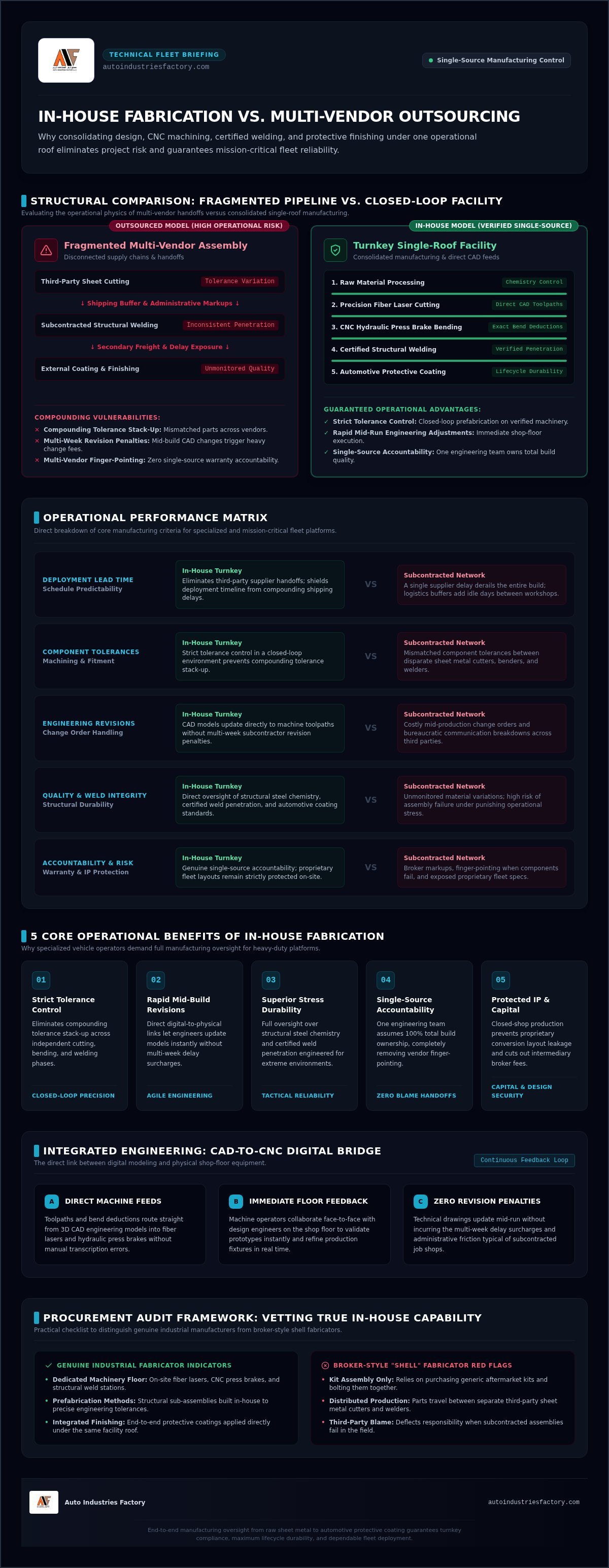
In-house fabrication represents the consolidation of every core manufacturing phase under a single operational roof. Rather than relying on distributed contractors, a dedicated facility handles raw material processing, high-precision laser cutting, CNC bending, certified structural welding, and industrial finishing in one integrated workflow. This end-to-end framework contrasts sharply with fragmented outsourcing models. Traditional multi-vendor production fractures project management across disconnected facilities, introducing unmonitored material variations, shipping delays, and communication breakdowns.
For mission-critical applications like tactical transports and emergency rescue platforms, component failure isn't an option. Full manufacturing oversight ensures absolute control over structural steel chemistry, precise weld penetration, and rigorous coating standards. Modern industrial fleets demand this level of reliability, making dedicated manufacturing assets the baseline requirement for operational readiness.
To evaluate how internal operations compare against outsourced models in industrial settings, review this production breakdown:
In-House Fabrication vs. Outsourced Assembly Explained
A distinct line separates genuine industrial fabricators from shell assemblers. Brokers routinely purchase generic aftermarket kits, bolt them together, and market the result as custom engineering. In contrast, true factory manufacturing utilizes advanced prefabrication methods directly on site to build structural sub-assemblies to strict engineering tolerances.
This closed-loop environment eliminates the compounding tolerance stack-up that occurs when parts travel between independent sheet metal cutters and welders. It also ensures indisputable accountability: one engineering team owns the total build quality, eliminating third-party blame when vehicles face punishing field service.
The Role of Integrated Engineering in Custom Builds
Seamless execution depends on direct integration between computer-aided design (CAD) software and computer numerical control (CNC) equipment. This digital-to-physical bridge provides key operational advantages:
- Direct machine feeds: Toolpaths and bend deductions route straight from engineering models to fiber lasers and hydraulic press brakes.
- Immediate floor feedback: Machine operators collaborate face-to-face with design engineers to validate prototypes instantly.
- Rapid engineering adjustments: One of the core benefits of in-house fabrication is updating technical drawings mid-run without incurring multi-week subcontractor revision penalties.
Fleet operators needing dependable turnaround times can review comprehensive fabrication workflows through specialized conversion services that maintain complete, single-facility ownership.
In-House Fabrication vs. Outsourcing: Key Operational Differences
Procurement teams often evaluate initial bids without calculating the compounding friction of subcontracted builds. When a conversion moves between separate cutting, welding, and paint facilities, hidden costs pile up fast. Third-party logistics introduce shipping buffers, while each vendor adds administrative fees and individual profit markups. Closed-shop production protects your capital and keeps proprietary fleet layouts entirely secure.
| Operational Metric | In-House Fabrication | Outsourced Subcontracting |
|---|---|---|
| Lead Time Predictability | Unified scheduling across all workstations | Compounding delays across vendor queues |
| Tolerance Integrity | Continuous real-time stage verification | High risk of multi-vendor tolerance stack-up |
| Engineering Change Agility | Immediate floor adjustments with zero markup | Administrative surcharges and multi-week delays |
| IP & Design Security | Restricted to a single secure facility | Dispersed across external commercial shops |
| Procurement Costs | Direct raw material and processing rates | Layered subcontractor margins and freight fees |
| Build Accountability | Single-source engineering responsibility | Multi-party disputes over assembly failures |
Supply Chain Reliability and Production Velocity
Direct raw inventory management shields conversion programs from unpredictable external disruptions. Eliminating inter-facility transit cuts weeks from delivery timelines. Crucially, single-facility floor control lets managers reallocate machine capacity instantly during urgent fleet replenishment runs without waiting for external contractor queues.
Unified Quality Management and Defect Prevention
A single quality management standard monitors every laser cut, bend angle, and weld penetration point. In-process inspection gates verify dimensional accuracy at the machinery station before assemblies proceed to welding or coating. Catching variations early prevents compromised sub-assemblies from reaching the vehicle chassis. This defect elimination demonstrates the real benefits of in-house fabrication for heavy-duty fleet platforms.
Transparent Communication and Project Visibility
Direct communication with the technicians cutting and welding your vehicles eliminates message distortions caused by third-party broker networks. Fleet managers get unvarnished status updates, live milestone sign-offs, and technical consultations with the engineers running the machines. If your fleet demands direct factory access and tighter build schedules, partnering with Auto Industries Factory ensures complete manufacturing transparency at every stage.
5 Critical Benefits of In-House Fabrication for Specialized Fleets
Specialized fleet assets operate under punishing conditions where structural fatigue isn't just an inconvenience; it's an operational failure. Delivering vehicles that endure these environments requires a manufacturing model that controls every variable from raw stock to finished mount. The core benefits of in-house fabrication center on five decisive operational advantages:
- Sub-millimeter tolerance control across all sheet metal and plate components
- Fluid design adaptability for bespoke field configurations
- Compressed build cycles that eliminate multi-vendor scheduling queues
- Transparent capital expenditure with zero intermediary broker markups
- Superior structural longevity that lowers total cost of ownership across fleet lifecycles
When heavy utility, security, and medical fleets rely on custom structural metalwork, internal execution ensures structural integrity outlasts tough field demands.
Superior Tolerance Control with Laser Cutting and CNC Machining
Precision fitment starts on the cutting table. Industrial fiber lasers slice structural steel and aluminum plate with minimal heat-affected zones, hitting tolerances down to fractions of a millimeter. Multi-axis CNC press brakes replicate these cuts with consistent bend angles, ensuring that every bracket, reinforcement gusset, and mounting plate aligns flush against vehicle chassis hardpoints without forceful adjustments during final assembly.
Uncompromised Customization and Rapid Prototyping
Off-the-shelf assemblies rarely survive severe operational duties. In-house engineering teams model, test, and fabricate purpose-built reinforcements directly for specific vehicle chassis. Fabricating heavy-duty components like custom bull bars and bumpers internally allows technicians to build and stress-test physical prototypes in hours rather than waiting weeks for an external sample. This agility lets fleet directors deploy custom equipment lockers, roof mounting systems, and chassis armoring without lengthy development cycles.
Enhanced Structural Safety for Mission-Critical Operations
Certified weld integrity directly impacts occupant safety during rollover events, dynamic impacts, and rough off-road terrain. Dedicated in-house welding bays enable rigorous root-pass inspections and continuous penetration monitoring. These standards are critical for life-saving platforms like ambulance conversions, where internal cabinetry, partition walls, and subfloors must withstand severe deceleration forces.
Structural reliability also requires total surface protection. Managing mechanical prep, degreasing, and industrial powder coating under the same roof ensures uniform paint adhesion. This sealed finish locks out corrosion and abrasive sand, maximizing fleet return on investment nationwide.
How to Evaluate a Fabricator's In-House Capabilities
Procurement audits must separate verified industrial plants from broker-style shell fabricators. Many commercial conversion vendors present impressive digital portfolios while subcontracting all primary shearing, bending, and welding to unverified third parties. This practice exposes your fleet to unmonitored production delays and poor quality control. To secure the real benefits of in-house fabrication, procurement teams must conduct hands-on technical audits before signing supply contracts.
A thorough supplier evaluation centers on three practical verification pillars:
- Physical verification of heavy machinery assets on the factory floor
- Validation of structural welder credentials and non-destructive testing protocols
- Turnkey multi-system integration capabilities under single-roof supervision
Auditing On-Site Machining and Tooling Assets
Walk the production floor directly. Confirm the operational presence of high-precision fiber laser cutting tables, multi-axis CNC press brakes, and dedicated metal bending stations. The facility must show clear raw material staging for heavy-gauge steel and aluminum alloy plates. Dedicated down-draft painting bays and industrial coating lines should sit within the same facility footprint, guaranteeing seamless surface finishing without road transport between shops.
Verifying Technical Certifications and Structural Standards
Ask for welder qualifications and code compliance records. Structural metalwork on specialized platforms must withstand massive dynamic stresses and extreme terrain vibration. Verifiable quality management frameworks require standardized root-weld inspections, structural load testing, and thorough electrical isolation checks. These structural protocols are mandatory when engineering high-stress builds like police vehicle modifications, where officer protection barriers, equipment retention brackets, and push bumpers face punishing operational abuse.
Assessing Turnkey Systems Integration Capabilities
Structural fabrication is only half the equation; mission-ready conversions require seamless integration of mechanical and electrical systems. Audit whether the builder designs and installs custom wiring harnesses, auxiliary battery isolators, emergency lighting controls, and heavy-duty interior storage entirely within their own bays. Builders who outsource their electrical or interior work reintroduce the exact scheduling logjams you're trying to avoid.
To inspect fully unified production floor assets and verified nationwide build capabilities, explore our services page to evaluate how complete in-house manufacturing protects your operational timeline.
Maximize Fleet Performance with Auto Industries Factory's In-House Expertise
Operational readiness begins with complete manufacturing control. Auto Industries Factory LLC serves as a premier nationwide specialist in purpose-built vehicle conversions and custom industrial metalwork. By eliminating third-party sub-assemblies and keeping every engineering station under one corporate roof, we provide fleet managers with uncompromising build reliability, strict schedule adherence, and single-source accountability. Capitalizing on the true benefits of in-house fabrication requires partnering with a production facility engineered from the ground up for high-stress vehicular applications.
End-to-End Metalworking and Finishing Under One Roof
Our facility integrates every primary metalworking capability into a continuous production line. High-precision laser cutting tables slice through heavy plate with clean edges, feeding directly into multi-axis CNC bending systems that shape structural frames without micro-fractures. In our dedicated welding bays, certified technicians execute high-penetration structural joints designed to withstand severe torsional stress.
Finishing stages follow that same rigorous internal path. Rather than loading bare metal assemblies onto flatbeds for third-party coating, components transition immediately to automated surface preparation and specialized automotive painting lines. Whether your organization requires complete vehicle color change projects or high-durability coatings, executing every phase internally guarantees exceptional surface adhesion and corrosion resistance. Review our comprehensive fabrication setup and project portfolios directly on our corporate homepage.
Engineered for Mission-Critical and Demanding Environments
Severe operational duty demands verified structural performance. We engineer mission-critical vehicle conversions across multiple specialized sectors:
- Medical and Emergency Response: Purpose-built box type ambulances and extended roof ambulance builds on Toyota and GMC chassis.
- Security and Tactical Operations: Heavy-duty police and military vehicle modifications configured for rapid tactical deployment and officer safety.
- Commercial and Tourism Fleets: Reinforced safari vehicle conversions built to conquer remote off-road tracks.
- Structural Fleet Protection: Heavy-duty metal canopies, roof racks, front brush guards, and custom bull bars and bumpers, available as custom single builds or in bulk quantity runs.
With comprehensive metal cutting, bending, and assembly housed under a single roof, our nationwide service network ensures consistent fleet performance across demanding operational environments. To eliminate supply chain bottlenecks and optimize your fleet lifecycle, request a comprehensive fabrication consultation with our technical engineering team today.
Upgrade Your Fleet with Complete Manufacturing Control
Fragmented manufacturing puts fleet reliability, procurement budgets, and deployment schedules at risk. Consolidating laser cutting, CNC bending, certified structural welding, and industrial coating under one facility roof eliminates third-party friction and protects your delivery milestones. Leveraging the true benefits of in-house fabrication ensures that every mounting bracket, chassis reinforcement, and specialized body conversion meets strict engineering tolerances engineered to endure severe operational environments.
Direct factory oversight gives procurement managers complete transparency, agile mid-production adjustments, and indisputable single-source accountability. When mission-critical vehicles like emergency ambulances and tactical units demand unyielding structural integrity, cutting corners with broker networks isn't an option. Take control of your build quality and lifecycle durability. Partner with Auto Industries Factory for your custom fleet fabrication to deploy dependable, purpose-built vehicle fleets engineered for lasting field performance.
Frequently Asked Questions
What is the primary difference between in-house fabrication and contract assembly?
In-house fabrication executes all structural metal cutting, forming, welding, and finishing within a single owned facility, whereas contract assembly relies on third-party shops to manufacture separate parts before bolting them together. Contract assembly introduces multi-tiered vendor markups, shipping bottlenecks, and cumulative tolerance variations. Conversely, in-house fabrication maintains direct oversight over raw materials, ensuring continuous precision and total quality accountability across every build phase.
How does in-house fabrication reduce overall turnaround times for custom vehicle builds?
Turnaround times drop significantly because all manufacturing stages occur sequentially under one roof without third-party transit delays. When laser cutting, CNC bending, and certified welding operate in the same facility, technicians transfer assemblies directly between workstations within minutes. Realizing the full benefits of in-house fabrication means eliminating external vendor backlogs, freight coordination lags, and multi-week scheduling queues, which keeps vehicle conversions moving on strict, predictable delivery schedules.
Why is CNC laser cutting and bending superior to manual fabrication methods?
CNC laser cutting and automated press brake bending eliminate the dimensional inconsistencies inherent in manual cutting torch work and mechanical shearing. High-power industrial lasers achieve micro-tolerances down to fractions of a millimeter, leaving clean, burr-free edges that require minimal secondary dressing. Computer-controlled press brakes calculate exact bend deductions across repeat runs. This repeatable accuracy ensures brackets, canopies, and bumper mountings fit the vehicle chassis perfectly every single time.
Can in-house fabricators accommodate mid-production design modifications?
Yes, in-house fabricators handle mid-production engineering changes rapidly because design engineers collaborate directly with machine operators on the shop floor. When operational requirements shift, CAD programmers update structural models and immediately route revised toolpaths directly to CNC lasers and press brakes. This closed-loop workflow eliminates the administrative disputes, inflated change-order fees, and extended project halts common when renegotiating specifications with detached external subcontractors.
How does in-house metal fabrication improve vehicle safety and structural integrity?
Direct facility control guarantees rigorous verification of metal grade certifications, structural weld penetration, and joint reinforcement. Technicians conduct multi-stage non-destructive inspections at every welding bay, ensuring sub-assemblies withstand severe rollover impact, torsional flexing, and extreme operational stress. Highlighting the structural benefits of in-house fabrication, this continuous quality oversight prevents fatigue cracks and structural detachment in critical applications like patient care compartments and tactical transport armoring.
What types of specialized vehicles benefit most from turnkey in-house fabrication?
Mission-critical platforms operating in demanding environments gain the greatest advantage from turnkey manufacturing. This includes emergency box-type and extended-roof ambulances on GMC or Toyota chassis, tactical police and military transport units, and heavy-duty safari vehicles. These applications require bespoke internal cabinetry, reinforced roll cages, heavy-gauge front bull bars, and metal roof canopies that must perform reliably without failure across rugged, high-heat terrain.
How do I verify if a vehicle upfitter actually manufactures components in-house?
Conduct an on-site technical facility audit before signing any procurement contract. Request to see active fiber laser cutting machines, CNC press brakes, certified welding bays, and dedicated automotive coating booths in operation on their shop floor. Shell upfitters rely on third-party deliveries and warehouse shelving filled with generic aftermarket bolt-ons, whereas true industrial fabricators maintain raw steel plate inventory and active engineering workstations.


