
The lowest upfront quote on an imported vehicle build often becomes a fleet's most expensive operational mistake. When weighing local vs international vehicle converters, procurement teams frequently discover that nominal unit savings quickly disappear behind 20- to 45-day ocean transit delays, unexpected port clearance fees, and technical miscommunications over bespoke layouts.
You already understand the operational stakes. Deploying mission-critical platforms, whether specialized ambulances, tactical law enforcement units, or expedition vehicles, demands complete adherence to domestic transport standards and immediate post-delivery warranty support. You can't afford grounded assets while waiting months for replacement body components or structural repairs from an overseas builder.
In this guide, you'll discover how domestic and overseas fabricators compare across total lifecycle costs, engineering verification, lead times, and regulatory compliance. We outline a clear framework to inspect conversion capabilities directly, ensuring you select a manufacturing partner that guarantees rapid deployment and relentless fleet uptime across the United Arab Emirates.
Key Takeaways
- Calculate total landed costs to see why evaluating local vs international vehicle converters reveals hidden expenses behind overseas shipping, customs delays, and port storage.
- Understand the operational trade-offs of overseas builders, where standard mass-scale output often clashes with lengthy freight lead times and difficult warranty enforcement.
- Discover how direct workshop access and complete in-house fabrication provide superior quality verification for bespoke layouts and rapid field deployment.
- Examine application-specific demands across mission-critical fleets, from specialized box-type ambulances and tactical units to expedition vehicles.
- Use an actionable procurement checklist to audit a fabricator's true in-house cutting, welding, and finishing capabilities before committing capital.
Local vs International Vehicle Converters: Strategic Decision Factors for Fleet Procurement
Fleet procurement decisions shape operational readiness for years. When evaluating local vs international vehicle converters, engineering teams must look past attractive factory-gate estimates to scrutinize total landed costs, build adaptability, and delivery risks. Overseas converters leverage large assembly plants, but domestic builders eliminate complex international supply chains and deliver immediate operational alignment.
Total Landed Cost vs Upfront Vehicle Pricing
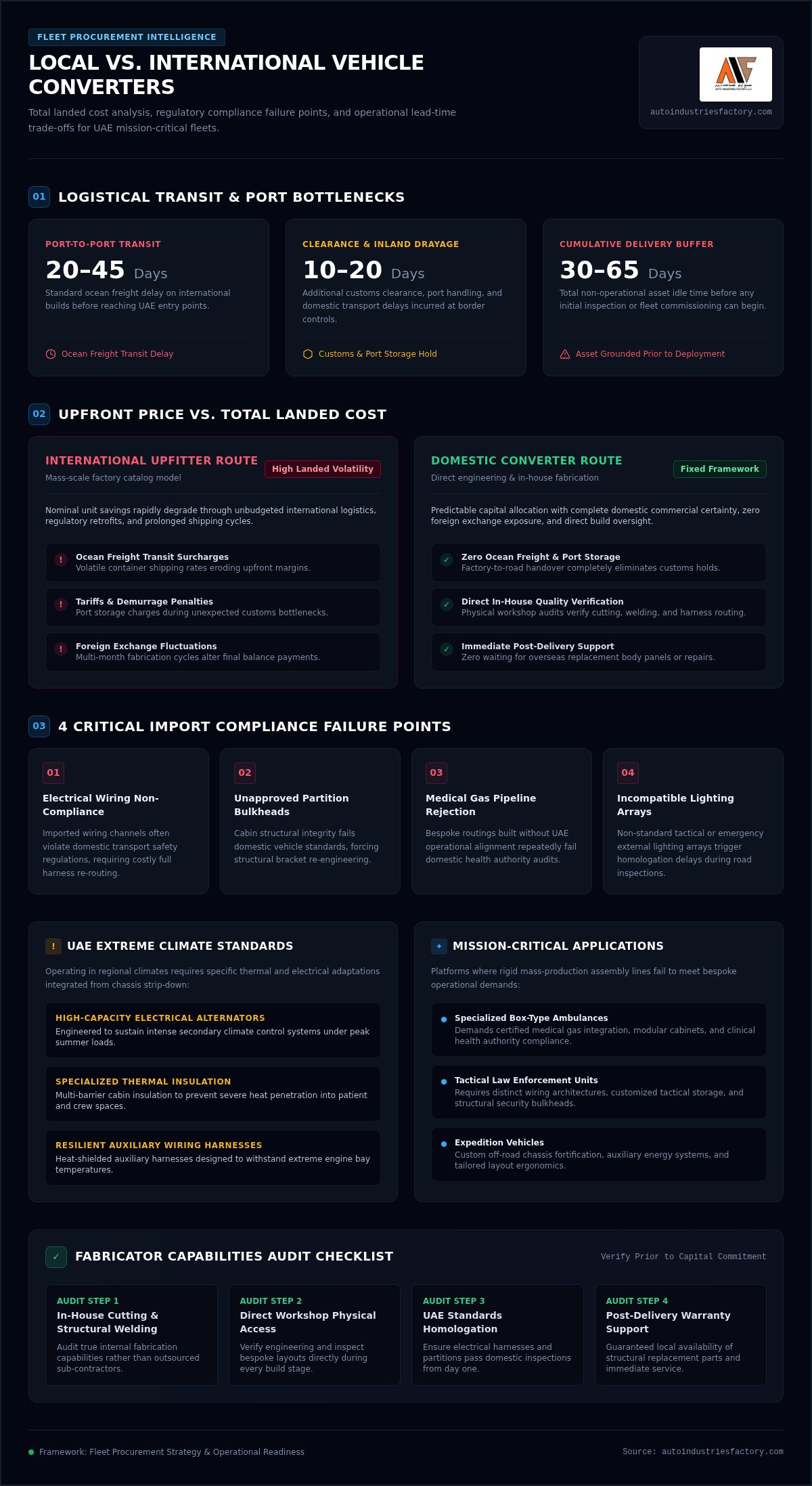
A basic unit quote never reflects the true final expenditure. Landed cost encompasses ocean freight transit, regional import tariffs, port handling charges, and potential demurrage penalties from customs bottlenecks. When components cross borders, unexpected delays rapidly erode initial margin advantages.
Currency fluctuations add another layer of risk during multi-month overseas fabrication cycles. A shifting exchange rate can dramatically increase final payment balances between blueprint sign-off and vehicle handover.
In contrast, domestic vehicle fabrication operates under transparent, fixed commercial frameworks. You avoid foreign exchange vulnerability and unbudgeted logistics fees. The initial quotation is merely an entry price; total landed cost determines your fleet's true investment.
Regulatory Compliance and National Safety Standards
Domestic vehicle converters build directly to United Arab Emirates operational standards. Regional climates require high-capacity electrical alternators, specialized thermal insulation, and resilient auxiliary wiring harnesses to survive extreme operating temperatures. Domestic specialists integrate these requirements from initial chassis strip-down to final finishing.
International builds frequently face compliance roadblocks upon arrival. Common failure points include:
- Non-compliant electrical wiring that violates domestic transport safety regulations.
- Unapproved partition bulkheads that compromise cabin structural integrity.
- Bespoke medical gas pipeline routings that fail domestic health authority audits.
- Incompatible external lighting arrays that delay roadworthiness homologation.
Retrofitting a non-compliant import creates substantial administrative friction. Correcting substandard sub-assemblies requires re-engineering structural brackets, re-routing harness channels, and enduring repeated inspection cycles. Partnering with domestic specialists through proven conversion services ensures full homologation from day one, keeping critical fleet programs completely on schedule.
Evaluating International Vehicle Converters: Capabilities, Scale, and Operational Bottlenecks
Large-scale international upfitters often attract procurement interest through standardized production lines and high catalog volume. However, comparing local vs international vehicle converters requires analyzing how global supply chains perform under operational pressure. When bespoke requirements clash with foreign factory schedules, cross-border procurement quickly introduces severe friction.
The Perceived Advantages of Global Upfitting Operations
High-volume overseas factories excel at producing thousands of uniform platforms. They rely on rigid assembly lines, stamped sheet metal, and pre-molded composite interiors designed for standardized global fleet programs. This factory setup suits distributed multinational entities purchasing identical utility packages across several continents. For fleets that require custom interior partitioning, distinct wiring architectures, or specialized exterior armor, these rigid assembly processes become a major obstacle to practical modifications.
Freight Volatility, Import Tariffs, and Extended Delivery Timelines
Cross-border vehicle transport introduces severe logistical vulnerabilities. Typical ocean transit requires 20 to 45 days port-to-port, while customs clearance, port handling, and inland drayage often add another 10 to 20 days. Any maritime backlog leaves critical chassis idling at container terminals.
Key bottlenecks during overseas transit include:
- Compounding port storage charges and demurrage fees during customs verification.
- Unscheduled carrier transshipment delays that disrupt fleet deployment targets.
- Chassis tie-ups that prevent operations from replacing damaged or decommissioned units.
- Damage sustained during open-sea transit requiring immediate secondary refinishing.
Emergency medical fleets and tactical security forces cannot afford multi-month delays. Missing an operational launch window due to a stranded cargo vessel puts public safety and frontline readiness at risk.
Communication Barriers and Warranty Enforcement Complexities
Distance compromises project execution. When foreign fabrication teams misinterpret bespoke technical drawings, rectifying an incorrect bracket location or misrouted pneumatic line across different time zones burns valuable weeks. Engineering revisions become expensive disputes rather than simple shop-floor adjustments.
Post-delivery support poses an even larger hurdle. Shipping defective composite assemblies, hydraulic components, or custom bracketry back to an overseas builder costs immense time and capital. Flying foreign technicians in for basic warranty disputes is rarely practical. Evaluating regional manufacturing infrastructure through Auto Industries Factory LLC reveals how on-ground fabrication teams resolve warranty claims and design adjustments instantly, protecting long-term fleet availability.
The Case for Local Vehicle Converters: Agility, Engineering Control, and Post-Delivery Support
Agility defines operational readiness. In the debate surrounding local vs international vehicle converters, domestic builders provide engineering control that overseas mass-production plants simply cannot match. By keeping design, fabrication, and integration within the country, domestic upfitters deliver rapid turnaround, tailored configurations, and lifecycle accountability.
In-House Fabrication and Direct Engineering Collaboration
Real customization requires true metalworking infrastructure, not just bolt-on plastic trim. When a workshop maintains its own fiber laser cutting, CNC machining, bending, and certified welding bays, prototype modifications happen in hours rather than months. Fleet engineers can step directly onto the production floor to inspect structural sub-frames, adjust equipment mounts, and refine partition designs before final assembly.
Direct collaboration ensures rapid CAD adjustments. When field crews provide feedback regarding equipment placement or load distribution, domestic technicians modify the cut files immediately. Utilizing comprehensive our services for bespoke vehicle conversions guarantees every bracket, reinforced bulkhead, and storage console integrates seamlessly with the chassis without relying on outsourced suppliers.
Seamless Chassis Sourcing and Elimination of Maritime Transit
Sourcing donor platforms through domestic dealership channels bypasses international shipping entirely. Factory chassis match national specifications out of the crate, including heavy-duty cooling packages, specialized filtration systems, and electrical architectures calibrated for desert environments. Key operational advantages include:
- Elimination of port congestions and container demurrage costs.
- Guaranteed chassis warranty coverage through domestic automotive dealer networks.
- Full mechanical compatibility with local fuel grades and ambient thermal thresholds.
- Measurable reductions in procurement carbon footprints by cutting cross-continental transport.
Local vehicle procurement keeps capital moving forward rather than sitting stagnant in shipping lanes.
Rapid After-Sales Service and Emergency Fleet Maintenance
Vehicle delivery marks the beginning of operational life, not the end of a transaction. If an emergency vehicle incurs structural or body damage, waiting weeks for imported replacement parts sidelines critical assets. Domestic converters maintain raw material stocks and original CAD patterns, enabling immediate fabrication of replacement metal panels, bumpers, and structural components.
Dedicated regional technicians provide direct warranty enforcement and technical support without bureaucratic hurdles. Continuous field service and fast component turnaround ensure regular maintenance schedules are met, extending the operational life of the chassis. Choosing domestic fabricators provides mission-critical fleets with immediate support and dependable long-term reliability across the United Arab Emirates.
Comparing Conversion Routes Across Critical Fleet Applications
Every operational vocation places unique stresses on a chassis. When evaluating local vs international vehicle converters, fleet managers must weigh the specific engineering demands of their sector against the risks of cross-border procurement. Critical mission profiles require precision fabrication that matches national operating conditions from day one.
Emergency Medical Fleets: Box and Extended Roof Ambulance Builds
Importing prefabricated ambulance shells frequently leaves healthcare providers with rigid layouts that cannot accommodate specific domestic clinical equipment. Local engineering allows teams to build purposeful configurations from the ground up, whether delivering a box type ambulance on a heavy-duty chassis or an extended roof ambulance on proven GMC and Toyota platforms. Reviewing our comprehensive ambulance conversion guide highlights why medical gas delivery manifolds, dual-inverter wiring, and medical-grade interior cabinetry must be engineered for easy maintenance access during urgent field service.
Defense and Law Enforcement: Specialized Tactical Modifications
Tactical platforms demand structural integrity and strict operational confidentiality. Domestic fabricators engineer security modifications with dedicated internal metalworking capabilities, delivering:
- Heavy-duty prisoner transport partitions and secure detention cells.
- Integrated tactical equipment storage, weapons mounting, and discrete communication consoles.
- Custom front metal bull bars, brush guards, and reinforced steel bumpers fabricated to absorb severe impacts.
- Fleet-wide vehicle color change and protective industrial coatings aligned with agency liveries.
Consulting our technical breakdown of police vehicle modifications illustrates the strategic advantage of keeping technical specifications, wiring schematics, and defensive upgrades within domestic borders.
Commercial and Utility Builds: Off-Road Safari Trucks and Accessories
Severe desert environments quickly destroy standard mass-market accessories. Off-the-shelf international bolt-ons often fail when subjected to intense desert heat, fine sand ingress, and punishing terrain. Upfitting platforms such as the Toyota Land Cruiser and Hilux requires robust metal canopies, high-capacity roof racks, and structural underbody protection engineered specifically for high mechanical loads. Exploring the detailed standards in our guide to safari vehicle conversions demonstrates why domestic metal cutting and bending provide superior durability for expedition and desert operations.
Optimize your fleet readiness today by consulting with Auto Industries Factory to engineer heavy-duty commercial conversions tailored precisely to your operational requirements.
How to Choose the Right Vehicle Conversion Partner for Your Mission
Selecting an upfitter requires an objective audit of workshop capabilities, compliance, and ongoing lifecycle reliability. Resolving the choice between local vs international vehicle converters comes down to verifying true workshop infrastructure rather than accepting sales presentations at face value. Follow this four-step audit to protect your capital investment:
- Step 1: Check fabrication infrastructure. Confirm whether metal cutting, bending, and structural welding are completed directly on the shop floor or brokered to subcontractors.
- Step 2: Inspect active production lines. Review ongoing chassis builds to evaluate weld penetration, wiring loom routing, partition integrity, and paint finish durability.
- Step 3: Scrutinize after-sales metrics. Verify local replacement parts inventory, field warranty turnaround guarantees, and technical team response times.
- Step 4: Confirm chassis integration. Ensure the builder has direct experience engineering modifications onto your specific base platforms without compromising vehicle driveability.
Auditing End-to-End In-House Manufacturing Capabilities
A true conversion facility houses dedicated machinery. Insist on inspecting the shop floor to confirm active fiber laser cutting beds, CNC press brakes, and certified structural welding stations. Upfitters relying on pre-imported, flat-pack kits cannot adapt when layout specifications shift mid-project.
Verify that surface treatment operations remain in-house as well. A complete vehicle color change and protective industrial coatings require dedicated spray booths and controlled curing environments. Discover how our integrated manufacturing setup ensures rigorous quality control across every build stage by reviewing about us.
Assessing Structural Testing, Warranties, and Component Availability
Demanding proof of structural integrity protects crews and passengers. Upfitters must present load-bearing and stress-test data for high-stress assemblies such as heavy-duty roof racks, custom bumpers, and internal roll cages. Substandard metal gauge choices or poor welding techniques create catastrophic liability risks in the field.
Demand clear, written warranty terms backed by domestic technicians who deploy to your site. Verify that critical hardware-such as auxiliary wiring harnesses, heavy-duty latches, brackets, and pneumatic fittings-is stocked on national shelves for immediate dispatch.
Partnering with Auto Industries Factory LLC for Tailored Fleet Builds
Auto Industries Factory LLC delivers precision-engineered specialized vehicle conversions across the United Arab Emirates. From dedicated production lines for box-type and extended-roof ambulances on standard OEM chassis to rugged tactical modifications and safari expedition vehicles, every unit is engineered in-house. You gain complete design oversight, direct engineering access, and total lifecycle dependability with zero international shipping delays. Connect with our engineering specialists today to configure your next fleet build.
Secure Fleet Readiness with Direct Domestic Engineering
Deciding between local vs international vehicle converters comes down to operational readiness, structural durability, and lifecycle risk management. While overseas suppliers promise high-volume catalog production, the compounding realities of extended maritime transit, unexpected port clearance fees, and fragmented warranty enforcement erode initial cost advantages. Choosing a domestic engineering partner ensures your converted fleet meets national regulatory standards from day one while maintaining continuous mission readiness.
Auto Industries Factory LLC delivers turnkey in-house metal fabrication, CNC machining, fiber laser cutting, and specialized vehicle painting engineered specifically for operational demands across the United Arab Emirates. By keeping production domestic, you eliminate ocean shipping delays, gain direct factory floor inspection access, and secure immediate on-site warranty support. Build your fleet on verified craftsmanship and responsive local support. Discuss Your Fleet Conversion Requirements with Auto Industries Factory LLC to deploy dependable, custom platforms engineered for peak performance.
Frequently Asked Questions
What is the main difference between local and international vehicle converters?
The primary difference between local vs international vehicle converters centers on build control and geographical proximity. Domestic fabricators engineer bespoke modifications in-house with direct workshop access for quality audits and rapid adjustments. International upfitters typically operate distant assembly lines, which often leaves procurement teams managing cross-border shipping risks, extended lead times, and communication gaps regarding custom vehicle specifications.
Why do international vehicle conversions often take significantly longer to deploy?
International conversions take longer to deploy because maritime shipping and administrative clearance add weeks of delay beyond the actual build schedule. Ocean freight typically requires 20 to 45 days port-to-port, followed by customs processing, terminal inspections, and local roadworthiness checks. If imported components fail domestic safety standards, resolving compliance issues locally delays deployment even further.
Is it more cost-effective to convert an ambulance locally or import one?
Converting an ambulance locally is generally far more cost-effective when analyzing total lifecycle expenditures. While overseas catalog quotes may appear lower initially, unexpected ocean shipping rates, import duties, port handling fees, and currency shifts quickly eliminate those margins. Local builds also eliminate expensive vehicle downtime by providing immediate on-ground warranty support and readily available replacement parts.
How do domestic vehicle converters ensure compliance with national road regulations?
Domestic converters design vehicle layouts specifically to meet national transport, electrical, and public safety regulations from the start. They integrate approved interior bulkheads, heavy-duty electrical wiring capable of withstanding extreme desert temperatures, and certified equipment mounts. Because domestic technicians understand statutory roadworthiness and health authority standards, vehicles pass certification inspections immediately without requiring costly post-delivery structural rework.
Can a local vehicle converter customize standard Toyota and GMC chassis platforms?
Yes, specialized domestic converters regularly engineer modifications on standard OEM platforms like Toyota and GMC. Facilities with in-house laser cutting, CNC bending, and welding build box type ambulances, extended roof conversions, and safari vehicles on chassis like the Toyota Land Cruiser and Hilux. Working on domestically sourced platforms ensures full chassis warranty retention through authorized national dealership networks.
What happens if an imported converted vehicle requires warranty repairs or spare parts?
When an imported vehicle requires warranty repairs, operations face prolonged downtime and expensive cross-border shipping logistics. Sourcing bespoke replacement parts or structural brackets from foreign factories can sideline vehicles for months. In contrast, evaluating local vs international vehicle converters demonstrates that domestic fabricators resolve warranty claims rapidly using on-site metal fabrication and inventoried replacement components.
Can local converters handle large-volume commercial or government fleet orders?
Established domestic fabricators possess the dedicated production lines, fiber laser cutting machinery, and industrial welding infrastructure required to fulfill high-volume fleet contracts. They produce standardized ambulance fleets, tactical law enforcement units, and bulk exterior accessories without bottlenecks. Procurement teams benefit from consistent batch quality, staged vehicle deliveries, and direct factory floor progress tracking.


