
What if the high-spec ambulance or tactical unit you just commissioned fails to pass its first RTA inspection because the base frame cannot handle the 4,500 kg medical payload? For fleet managers in Dubai and Abu Dhabi, choosing the right chassis for conversion is the single most critical decision that determines whether a vehicle saves lives or sits idle in a repair bay. You already know that a safari 4x4 or a rapid response unit is only as strong as its foundation. If the gross vehicle weight rating is off by even 5%, the entire mission is compromised before it even begins.
It's frustrating to manage the complex overlap of GSO technical standards and the harsh reality of 50 degree Celsius desert operations. We understand the pressure to maximize interior space for mission-critical equipment while keeping the vehicle agile enough for remote dunes. This guide provides the technical roadmap to master UAE-specific regional factors and engineering requirements for specialized fleets. You'll learn how to navigate RTA compliance, calculate precise payload capacities, and select a durable chassis that minimizes mechanical downtime across the Emirates.
Key Takeaways
- Understand why the UAE’s extreme 50°C climate demands specific cooling and electrical upgrades to ensure the long-term reliability of your vehicle foundation.
- Master the technical criteria for choosing the right chassis for conversion by comparing top-tier models like the Toyota Land Cruiser, Nissan Patrol, and GMC Savana.
- Learn how to accurately calculate Gross Vehicle Mass (GVM) and payload limits to prevent the #1 cause of structural failure in specialized units.
- Gain clear insights into GSO 1794 standards and RTA Dubai requirements to ensure your fleet meets all regional safety and licensing regulations.
- Discover the professional engineering and design steps involved in transitioning a stock vehicle into a mission-ready solution at our specialized Ajman facility.
The Foundation of Every Mission: Why Chassis Choice Is Critical in the UAE
Choosing the right chassis for conversion is the first and most vital step in creating a specialized vehicle. It serves as the skeletal framework that determines safety, payload capacity, and total lifespan. If the foundation is weak, the entire mission is at risk. Auto Industries Factory (AIF) begins every project by analyzing the torsion and stress points of a vehicle chassis to ensure it can handle the added weight of medical gear or tactical armoring. We’ve seen that a poor selection leads to frame fatigue within 18 months, whereas a correctly matched chassis lasts over a decade.
To better understand this concept, watch this helpful video:
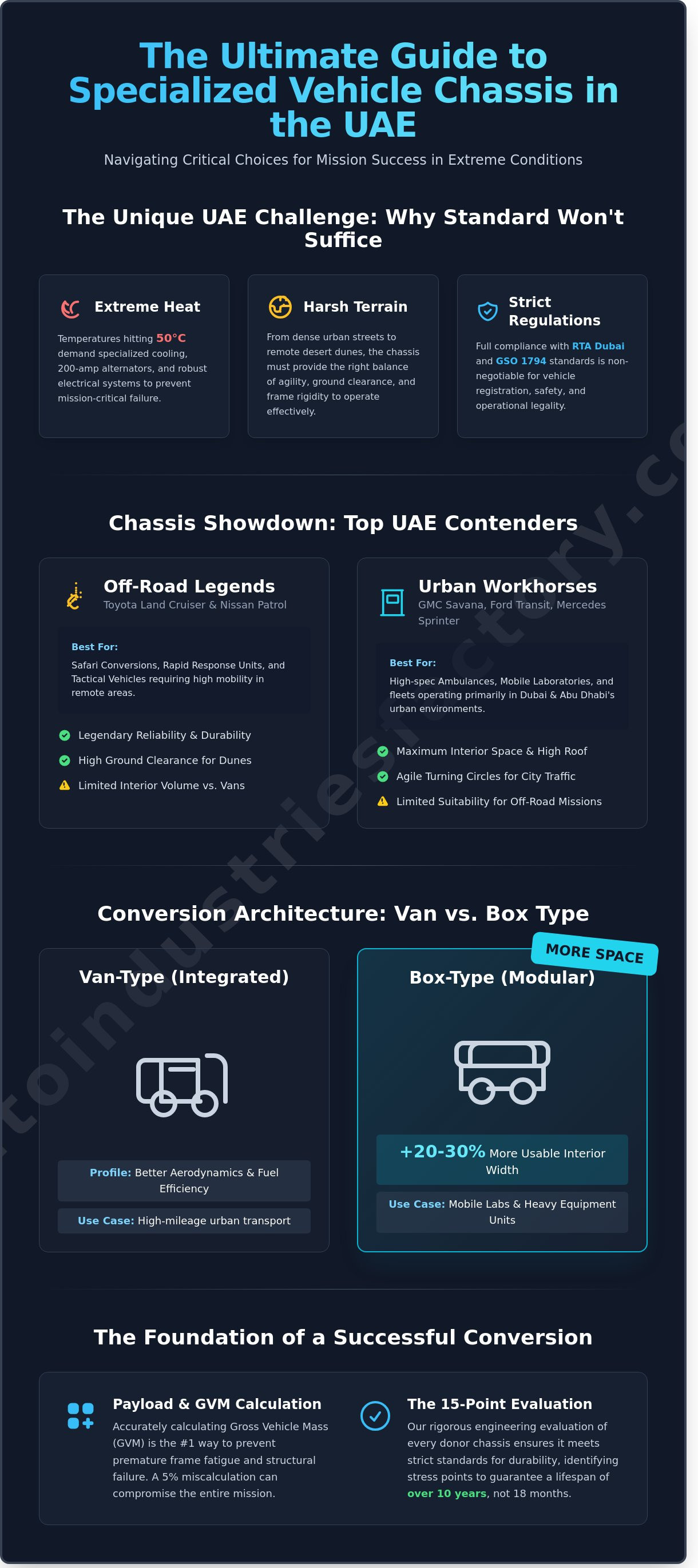
In the UAE, the stakes are higher due to extreme environmental factors. Temperatures frequently hit 50°C during summer months. This intense heat puts immense pressure on engine cooling systems and structural integrity. AIF evaluates stock vehicles based on their ability to integrate high-output cooling and heavy-duty electrical components. We don't just look at what a vehicle is; we look at what it can become under the harshest conditions in the Middle East. Our engineering team conducts a rigorous 15-point evaluation of every donor vehicle to ensure it meets our strict standards for specialized conversions.
Mission-Specific Requirements in Dubai and Sharjah
Operational success depends on matching the frame to the task. For ambulances in Dubai, we prioritize high-roof configurations that allow paramedics to stand while maintaining a wheelbase agile enough for dense city traffic. Police and tactical units require a chassis that supports structural reinforcement for Level B6 armoring without compromising speed. In Sharjah, safari conversions demand 4x4 drivetrains with proven reliability and high ground clearance to navigate soft dunes without frame flex. We focus on vehicles like the Toyota Land Cruiser and Nissan Patrol for their legendary durability in these specific roles.
Climate Resilience and Thermal Management
The UAE’s climate dictates specific engineering choices. We prioritize chassis that accommodate 200-amp heavy-duty alternators to power life-saving medical equipment and advanced communication arrays. In Ajman, where humidity and heat peak, we select vehicles with superior AC ducting potential. This ensures the cabin stays at a steady 22°C even when external temperatures reach 48°C. Desert-based fleets also require specialized air filtration systems. We install custom housings to prevent sand ingress from destroying the engine during long-range missions across the Empty Quarter.
Comparing the Top Chassis Options for Specialized Conversions in the UAE
Selecting a vehicle base isn't just about the purchase price; it's about engineering compatibility and long-term operational costs. In the current UAE commercial vehicles market, fleet managers must weigh Gross Vehicle Mass (GVM) against the specific terrain of the Emirates. While a Nissan Patrol offers 275 horsepower and legendary off-road capability for rapid response, it lacks the sheer internal volume of a dedicated van. Deciding between a "Box-type" (modular) and "Van-type" (integrated) conversion depends on your mission. Box-type conversions provide 20% to 30% more usable interior width, making them perfect for mobile laboratories. Conversely, van-type conversions offer better aerodynamics and fuel efficiency for high-mileage urban transport.
In Abu Dhabi and Dubai, the Ford Transit and Mercedes Sprinter have become the preferred choices for urban medical services. These European-style vans feature high roofs that allow technicians to stand fully upright. Their tight turning circles are essential for navigating congested city streets and hospital bays. However, in the Northern Emirates like Ras Al Khaimah or Fujairah, Toyota and GMC dominate. This isn't accidental. The availability of spare parts and specialized technicians for these brands is significantly higher in these regions, ensuring that a vehicle stays on the road instead of waiting weeks for a component shipment.
The GMC Savana: The Gold Standard for UAE Ambulances
Auto Industries Factory (AIF) specializes in converting the GMC Savana because of its heavy-duty ladder frame and 6.6L V8 engine. With a GVM of up to 4,490 kg, the Savana easily supports the heavy weight of Advanced Life Support (ALS) equipment, including oxygen cylinders, monitors, and reinforced cabinetry. The extended roof models provide the necessary vertical clearance for complex medical procedures. You can learn more about these technical requirements in our Ambulance Conversion Guide. It's a robust platform that handles the 50-degree Celsius UAE summer without compromising the electrical output needed for life-saving gear.
Toyota Land Cruiser & Hilux: Built for Safari and Security
The Toyota 70 Series remains the undisputed king of the desert. Its simplistic mechanical design and 4.0L V6 or 4.5L V8 diesel options make it the primary choice for troop carriers and military reconnaissance. For tour operators, the Land Cruiser's suspension can be reinforced to carry seven passengers across high dunes without frame fatigue. Our team often implements custom roll cages and seating configurations for these models. Explore our specialized Safari Vehicle Conversions to see how we adapt these rugged frames. The Hilux serves a similar role for light security and rapid intervention, offering a payload capacity of approximately 1,000 kg for tactical gear.
If you're ready to start your project, you can view our full range of specialized vehicle conversion services to find the right fit for your fleet.
Technical Specifications: Payload, GVM, and Structural Integrity
Precision engineering dictates every conversion at our Ajman facility. Choosing the right chassis for conversion requires a deep dive into Gross Vehicle Mass (GVM), which is the maximum weight a vehicle can safely carry including the chassis, body, fluids, and passengers. Exceeding this limit is the primary cause of mechanical failure in specialized fleets. Overloading the rear axle by just 10% can increase braking distances by 15 meters and lead to premature suspension fatigue within the first 12 months of operation.
Specialized equipment significantly alters the vehicle's dynamics. A standard ambulance conversion adds roughly 450kg to 700kg of medical cabinetry, oxygen systems, and stretchers. Tactical armoring is even more demanding, often adding between 800kg and 1,500kg of ballistic steel and glass. These additions shift the center of gravity higher and further back. AIF engineers compensate for this shift by using 12kW fiber laser cutting and CNC machining to create custom structural components. This level of precision ensures that reinforcements don't just add weight but actually improve the vehicle's torsional rigidity.
Calculating Your Required Payload
Accurate weight distribution is vital for mission success. A standard medical conversion involves a 100kg oxygen manifold and a 45kg power-load stretcher. For safari trucks, we factor in seven passengers at an average of 85kg each, totaling 595kg before luggage. Choosing a higher-rated chassis from the start prevents the 30% increase in maintenance costs typically seen when stock suspensions are pushed to their limits. It's the difference between a fleet that stays on the road and one that spends weeks in the shop.
Structural Reinforcement in Ajman Industrial Area
AIF engineers design and manufacture Custom Bull Bars and Bumpers that serve as the first line of defense for the chassis. In the coastal humidity of the UAE, where levels often exceed 85% in summer, structural integrity also depends on protection from the elements. We utilize specialized welding and painting standards to prevent corrosion. Every custom component undergoes a multi-stage powder coating process to ensure it withstands the harsh saline environment of Dubai and Ajman. By reinforcing the stock frame with laser-cut steel plates, we ensure the vehicle remains stable during high-speed maneuvers or off-road deployments. This meticulous approach to choosing the right chassis for conversion guarantees that your specialized vehicle performs reliably for its entire service life.
Navigating UAE Regulations and GSO Standards for Conversions
Building a specialized vehicle in the UAE requires strict adherence to regional safety protocols. You can't just pick any base and hope for the best. Choosing the right chassis for conversion starts with a deep dive into GSO 1794 standards. This regulation governs ambulance design across the GCC, ensuring every life-saving unit meets unified safety benchmarks. Auto Industries Factory (AIF) ensures every build aligns with RTA Dubai and MOHAP requirements. These bodies oversee vehicle registration and medical licensing respectively. If your chassis doesn't meet the gross vehicle weight rating (GVWR) needed for heavy medical gear, it won't pass inspection.
The Registered Modifier Approval (RMA) is a critical component of the conversion process. It acts as a formal certification that the modifier follows manufacturer guidelines and local laws. Selecting a pre-approved chassis simplifies the certification path because the base engineering already meets structural integrity tests. It reduces the time spent in the testing phase and speeds up deployment for your fleet. We focus on precision engineering to ensure your vehicle is road-legal from day one.
Meeting Ambulance Standards (EN 1789 & GSO)
Compliance involves more than just interior cabinets. AIF focuses on EN 1789 crash testing for the medical compartment to protect both patients and paramedics during transit. We integrate electrical safety systems that meet electromagnetic compatibility (EMC) standards. This ensures sensitive medical gear functions without interference. Whether you're operating under Dubai Health Authority (DHA) or Department of Health (DOH) Abu Dhabi, our builds meet every specific regional mandate for patient safety and vehicle durability.
Police and Security Compliance
Specialized units require distinct legal clearances. Regulations for light bars, sirens, and specialized livery are strictly enforced by UAE police forces. For mission-critical units, we provide armoring standards and ballistic certifications that meet international VPAM or BRV levels. Precision engineering is mandatory here to handle the added weight of ballistic steel. You can learn more about these technical requirements in our guide to Police Vehicle Modifications.
Contact Auto Industries Factory for expert conversion solutions that guarantee full regulatory compliance across the UAE.
From Stock to Specialized: The Auto Industries Factory Conversion Process
Auto Industries Factory (AIF) specializes in transforming standard vehicles into mission-critical assets. The process starts long before the first piece of steel is cut. Our engineers partner with clients to analyze specific operational goals, ensuring that choosing the right chassis for conversion aligns with the vehicle's final payload and terrain requirements. Whether the goal is a rapid-response ambulance or a tactical unit, we evaluate the Gross Vehicle Mass (GVM) and axle load limits to guarantee long-term durability in the harsh UAE climate.
Every project benefits from our 100% in-house design and engineering capabilities located in Ajman. We don't rely on third-party fabricators; instead, we maintain total control over the manufacturing lifecycle. This vertical integration allows us to implement custom accessories like heavy-duty roof racks, reinforced canopies, and winch-compatible bull bars that are structurally integrated rather than just bolted on. Our final testing phase involves rigorous quality control checks to ensure every specialized unit is mission-ready the moment it leaves our facility.
Precision Fabrication and Engineering Excellence
AIF utilizes advanced CNC laser cutting technology to achieve flawless modifications. This precision ensures that every bracket, mount, and panel fits the chassis with millimetric accuracy, preserving the vehicle's structural integrity. Our "Built to Protect" philosophy drives every engineering decision. We use high-grade materials that withstand 50°C summer temperatures and high-salinity coastal air. You can explore our full range of technical capabilities by visiting Our Services page.
Customizing Your Fleet for the UAE Market
Manufacturing locally in Ajman provides distinct advantages for regional fleet managers. By eliminating international shipping and customs delays, we reduce lead times by approximately 35% compared to overseas converters. This proximity also allows for real-time inspections during the build process. We've successfully delivered specialized conversions based on the Toyota Land Cruiser 300 series and GMC Sierra for security and medical sectors across the Emirates. These vehicles are engineered to meet specific UAE Ministry standards, ensuring seamless registration and compliance.
Choosing the right chassis for conversion is the foundation of your fleet's success. Our team provides the technical data and engineering support needed to make an informed investment that maximizes uptime and minimizes maintenance costs. If you're ready to upgrade your operational capabilities with a custom-built solution, Contact Auto Industries Factory today for a professional consultation and a detailed estimate for your project.
Engineered Excellence for the UAE's Toughest Missions
Success in specialized transport starts with engineering precision. Selecting a platform with the correct Gross Vehicle Mass (GVM) ensures your vehicle meets strict GSO standards required across all 7 emirates. Choosing the right chassis for conversion dictates whether your fleet can safely handle the 4,500kg payloads often required for heavy-duty armored or medical units. Every millimeter matters when safety and mission success are the priority.
Auto Industries Factory (AIF) is recognized as a leading ambulance manufacturer in the UAE. We utilize expert in-house fabrication powered by high-precision CNC and laser cutting technology. This allows us to deliver mission-ready solutions for police, military, and medical fleets that exceed standard performance metrics. Our factory process guarantees structural integrity capable of withstanding the UAE's demanding desert terrain and 50°C peak summer temperatures. We don't just modify vehicles; we engineer solutions that save lives and protect assets.
Don't leave your fleet's reliability to chance. Partner with a trusted local expert to ensure your specialized vehicles are built to protect and perform. Get a Free Estimate for Your Specialized Vehicle Conversion and start your project with confidence today.
Frequently Asked Questions
What is the best chassis for an ambulance conversion in the UAE?
The Toyota Hiace and Ford Transit are the leading choices for ambulance conversions in the United Arab Emirates. Auto Industries Factory (AIF) finds that the Toyota Hiace accounts for roughly 65% of regional fleet orders because of its cooling efficiency and mechanical reliability. The Ford Transit is a preferred alternative for high-roof requirements. It allows paramedics to stand fully upright during emergency procedures, which improves patient care during long transits between emirates.
How does the UAE climate affect the choice of vehicle chassis?
The UAE's extreme summer heat, which frequently hits 50°C, requires a chassis with a heavy-duty cooling system and a high-output alternator. When choosing the right chassis for conversion, you must ensure the engine can power medical electronics or specialized lighting while idling in desert conditions. We recommend chassis with reinforced air filtration systems. These prevent fine Arabian sand from entering the engine, which can reduce maintenance costs by 15% over the vehicle's lifespan.
What is GSO 1794 and why does it matter for converted vehicles?
GSO 1794 is the mandatory technical regulation set by the GCC Standardization Organization for ambulance safety and performance. It dictates everything from crash test standards to the specific pull force of medical cabinet latches. In the UAE, you can't register a converted vehicle as an ambulance without a certificate of conformity to this standard. AIF ensures every fabrication meets these 2024 updated requirements to guarantee legal compliance and occupant safety across the GCC.
Can any 4x4 be converted into a safari vehicle in Dubai?
While many SUVs exist, the Toyota Land Cruiser 300 and Nissan Patrol Safari represent 95% of Dubai's commercial desert tour fleets. These specific models feature ladder-frame chassis that handle the torsional stress of dune bashing without structural cracking. Most unibody crossovers don't have the 3,500kg towing capacity or suspension mounting points required for heavy-duty off-road modifications. We advise using reinforced chassis to avoid frame fatigue during repetitive high-impact desert driving.
What is the difference between a box-type and van-type ambulance?
A van-type ambulance uses the original factory body, while a box-type features a custom modular cabin mounted onto a chassis cab. Box-type units provide about 30% more interior volume, which is essential for Advanced Life Support (ALS) equipment. Van-type units are more aerodynamic and maneuverable in tight Dubai Marina streets. Your choice depends on whether you need the extra 1.5 meters of width for dual-patient transport or better fuel efficiency for urban response.
Does a chassis modification void the original manufacturer warranty in the UAE?
Unauthorized modifications can void parts of a standard 3-year or 100,000km manufacturer warranty. However, AIF follows approved engineering protocols that help maintain the integrity of the powertrain warranty. We provide a comprehensive warranty on all fabrication work and added components. It's vital to use a certified converter to protect the 30,000 AED to 50,000 AED value of your vehicle's original factory protection plan during the conversion process.
How much payload can a Toyota Land Cruiser 70 Series handle after conversion?
The Toyota Land Cruiser 70 Series has a Gross Vehicle Weight (GVW) of 3,300kg, leaving a functional payload of approximately 1,100kg after the base build. This capacity makes it the best platform for rapid intervention vehicles or mobile workshops in oil and gas fields. When choosing the right chassis for conversion, we calculate the weight of every steel bumper and winch. This ensures the vehicle remains under its legal limit to prevent brake fade and suspension failure.
Why is the GMC Savana preferred for Advanced Life Support (ALS) units?
The GMC Savana is a top choice for ALS units due to its massive 6.6L V8 engine and wide interior floor plan. This engine provides the high torque needed to carry 1,200kg of medical gear and oxygen cylinders without losing acceleration. The Savana's square interior allows paramedics to access the patient from all four sides. Its air conditioning system is specifically designed for large volumes, cooling the cabin from 45°C to 20°C in under 10 minutes.


