
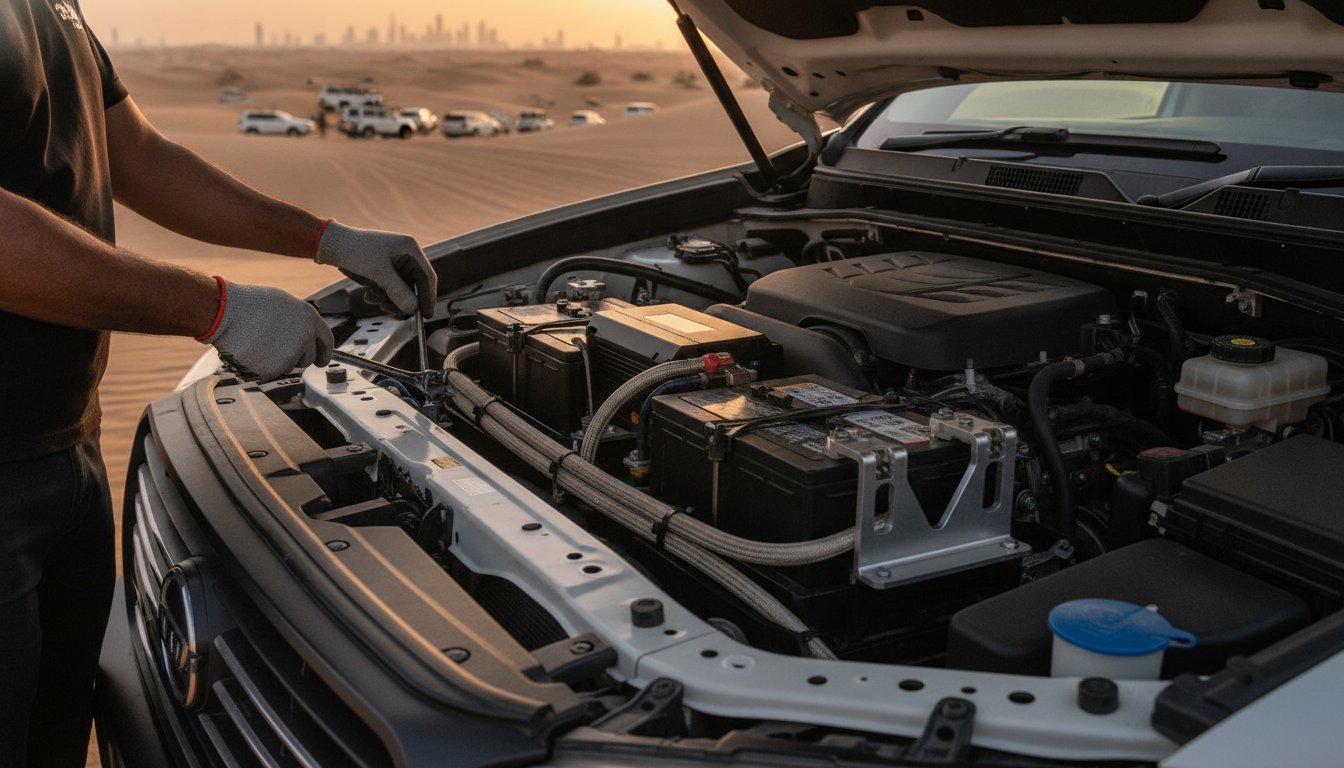
Will your vehicle's electrical system survive a midday rescue operation in the UAE desert? When ambient temperatures hit 50°C, a standard battery setup isn't just insufficient; it's a liability. For professionals managing safari fleets or emergency response units, a professional dual battery system installation Dubai is an engineering necessity rather than a luxury. You've likely seen the results of poorly wired DIY kits, from melted insulation to catastrophic vehicle fires that compromise mission-critical operations.
We understand that reliability is your primary concern when operating in extreme environments. You need a secondary power source that integrates seamlessly with complex vehicle electronics without risking the primary starter. This expert guide provides the technical blueprint for installing dual battery systems that withstand the harshest conditions in the region. We'll cover everything from thermal protection standards to high-output management, ensuring your equipment stays powered when failure isn't an option.
Key Takeaways
- Understand why isolating your secondary power circuit is vital for protecting the starter battery while powering mission-critical equipment like medical devices or safari refrigeration.
- Master the technical requirements for a professional dual battery system installation Dubai that utilizes thermal shielding to survive 50°C desert heat.
- Learn how to choose between AGM and Lithium chemistries based on high-heat stability and the functional differences between DC-DC chargers and voltage sensitive relays.
- Discover the importance of custom-fabricated mounting brackets and strategic cable routing to prevent vibration damage and electrical fires during off-road operations.
- Explore how precision engineering and laser-cut components ensure seamless electrical integration for specialized ambulance and safari vehicle conversions.
Why a Dual Battery System is Essential for Dubai’s Extreme Environments
A dual battery system is a specialized electrical configuration that isolates a secondary power circuit from the vehicle's primary starter battery. This setup ensures that auxiliary equipment draws power only from the secondary unit, leaving the Automotive battery fully charged and ready to crank the engine. In the UAE, where ambient temperatures frequently exceed 50°C, this separation isn't just a convenience; it's a safeguard against total system failure. High heat accelerates the chemical degradation of battery plates and increases fluid evaporation, meaning a single battery under heavy load will fail much faster than in cooler climates.
For mission-critical operations like ambulance conversions, the secondary circuit is what keeps life-saving medical monitors and climate control systems running during stationary patient care. Without a professional dual battery system installation Dubai, the risk of a "dead-in-desert" scenario becomes a reality for off-road enthusiasts and fleet managers alike. Relying on a single power source for both ignition and high-draw equipment is a design flaw that the harsh Arabian terrain will eventually exploit.
To better understand the technical layout and benefits of these systems, watch this expert breakdown of 12V setups:
The Problem with Single Battery Setups in the Desert
Standard factory batteries aren't designed for the sustained discharge required by winches, high-intensity LED light bars, or heavy-duty air compressors. Using these accessories on a single-battery vehicle can drain the voltage below the starting threshold in as little as ten minutes. Furthermore, when you finally jump-start the vehicle, the alternator faces extreme thermal stress. It must work at maximum capacity to bulk-charge a depleted battery while battling the engine bay's heat, often leading to premature alternator burnout and costly roadside repairs.
Specialized Applications: From Safari to EMS
Reliability is the cornerstone of police vehicle modifications, where communication arrays and signal boosters must remain active 24/7. In the tourism sector, safari operators traversing the Liwa Desert depend on secondary power to maintain consistent refrigeration for supplies. A dedicated secondary battery ensures that these high-stakes electrical loads don't compromise the vehicle's mobility, allowing for seamless operation in the most demanding environments on earth.
Engineering the Setup: Choosing the Right Components for the UAE
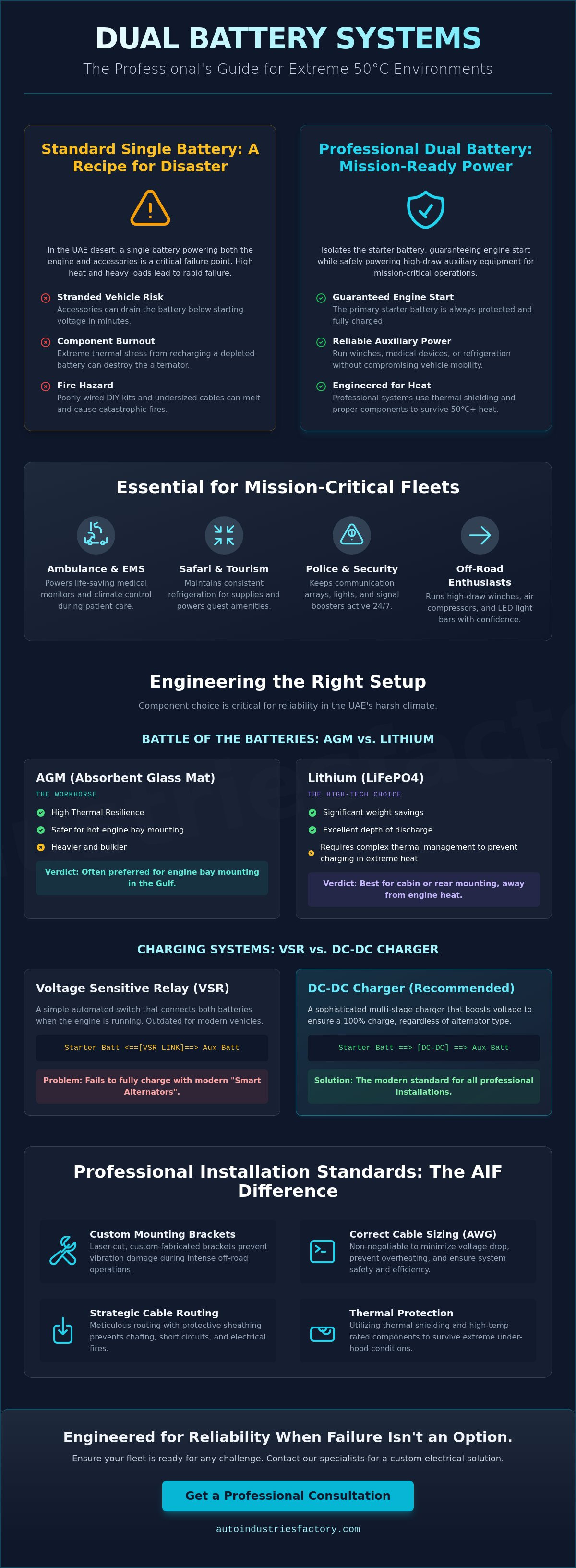
Selecting components for the UAE requires a shift from standard automotive thinking. A successful dual battery system installation Dubai hinges on matching chemistry to the operational environment. While Lithium (LiFePO4) provides exceptional depth of discharge and weight savings, high-quality AGM units are often preferred for engine bay mounting because of their thermal resilience. Lithium batteries typically require sophisticated internal management to prevent charging when internal temperatures exceed safe thresholds, a common occurrence in the Gulf.
The technical divide between Voltage Sensitive Relays (VSR) and DC-DC chargers is significant for modern fleets. Traditional VSRs are simple switches that connect batteries when the alternator is active. However, modern Euro 6 and smart alternators often drop output voltage to levels that cannot fully charge a secondary battery. A DC-DC charger is essential here; it acts as a dedicated multi-stage charger that boosts voltage to ensure your auxiliary power is always at 100% capacity regardless of the alternator's behavior.
Proper cable sizing is the backbone of system safety. Using the correct American Wire Gauge (AWG) is non-negotiable to minimize voltage drop over long runs to the rear of a vehicle. Undersized wiring creates resistance and heat, which compromises efficiency and can lead to electrical fires. Fleet managers should ensure all wiring meets rigorous benchmarks, referencing OSHA Motor Vehicle Standards to maintain operational safety and compliance across their specialized vehicles.
Deep Cycle vs. Dual Purpose Batteries
Deep cycle batteries are engineered to provide consistent power over long periods, making them the industry standard for sustained auxiliary draw. Unlike starter batteries, they handle repeated deep discharges without internal damage. For those tackling corrugated desert tracks and high-speed dune bashing, we recommend units with reinforced casing and high vibration resistance to prevent internal plate shedding and premature failure.
Advanced Battery Management Systems (BMS)
Modern setups utilize Bluetooth-enabled Battery Management Systems (BMS) for real-time monitoring via smartphone or in-cab displays. This transparency allows operators to track voltage and current draw instantly. For long-term stationary use, integrating PV panels onto custom roof racks provides a sustainable charge without idling the engine. For mission-critical reliability, you can consult with our engineers to integrate these components into your next specialized vehicle modification.
Professional Installation Standards for Specialized Vehicles
Precision engineering defines a professional dual battery system installation Dubai. In the UAE, the combination of extreme vibration and relentless heat makes standard plastic trays and zip-tie cable management a liability. We treat the secondary electrical system as a structural component, ensuring it meets the same rigorous standards as the vehicle's drivetrain. A failure in the desert isn't just an inconvenience; it's a threat to mission-critical operations.
Our installation protocol follows four essential steps. First, we use custom bracket fabrication to create reinforced mounts. These trays are designed to withstand high-G impacts during dune bashing or rapid response maneuvers. Second, we apply thermal shielding. All cables are routed away from high-heat zones like exhaust manifolds and protected with heat-reflective sleeving. Third, we integrate circuit protection by placing high-amp fuses or manual-reset circuit breakers near both battery terminals. Finally, we program the charging profile. This step ensures the DC-DC charger delivers the exact voltage required by your battery's specific chemistry, preventing overcharging in high ambient temperatures.
Mounting Solutions: Engine Bay vs. Canopy
Under-bonnet mounting is common but places the battery under extreme thermal stress. For high-capacity setups, we often recommend utilizing metal canopies on safari trucks and fleet vehicles. A rear-mounted position allows for larger Lithium (LiFePO4) banks in a more controlled environment. This separation protects the sensitive internal electronics of the battery from the 80°C+ temperatures often found inside a working engine bay.
Wiring and Grounding Best Practices
Inadequate grounding is the leading cause of electrical gremlins in modified vehicles. We prioritize direct chassis grounding to handle the massive current draw of accessories like winches and heavy-duty compressors. Every electrical run is encased in fire-retardant split loom tubing. This professional-grade finish prevents abrasion against the vehicle's frame and ensures long-term reliability in abrasive desert sand. To ensure your fleet is equipped for the harshest conditions, you should explore our specialized vehicle modification services for a fail-safe power solution.
Custom Electrical Solutions by Auto Industries Factory
Auto Industries Factory bridges the gap between theoretical engineering and rugged, real-world application. A professional dual battery system installation Dubai isn't just about connecting wires; it's about structural integration. We utilize in-house design and precision laser cutting to manufacture custom battery trays and control panels that fit the exact geometry of your vehicle's chassis. This level of customization is essential for complex safari vehicle conversions where space is at a premium and reliability is non-negotiable.
Our work meets the highest regional safety standards required for government and medical fleet upfitting. We don't just install; we validate. Every system undergoes comprehensive testing, including load bank analysis to simulate peak demand and thermal imaging of all connections. This process identifies potential hot spots before the vehicle ever leaves the shop, ensuring your secondary power source remains fail-safe under the most intense mission-critical loads.
In addition to electrical reliability, specialized fleets operating in high-heat environments depend on premium engine protection. Many of our clients optimize their maintenance cycles through Wholesale and Bulk Product Sales, securing the high-quality lubricants necessary to keep heavy-duty engines running smoothly alongside their new power systems.
Why Choose In-House Fabrication?
Generic, one-size-fits-all kits often fail when subjected to the extreme vibrations of the UAE's dunes. Our custom-built solutions are designed to integrate perfectly with other modifications, such as custom bull bars and specialized lighting mounts. This unified approach to vehicle modification ensures that your electrical architecture supports your hardware without compromising the vehicle’s structural integrity or aesthetic finish.
Get a Professional Consultation in Ajman & Dubai
We take a solution-oriented approach to every project. During the design phase, our engineers conduct a thorough assessment of your fleet's specific power requirements to determine the optimal battery chemistry and charging profile. Whether you're managing an emergency response unit or a high-end safari fleet, we provide the engineering precision your operation demands. Contact Auto Industries Factory LLC today to schedule a technical consultation at our facilities in Ajman or Dubai.
Engineered Power for the Arabian Frontier
Reliability in the UAE’s desert isn't left to chance; it's the result of precise engineering and rigorous thermal management. By prioritizing multi-stage DC-DC charging profiles and custom-fabricated mounting solutions, you ensure your fleet remains operational even when ambient temperatures peak. A professional dual battery system installation Dubai protects your primary starter while providing a fail-safe power source for specialized equipment and high-draw electronics.
Auto Industries Factory LLC brings technical mastery to every project. As an ISO-certified fabrication facility, we specialize in high-stakes ambulance and military conversions where electrical failure is not an option. Our in-house CNC and laser cutting capabilities allow us to build robust, vibration-resistant electrical architectures tailored to your specific vehicle platform. Don't risk your mission or your safety on generic kits that can't handle the relentless Arabian heat.
Contact Auto Industries Factory for a Custom Vehicle Electrical Quote and equip your fleet with a power solution built for the extreme. We look forward to engineering your next mission-critical vehicle conversion.
Frequently Asked Questions
Do I need a dual battery system for occasional off-roading in Dubai?
You need a dual battery system if you plan to run a 12V fridge, auxiliary lighting, or heavy-duty compressors while the engine is off. Desert heat significantly reduces a battery’s reserve capacity. Relying on a single starter battery for both ignition and accessories increases the risk of being stranded in remote areas like the Liwa Desert.
Will installing a second battery affect my vehicle’s alternator lifespan?
A correctly engineered setup won't damage your alternator. By using a DC-DC charger, the system regulates the current draw to safe, manageable levels. This prevents the alternator from overworking and overheating, which often happens in a professional dual battery system installation Dubai when using inferior, non-regulated isolation switches.
What is the best battery type for the high heat of the UAE?
High-quality AGM batteries are the preferred choice for under-bonnet installations because of their superior thermal resilience. If the battery is mounted in a rear canopy or cabin, Lithium (LiFePO4) is the better option. Lithium provides more usable power and faster charging cycles but requires protection from the extreme temperatures found inside an engine bay.
Can I charge my dual battery system using solar panels in the desert?
Solar integration is an excellent solution for maintaining power during extended stationary periods in the desert. Most specialized chargers include a dedicated solar input with a built-in regulator. This setup is particularly effective in the UAE, where high solar irradiance ensures your secondary battery stays charged without the need to idle the vehicle's engine.
How long does a professional dual battery installation take in Dubai?
A standard professional dual battery system installation Dubai usually requires one to two business days. This timeframe allows for custom bracket fabrication, secure cable routing, and rigorous load testing to ensure the system is fail-safe. For complex fleet conversions involving multiple auxiliary systems, the process may take longer to meet our specific engineering standards.


