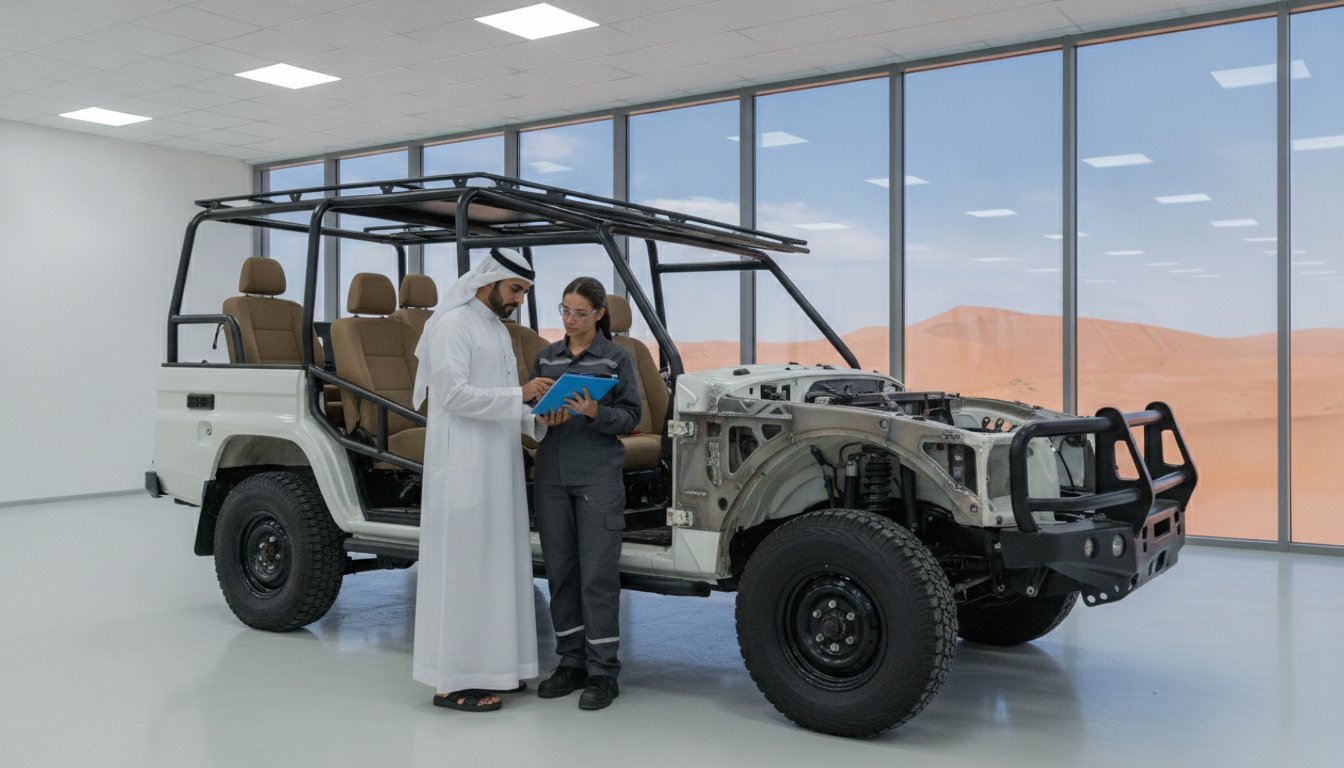
A single structural failure in the red dunes doesn't just cost a tour. It can cost a reputation, a commercial license, and up to AED 50,000 in RTA fines. You understand that a standard factory 4x4 isn't engineered for the relentless heat and mechanical stress of daily commercial desert operations. High fleet downtime due to poor fabrication or overheating engines is a risk no professional operator can afford. Mastering a safari vehicle conversion UAE authorities will approve requires a precise blend of heavy-duty metalwork and strict regulatory compliance.
This guide provides the technical roadmap to building a durable, high-performance fleet that prioritizes passenger safety and 360-degree views. You'll learn the essential fabrication processes needed to meet Cabinet Resolution No. (117) of 2024 and mandatory internal Roll-Over Protection System (ROPS) standards. We will analyze the engineering requirements for suspension lifts, exhaust noise limits, and chassis reinforcement. By the end of this article, you'll have the expertise to reduce maintenance costs through superior fabrication and ensure your fleet remains fully compliant with RTA and MoIAT regulations through 2026 and beyond.
Key Takeaways
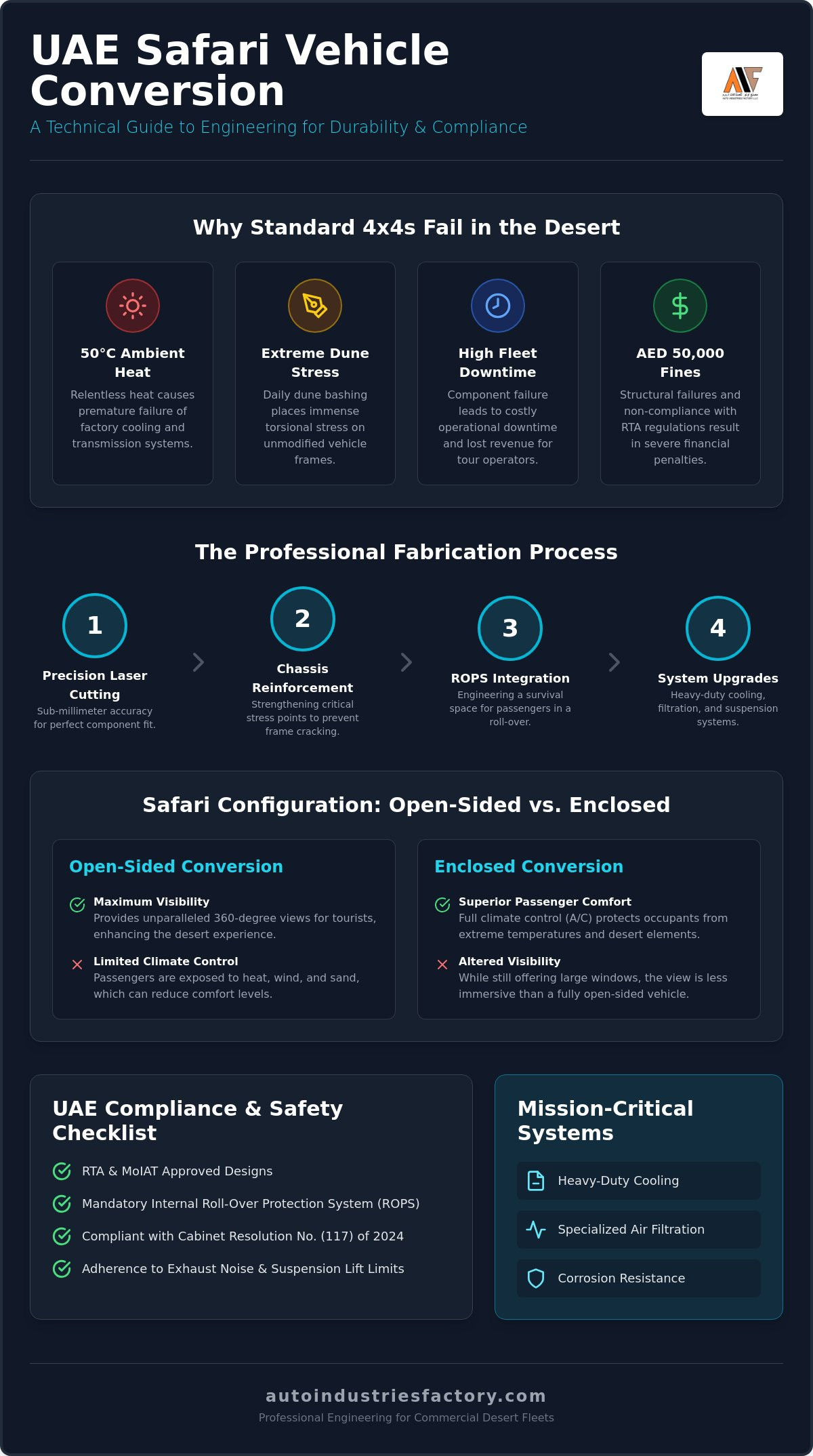
- Understand why a professional safari vehicle conversion UAE requires a total structural reimagining to withstand 50°C heat and extreme dune bashing.
- Learn how precision laser cutting and chassis reinforcement create the foundation for a durable, high-performance desert fleet.
- Compare open-sided and enclosed configurations to balance maximum tourist visibility with superior climate control and passenger comfort.
- Master the RTA and MoIAT approval process to ensure your modified vehicles meet mandatory safety standards and avoid costly fines.
- Discover how modular interior designs and high-quality fabrication significantly reduce long-term maintenance costs and operational downtime.
Defining the Safari Vehicle Conversion: Why UAE Standards Demand Professional Engineering
A professional safari vehicle conversion UAE is a total structural and mechanical reimagining of a 4x4 chassis. It goes far beyond cosmetic upgrades or simple accessories. We treat the base vehicle as a raw platform that requires significant reinforcement to handle the specialized demands of the desert. Standard factory SUVs are designed for paved roads and occasional light trails. They aren't built to survive the relentless stress of 50°C ambient heat and the high-torque requirements of daily dune bashing. Without professional modification, factory components like transmission coolers, suspension bushings, and body mounts will fail prematurely. This leads to costly downtime for tour operators.
In the UAE tourism and expedition sectors, every build must be mission-specific. A vehicle used for luxury desert dinners has different engineering requirements than one used for extreme dune expeditions. At Auto Industries Factory, we build around the concept of "Rugged Reliability." This means every weld, bracket, and cooling line is engineered to exceed the original manufacturer's specifications. We transform a standard off-road vehicle into a specialized tool that can withstand thousands of kilometers of sand travel without structural fatigue.
To better understand the scale of this engineering process, watch this detailed conversion breakdown:
The Difference Between Commercial and Private Safari Specs
Commercial tour trucks carry high passenger loads, which drastically shifts the vehicle's center of gravity. We adjust seating configurations to maintain balance and prevent roll-over risks during steep descents. Private expedition vehicles might prioritize storage and range, but commercial fleets require heavy-duty secondary cooling systems. These systems ensure the engine and transmission don't overheat while idling in the sun or climbing soft dunes under full load. Precision engineering ensures these modifications don't compromise the vehicle's handling or safety ratings.
Environmental Challenges for UAE Safari Fleets
The UAE desert presents unique environmental threats. Fine desert sand acts as an abrasive that can quickly clog standard air intakes and destroy engine internals. We integrate specialized filtration and snorkel systems to protect the heart of the vehicle. Coastal desert operations also face salt air and high humidity, which accelerate metal corrosion. Our fabrication process includes corrosion-resistant treatments on all custom metalwork to ensure long-term durability. For a deeper look at these technical requirements, read our Ultimate Guide to Safari Vehicle Conversions.
The Technical Fabrication Process: From Chassis Reinforcement to ROPS
Engineering a fleet for the desert requires more than just bolting on accessories. A high-quality safari vehicle conversion UAE relies on industrial-grade fabrication that starts at the chassis level. We utilize in-house laser cutting and CNC machining to produce components that meet exact tolerances. This precision ensures that every bracket and support beam fits perfectly, eliminating the vibration-induced fatigue that plagues lower-quality builds. When components are cut to sub-millimeter accuracy, the structural integrity of the entire vehicle remains uncompromised.
Chassis reinforcement is our non-negotiable first step. When a vehicle carries seven passengers across shifting dunes, the frame undergoes immense torsional stress. We strengthen critical stress points to prevent frame cracking or bending. This foundation allows us to integrate a robust Rollover Protection System (ROPS). Our ROPS designs are engineered to maintain the survival space for passengers in the event of a roll. This engineering aligns with the UAE National Standards for Modified Vehicles, ensuring both safety and legal compliance for commercial operators.
Beyond the internal cage, we integrate custom-fabricated metal canopies and body panels. These are designed to replace factory glass or plastic sections that are prone to failure in extreme heat. We use a combination of high-grade steel for structural components and lightweight aluminium for non-load-bearing panels. This hybrid approach keeps the vehicle's weight within safe limits while providing a shell that can withstand minor impacts and the abrasive nature of sand-blasting winds.
Advanced Metalwork and Welding Standards
We use specialized welding techniques to prevent structural fractures. Standard welds often fail under the high-frequency vibrations of off-road travel. Our team utilizes TIG and MIG welding processes tailored to the specific alloy being used. This level of detail extends to our Custom Bull Bars and Bumpers, which provide essential front-end protection. These components are designed to absorb energy during impact, protecting the radiator and engine from terrain-induced damage.
In-House Design and Prototyping
Every project begins in our CAD department. We calculate weight distribution and center of gravity before the first piece of steel is cut. This data-driven approach prevents the top-heavy handling common in amateur conversions. Having all fabrication under one roof allows for total quality control at every stage. CNC machining ensures 100% part interchangeability for fleet maintenance, allowing operators to swap damaged components without custom fitting. You can explore our specialized conversion services to see how we maintain these engineering standards across every build.
Evaluating Safari Configuration Types: Open-Sided vs. Enclosed Conversions
Choosing the right configuration for a safari vehicle conversion UAE fleet is a strategic decision that impacts both guest satisfaction and operational overhead. The two primary paths are open-sided builds and enclosed conversions. Open-sided vehicles provide the 360-degree panoramic views that tourists expect for photography and wildlife spotting. In contrast, enclosed builds offer maximum climate control. In the UAE's extreme climate, AC performance is a critical factor for luxury tour operators who prioritize passenger comfort during the peak heat of the day. For these high-end applications, an "Extended Roof" modification is often integrated to increase head space and allow for more efficient airflow ducting.
Beyond standard tourism, we engineer specialized "Hunting" conversions for private and military clients. These builds often feature elevated seating platforms and specialized equipment mounts that require a complete recalibration of the vehicle's suspension and balance. Selecting the correct configuration depends on your specific operational terrain. If your tours involve high-speed travel across soft dunes, a lightweight open-sided build might be preferable. For long-distance desert expeditions where dust ingress and heat fatigue are concerns, a fully enclosed and insulated cabin is the superior choice.
The Open-Sided Advantage for UAE Tourism
Removing factory side panels and roof sections compromises a vehicle's torsional rigidity. To restore this strength, we engineer heavy-duty roll cages that serve as both safety structures and aesthetic frame elements. These designs are developed to meet SAE International engineering standards, ensuring the chassis won't flex or warp under the intense mechanical stress of dune bashing. We also integrate weather protection solutions, such as high-tensile clear PVC panels or roll-down canvas. These allow operators to quickly seal the cabin during a sandstorm without sacrificing the immersive experience for the guests.
Platform Selection: Land Cruiser vs. Hilux
The choice of base platform dictates the limits of your conversion. We primarily work with two industry leaders:
- Toyota Land Cruiser (LC70): This is the gold standard for rugged, no-nonsense desert builds. Its solid axles and high payload capacity make it the ideal candidate for heavy, enclosed conversions and long-range expeditions.
- Toyota Hilux: The Hilux offers an excellent balance of utility and durability. It's a cost-effective platform for large-scale fleet conversions where ease of maintenance and fuel efficiency are higher priorities than luxury prestige.
Compliance and Safety: Meeting UAE National Standards for Modified Vehicles
Operating a commercial fleet across the Emirates requires more than just mechanical capability; it demands total legal compliance. A safari vehicle conversion UAE must adhere to federal safety regulations to ensure it is road-legal from Abu Dhabi to Ras Al Khaimah. Every modification we perform is designed to pass the rigorous technical inspections mandated by the Ministry of Industry and Advanced Technology (MoIAT) and the Roads and Transport Authority (RTA). Failure to meet these standards can result in vehicle impoundment and fines reaching up to AED 50,000. Working with a factory that understands these national guidelines is the only way to protect your investment.
Ensuring your modified vehicle is road-legal follows a strict 5-step engineering and administrative process:
- Technical CAD Review: Pre-approval of the modification plan based on structural engineering data.
- Certified Fabrication: All work must be completed in an ESMA-certified workshop using approved materials.
- Engineering Report Generation: Compiling material strength certificates and welding inspections.
- Technical Inspection: A physical assessment by the RTA to verify the integrity of the ROPS and chassis.
- Registration Update: Finalizing the vehicle's Mulkiya to reflect its modified status.
Navigating the RTA Approval Process
The RTA requires detailed documentation for every major structural change, especially for open-sided conversions. We handle the technical documentation process by providing the necessary CAD drawings and material specifications that inspectors require. This includes verifying that any suspension lift does not exceed the 50mm limit set for off-road vehicles. All seating and seatbelt anchor points must be secured directly to the reinforced chassis or the internal roll cage structure rather than the floor pan to meet national safety standards.
Safety Systems Integration
Commercial safari trucks must be equipped with specialized safety hardware that goes beyond standard 4x4 requirements. We integrate automatic fire suppression systems in the engine bay and clearly marked emergency exits for enclosed builds. High-visibility lighting and long-range communication arrays are also essential for desert safety and coordination. Our experience in Police Vehicle Modifications provides a direct crossover in safety engineering, ensuring your safari fleet meets the same mission-critical standards as law enforcement vehicles. If you need a fleet that is both high-performing and fully compliant, you can request a technical consultation for your conversion project today.
Maximising Fleet Longevity through Custom Fabrication Solutions
High-quality fabrication is the most effective way to protect your bottom line. In the UAE desert, vehicles don't just wear out; they suffer from structural fatigue caused by constant high-frequency vibrations and extreme thermal expansion. A standard safari vehicle conversion UAE build often fails because off-the-shelf components aren't designed for these specific stresses. By utilizing custom fabrication, we eliminate the weak points found in mass-produced parts. Every bracket, mount, and reinforcement is engineered to survive years of service rather than just a single season. This proactive engineering approach, paired with sourcing durable tires from specialists like Partner Tires, significantly reduces long-term maintenance costs and keeps your fleet operational during the peak tourism months.
Modular interior designs further enhance fleet longevity. Sand ingress is an unavoidable reality of desert operations, and it acts as an abrasive that destroys standard upholstery and flooring. We design interiors with removable, heavy-duty panels and modular seating that allow for rapid deep cleaning and easy part replacement. If a single section of the interior is damaged, you don't need to strip the entire cabin. You simply replace the specific module. This modularity ensures your vehicles always look pristine for guests while minimizing the time spent in the workshop.
Surface protection is equally critical. The UAE's UV index and salt-heavy air can degrade metal and paint in months. We apply industrial-grade protective coatings and professional-grade paint systems to every conversion. These coatings provide a barrier against rust and sun-induced fading, preserving the vehicle's professional appearance and resale value. Durable finishes ensure that your fleet remains a high-quality representation of your brand, even after hundreds of trips into the dunes.
Maintaining this professional appearance often involves expert cosmetic care; for those interested in high-standard automotive restoration and dent repair, fivestardentremoval.com offers a look at the technical precision required for such specialized services.
Custom Accessory Integration
Utility should never compromise safety or aerodynamics. We fabricate bespoke roof racks, rear bumpers, and side steps specifically for the vehicle model in your fleet. Unlike universal accessories, our integrated components are bolted directly to reinforced chassis points. This prevents the rattling and structural cracking common with generic add-ons. Our ability to handle complex, high-stakes projects is evidenced by our specialized Ambulance Conversions, where precision and reliability are life-critical requirements. We apply that same level of engineering rigor to every safari accessory we build.
The Auto Industries Factory Advantage
Auto Industries Factory serves as a strategic partner in your fleet's lifecycle management. Our facility houses complete in-house capabilities, including CAD design, laser cutting, CNC machining, and professional painting. This vertical integration allows us to maintain total control over quality and timelines. We invite you to visit our factory for a technical consultation on your next fleet project. Our team will help you design a solution that balances performance, guest comfort, and long-term durability. You can explore our full range of conversion services to see how we can transform your 4x4 fleet into a high-performance safari operation.
Securing the Future of Your Desert Fleet
Building a high-performance desert fleet requires a shift from simple modifications to precise structural engineering. You've seen how chassis reinforcement and mandatory ROPS installations protect both your passengers and your legal standing. A professional safari vehicle conversion UAE needs to balance immersive guest experiences with the mechanical resilience to survive extreme temperatures. By focusing on modular interiors and protective coatings, you can significantly extend the operational life of your Hilux or Land Cruiser platforms.
As specialists in high-stakes vehicle fabrication, we provide the technical expertise to turn these engineering standards into a tangible competitive advantage for your tour operation. Our in-house CNC and laser cutting technology ensures every component meets industrial tolerances; our team provides complete RTA compliance support to keep your vehicles on the road. Consult our engineers for your custom safari vehicle conversion to ensure your fleet is ready for the challenges of 2026. We're ready to help you build a fleet that defines engineering excellence.
Frequently Asked Questions
Is an open-sided safari vehicle legal for road use in the UAE?
Yes, open-sided vehicles are road-legal provided they possess a certified Rollover Protection System (ROPS) and clear MoIAT and RTA approvals. The conversion must be performed at an ESMA-certified workshop to ensure the structural integrity matches federal safety mandates. Without these certifications, you risk heavy fines and registration failure. Professional engineering ensures the vehicle remains stable and safe for both highway travel and off-road tours.
Which vehicle is best for a safari conversion: Toyota Land Cruiser or Nissan Patrol?
The Toyota Land Cruiser, specifically the LC70 series, is widely considered the gold standard for a safari vehicle conversion UAE fleet. While the Nissan Patrol is a capable off-roader, the Land Cruiser’s solid axles and high payload capacity make it superior for heavy-duty commercial modifications. It provides the mechanical simplicity needed for remote desert operations where electronic reliability is critical for passenger safety.
How long does a professional safari vehicle conversion take?
The timeline for a professional safari vehicle conversion UAE depends on the complexity of the build and the configuration selected. A full structural reimagining, including chassis reinforcement, ROPS installation, and custom interior work, is a phased engineering process. Each stage requires precise fabrication and quality control checks to ensure the vehicle meets the high-performance standards required for the UAE's extreme desert environment.
What is a Rollover Protection System (ROPS) and why is it mandatory?
A Rollover Protection System (ROPS) is a high-tensile steel internal cage designed to maintain passenger survival space during a rollover. It's mandatory for commercial safari operations under RTA regulations. This system compensates for the loss of structural integrity when roofs are extended or side panels are removed. It provides essential protection during high-torque dune bashing maneuvers where the risk of a rollover is highest.
Can you convert an existing 4x4, or do I need to buy a new one?
You can convert both brand-new and existing 4x4 vehicles. For existing vehicles, a thorough chassis and mechanical inspection is the first step to ensure the platform can handle the additional stress of a conversion. Starting with a new vehicle often simplifies the warranty process and ensures the base components have zero fatigue before the structural engineering work begins. Both options require RTA inspection upon completion.
What maintenance is required for a modified safari vehicle in desert conditions?
Desert conditions require intensive maintenance schedules focused on sand ingress and heat management. You'll need to clean or replace air filters frequently and conduct regular inspections of suspension bushings and cooling systems. High-torque driving in soft sand places extreme stress on the transmission and engine. Regular fluid checks and cooling system flushes are vital to prevent fleet downtime and ensure passenger comfort during peak heat.
Does a safari conversion affect the vehicle’s original manufacturer warranty?
Structural modifications typically void the manufacturer’s warranty on the affected components. However, professional fabrication shops often provide their own warranties on the custom metalwork and integrated systems. It's important to discuss warranty coverage with your engineering partner to ensure your investment is protected against fabrication defects or structural failures. Reputable builders stand by their craftsmanship with specific guarantees on all custom-fabricated parts.
Are custom bull bars and bumpers required for RTA compliance?
Custom bull bars and bumpers aren't strictly mandatory for registration, but they're essential for protecting the vehicle’s front end from terrain damage. If you choose to install them, they must comply with RTA guidelines regarding material type and protrusion limits. Correctly engineered bumpers protect the radiator and engine during dune impacts. This reduces the risk of catastrophic mechanical failure and keeps your fleet operational in harsh conditions.


