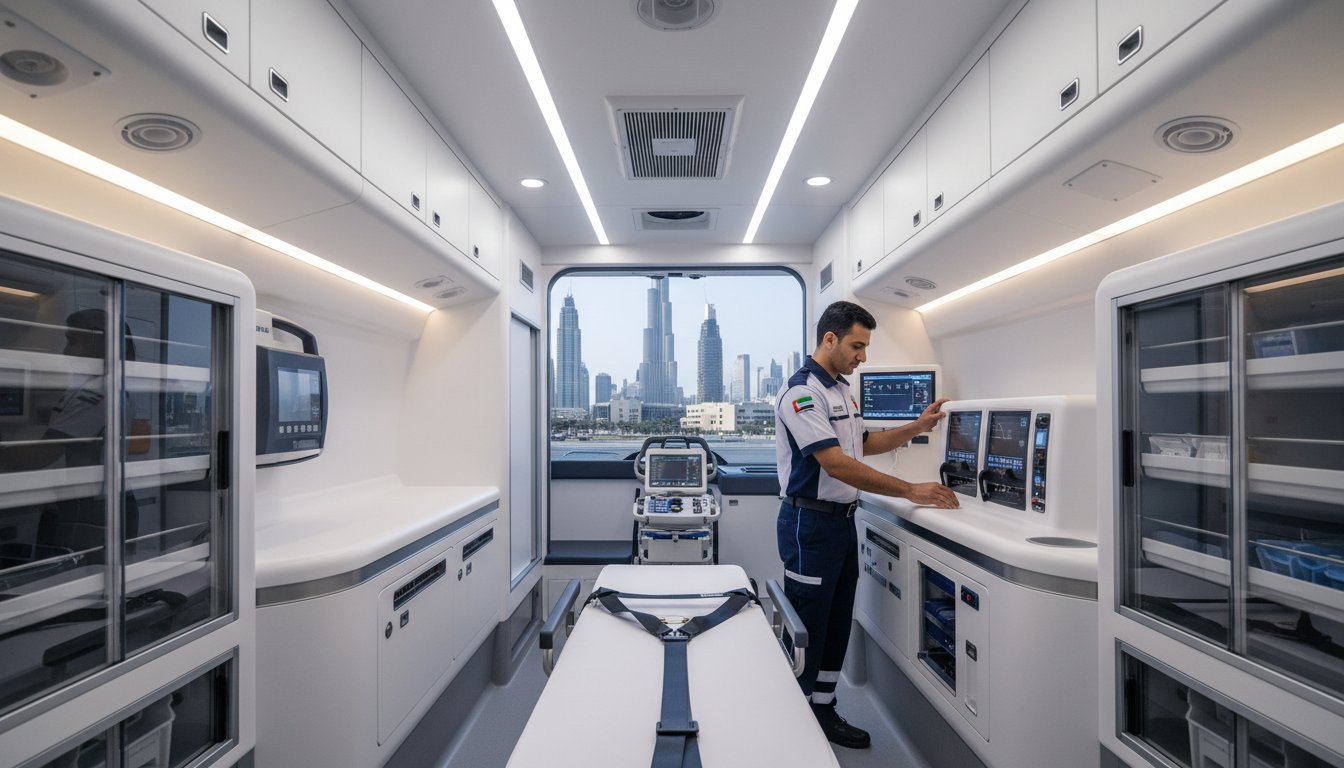
In the high-pressure environment of UAE emergency services, a single lost second during patient stabilization can change a medical outcome forever. Most fleet managers focus on engine horsepower, yet the true efficiency of a life-saving mission depends entirely on the precision of the ambulance interior design and layout. When equipment comes loose during high-speed transport or materials warp under the relentless 50°C heat of a Dubai summer, the mission is compromised before the vehicle even reaches the hospital.
We understand that meeting the rigorous 2024 DHA and MoH inspection standards is a non-negotiable requirement for your fleet. You need a setup that survives 12-hour shifts in extreme humidity while keeping every life-saving tool within a 30-centimeter reach of the medic. This guide provides the blueprint to master ergonomic, compliant, and mission-ready interiors tailored for the unique demands of the UAE medical sector. We'll examine how to optimize space for faster response times, select heavy-duty heat-resistant materials, and ensure every modification passes local health authority inspections with a 100% success rate.
Key Takeaways
- Master the essential UAE regulatory landscape by aligning your fleet with the latest 2026 RTA, DHA, and Ministry of Health standards.
- Discover how to optimize ambulance interior design and layout using "Reach Zone" ergonomics that keep life-saving tools within a medic’s immediate grasp.
- Learn why specialized material engineering and advanced HVAC integration are critical for maintaining equipment integrity in the 50°C UAE summer heat.
- Identify the most effective vehicle configurations for your specific mission, ranging from compact Type II conversions to high-capacity neonatal transport units.
- Explore how precision fabrication and professional engineering blueprints translate complex medical requirements into rugged, mission-ready emergency solutions.
Fundamentals of Ambulance Interior Design and Layout in Dubai
Auto Industries Factory (AIF) specializes in high-performance vehicle conversions where every millimeter counts. In emergency medicine, the "Logic of Space" dictates that the interior architecture must facilitate immediate clinical intervention without obstruction. Effective ambulance interior design and layout isn't just about storage; it's a life-saving blueprint that minimizes reach distances for paramedics and stabilizes patients during high-speed transport. Citing Ambulance Design Fundamentals helps us understand that functional design has evolved from simple transport to mobile intensive care units that require precise engineering.
To better understand the practical application of these spatial concepts, watch this overview of modern vehicle configurations:
For 2026, the UAE Ministry of Health (MoH) and Dubai Health Authority (DHA) have updated their requirements to align more closely with European safety benchmarks. EN 1789 is the unified European standard that specifies requirements for the design, testing, performance, and equipping of road ambulances used for the transport and care of patients across the GCC. These regulations ensure that vehicle conversions can withstand 10G impacts without internal equipment becoming hazardous projectiles. Our engineering team integrates these safety parameters into every chassis modification to ensure full compliance for municipal and private fleets.
Our facilities in Dubai and Ajman provide a critical logistical edge for fleet maintenance and rapid deployment. Local fabrication ensures that fleet managers don't face months of downtime waiting for imported components or specialized repair parts. AIF provides these specialized fabrication solutions directly from our workshops, allowing for custom modifications that meet the specific heat-load demands of the UAE climate, where ambient temperatures frequently exceed 45 degrees Celsius.
The Triad of Ambulance Design: Safety, Access, and Hygiene
AIF utilizes CNC-machined internal frames because they offer superior structural integrity compared to traditional welded setups. These frames survive the rigors of UAE road conditions, including frequent speed humps and off-road desert responses. Our ambulance interior design and layout prioritizes 360-degree patient access, allowing Advanced Life Support (ALS) teams to manage airways and administer IVs from multiple angles simultaneously. We select non-porous, medical-grade GRP (Glass Reinforced Plastic) surfaces to ensure compliance with international infection control protocols and easy decontamination.
Regulatory Landmarks for UAE Fleet Managers
Navigating the differences between DHA and Abu Dhabi Department of Health (DoH) is vital for regional compliance. While DHA focuses heavily on rapid-response urban layouts, DoH often requires specific long-distance stabilization features for cross-emirate transport. Mandatory mounting points for 10-liter oxygen cylinders and heavy cardiac monitors must be integrated into the vehicle's structural chassis, not just the interior skin. Aligning with MoH 2026 standards ensures your fleet remains operational as regional safety regulations tighten across the Emirates.
Maximizing Ergonomics: The Science Behind Efficient EMS Layouts
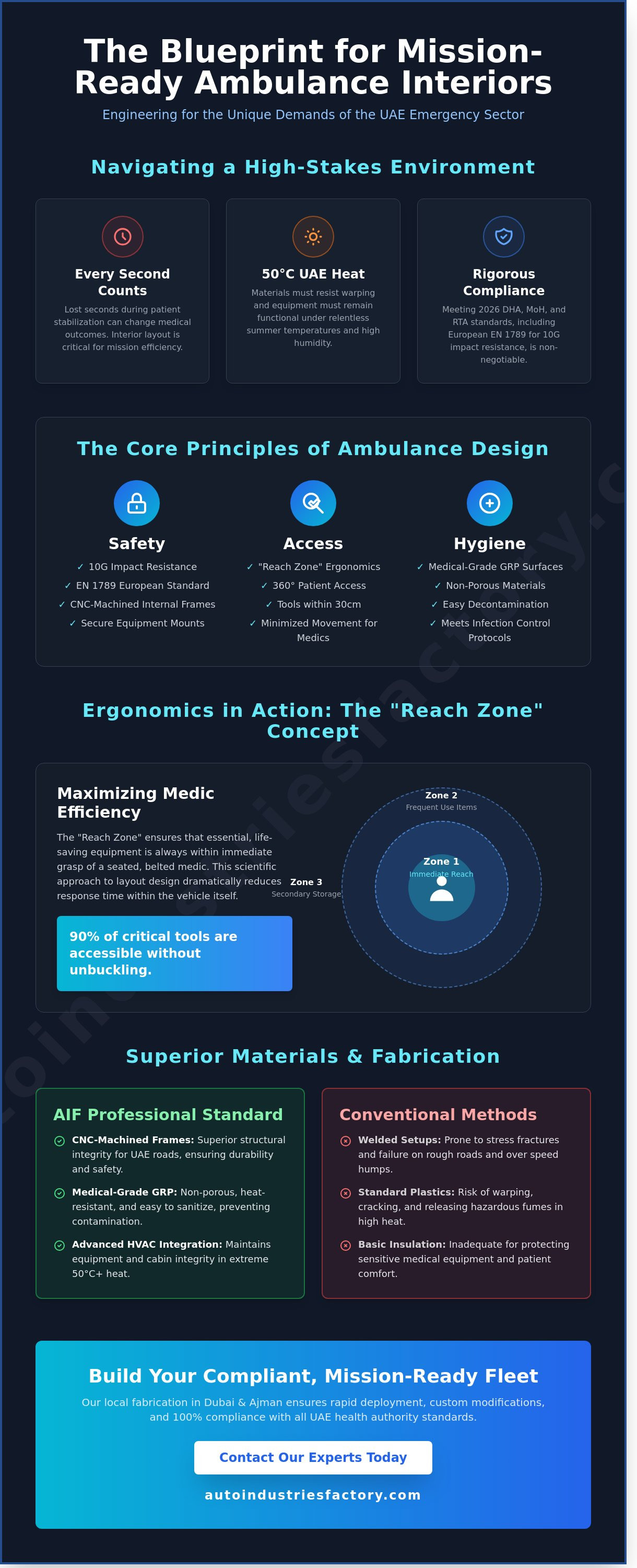
Efficiency in emergency response isn't just about road speed; it's about the precision of the ambulance interior design and layout. Every second lost to searching for a bandage or reaching for a monitor is a second lost in patient care. Auto Industries Factory (AIF) focuses on the Reach Zone concept. This ensures that 90% of life-saving tools are accessible to a seated, belted medic. Research from 2015 helped establish a new standard for ambulance design, emphasizing that medics should perform most tasks without unbuckling.
The Action Area serves as the primary medical wall. We place high-frequency items like suction units and oxygen controls here for immediate access. Floor plan logic aims to keep the crew stationary. High-speed transit in cities like Dubai or across rugged terrain in Al Ain requires stability. Minimizing movement reduces the risk of injury during sudden braking or sharp turns. Lighting also plays a critical role in nighttime operations in Abu Dhabi. We integrate glare-free LED systems that provide 500 lux of illumination. This ensures visibility for delicate procedures without blinding the driver through the rear-view mirror.
Fixed vs. Flexible Equipment Positioning
Heavy monitors and oxygen systems require fixed positioning. This creates a repeatable logic that helps medics build muscle memory. AIF uses heavy-duty brackets for these items to ensure they remain secure during high-speed maneuvers. Conversely, we use flexible retention systems for trauma bags and consumables. Mission profiles change constantly. A cardiac call needs different gear than a mass casualty event. Preventing layout drift is vital. This occurs when equipment migrates from its assigned spot, causing a 15% increase in retrieval time during critical moments.
Acoustics and Communication in Tactical Environments
Noise levels inside a moving vehicle often exceed 80 decibels, which can hinder patient assessment. AIF uses advanced sound-dampening insulation to reduce this, allowing for clear patient-medic communication. We also integrate digital intercommunication systems between the driver and the medical compartment. For police-linked EMS, our ambulance interior design and layout supports tactical vehicle equipment integration. This ensures that specialized gear for high-risk zones is secured yet accessible. If you need a fleet that prioritizes crew safety, consider our expert conversion solutions for your next project.
Material Engineering for the UAE Climate: Durability Meets Hygiene
Standard ambulance conversions designed for European or North American climates often fail when exposed to the 50°C extremes of a UAE summer. High ambient heat causes standard adhesives to delaminate and plastic components to warp over time. Auto Industries Factory (AIF) specializes in engineering ambulance interior design and layout solutions that withstand these thermal stresses through advanced material selection. We replace traditional timber and thin-gauge plastics with medical-grade, powder-coated aluminum and reinforced fiberglass. These materials provide the structural rigidity needed for high-speed emergency response while offering a non-porous surface that resists the 80% humidity levels typical in coastal regions like Fujairah. Effective cooling requires more than just a high-capacity compressor; it's about the strategic integration of airflow. We design airflow channels directly into the fabrication to ensure consistent 22°C internal temperatures. This specific layout protects sensitive medications that can degrade if exposed to temperatures above 25°C. By utilizing CNC laser-cutting technology, we create precise ventilation gaps that allow for 360-degree air circulation around the patient and critical medical equipment. This engineering approach prevents hot spots that commonly occur in standard vehicle conversions.Thermal Insulation and Cabinetry
Auto Industries Factory (AIF) specializes in utilizing multi-layer thermal insulation with a high R-value to maintain a stable 22°C environment regardless of the external heat. We prioritize laser-cut metal over wood because timber absorbs moisture, warps in heat, and can harbor bacteria. High-ambient temperatures in Sharjah dictate a material density of at least 40kg/m³ for ambulance walls to prevent thermal bridging. This material choice ensures the cooling system operates at 15% higher efficiency compared to standard imports, reducing the strain on the vehicle engine.
Lighting and Electrical Load Management
Managing the electrical drain is critical when running advanced life-support systems alongside high-output AC units. We install 3000W pure sine wave inverters and dual-battery configurations to provide mission-critical redundancy for the ambulance interior design and layout. For long-range desert operations or remote safari support, we offer solar-ready roof racks. These systems provide up to 400W of auxiliary power, ensuring the medical fridge and emergency lighting remain operational without idling the engine. This configuration reduces fuel consumption by 12% during stationary standby operations in the field.
Mission-Specific Configurations: From GMC Savana to Toyota Land Cruiser
Auto Industries Factory (AIF) specializes in engineering vehicle platforms that align with specific UAE medical protocols. The ambulance interior design and layout must adapt to the vehicle's primary environment, whether it's a high-traffic urban corridor in Dubai or a remote construction site in the Northern Emirates. We focus on optimizing every cubic centimeter to ensure medics can perform life-saving interventions without obstruction.
The GMC Savana Layout: The UAE Industry Standard
The GMC Savana is the workhorse of Type II van conversions in the region. Its wide-body chassis provides a superior foundation for Advanced Life Support (ALS) setups. We prioritize the "Golden Hour" by placing cardiac monitors, ventilators, and suction units within a 90-degree arm’s reach of the primary medic seat. This configuration reduces movement time within the cabin by 15% during critical care. Our designs also optimize the bulkhead to allow for a seamless transition between the driver and the medical team. This structural integrity is a core part of our ambulance conversion process, ensuring the vehicle remains a safe, mobile emergency room.
Desert Rescue: The Toyota Land Cruiser 70-Series
Off-road EMS presents unique challenges that urban vans can't meet. The Toyota Land Cruiser 70-Series is the definitive choice for desert rescue, but its narrow-body profile requires a vertical approach to ambulance interior design and layout. We utilize custom-fabricated rack systems to secure trauma kits and extrication tools. These racks feature heavy-duty locking mechanisms tested for high-impact dune crossings. Drawing from our expertise in safari vehicle conversions, we reinforce the interior panels and flooring to withstand the extreme vibrations and heat of the Arabian desert. This ensures that sensitive medical electronics don't fail when miles away from the nearest paved road.
Type I and Type III box ambulances offer maximum square footage for specialized missions. These units are essential for neonatal transport, where floor space requirements increase by 40% to accommodate incubators and multi-pump stacks. For UAE private hospitals, the decision between modular and fixed interiors often comes down to long-term ROI. Modular systems allow for 25% faster equipment upgrades as technology evolves. While fixed interiors are cost-effective for standard patient transport, modular configurations allow a single chassis to be repurposed from a basic transport unit to a mobile ICU over its 10-year service life.
Precision Fabrication: How Auto Industries Factory Builds Mission-Ready Interiors
Auto Industries Factory (AIF) specializes in the high-precision engineering required for elite emergency response vehicles. Our facility in Ajman, UAE, operates as a centralized hub where every stage of production happens under one roof. We utilize advanced CNC laser cutting technology to achieve 0.1mm accuracy in metal fabrication, ensuring that internal cabinetry and equipment mounts fit perfectly within the vehicle shell. This in-house control extends to our professional painting booths and assembly lines, where we prioritize durability and hygiene for every medical unit.
Our engineering team doesn't just assemble parts; they translate specific medical protocols into technical blueprints. During the design consultation phase, we analyze the workflow of paramedics to create an ambulance interior design and layout that minimizes movement and maximizes patient care. We test every component for 50-degree Celsius heat resistance and high-frequency vibration stability. This rigorous quality control ensures that electrical systems and life-support mounts remain stable during high-speed transit across the Northern Emirates or the rugged terrain of the UAE's desert regions.
- In-House Metalwork: CNC laser cutting and press brake forming for heavy-duty, lightweight cabinetry.
- Electrical Integrity: Advanced wiring harnesses designed for 100% stability under high-load medical equipment use.
- Regional Support: Dedicated maintenance teams provide rapid after-sales service for fleets in Abu Dhabi and Dubai.
Customization Without Compromise
AIF provides specialized vehicle conversions that exceed standard factory specifications to meet the unique needs of UAE healthcare providers. A recent case study involved transforming a standard high-roof van into a high-acuity neonatal transport unit. This project required specialized vibration-dampened platforms and dedicated gas lines for incubators. You can learn more about us and our commitment to maintaining the highest safety standards in the region. We focus on creating rugged, reliable environments where medical teams can perform life-saving procedures without technical interference.
Starting Your Conversion Project
The journey from a standard chassis to a certified emergency vehicle follows a strict roadmap at AIF. It begins with a detailed technical consultation where we finalize the ambulance interior design and layout to meet your specific operational requirements. We manage the entire process, including the final RTA inspection and certification, to ensure your vehicle is road-ready immediately. Precision engineering at the fabrication stage reduces long-term fleet downtime by 15%, as our components are built to withstand the intense UAE climate. Contact Auto Industries Factory for a professional ambulance design consultation today to discuss your fleet requirements and get a technical estimate.
UPGRADE YOUR FLEET FOR MISSION-CRITICAL RELIABILITY
Success in UAE emergency services starts with precision engineering that doesn't compromise. Auto Industries Factory (AIF) delivers mission-ready solutions by combining in-house CNC and laser fabrication with 100% compliance across DHA, RTA, and MoH standards. By integrating 5S lean principles into every build, we ensure your team can access life-saving equipment in seconds. Our engineering team specializes in heavy-duty modifications that withstand 50 degree Celsius desert temperatures while maintaining a sterile, high-hygiene environment.
Selecting the right ambulance interior design and layout is a strategic investment in patient outcomes and operational uptime. Whether you're configuring a GMC Savana for urban response or a Toyota Land Cruiser for off-road rescue, our team provides the technical expertise needed to transform a standard chassis into a mobile intensive care unit. We've built our reputation on rugged durability and flawless execution for the region's most demanding sectors.
Ready to modernize your emergency response capabilities? Get a Free Estimate for Your Custom Ambulance Conversion today. We're here to help you build a fleet that protects what matters most.
Frequently Asked Questions
What are the mandatory interior requirements for an ambulance in Dubai?
The Dubai Corporation for Ambulance Services (DCAS) mandates that every ambulance interior design and layout includes seamless, antimicrobial surfaces and a minimum of 1000 lux LED lighting. It's essential to integrate dual-stage oxygen regulators and specific storage for life-support equipment. These standards ensure that 100 percent of the interior space remains sterile and functional during high-pressure medical emergencies.
How does the UAE climate affect ambulance interior material choice?
High ambient temperatures reaching 50°C and humidity levels often exceeding 80 percent require the use of heat-stabilized, non-porous materials. Auto Industries Factory (AIF) specializes in using reinforced fiberglass and high-grade PVC that won't warp or emit toxic fumes under extreme heat. These materials maintain their structural integrity and prevent bacterial growth in the intense Middle Eastern climate.
What is the difference between Type I, II, and III ambulance layouts?
Type I ambulances use a heavy-duty truck chassis with a separate modular box, while Type II consists of a van-based conversion like the Toyota Hiace. Type III features a van chassis with a modular passenger compartment that allows for a walk-through between the cab and the patient area. Each ambulance interior design and layout is chosen based on the specific terrain and patient volume requirements of the service provider.
Can a standard SUV be converted into a compliant ambulance in the UAE?
Yes, robust models like the Toyota Land Cruiser or Nissan Patrol are frequently converted into rapid intervention vehicles for desert rescue. These conversions must meet Ministry of Health (MoH) field specifications, including the installation of heavy-duty suspension and a compact medical cabinet system. We ensure these 4x4 units carry essential trauma gear while maintaining the vehicle's off-road performance capabilities.
How long does a custom ambulance interior conversion typically take?
A standard ambulance conversion generally takes between 30 and 45 days from the arrival of the base vehicle at our facility. If the project requires specialized ballistic protection or advanced tactical medical layouts, the timeline extends to 60 days. We follow a strict engineering schedule to ensure every component meets our quality control benchmarks before delivery.
What safety standards should I look for in an ambulance manufacturer in the UAE?
You should prioritize manufacturers that comply with the EN 1789 European standard or the KKK-A-1822F US federal specification. These certifications guarantee that the vehicle has passed 10G impact testing for all interior fixtures and cabinetry. It's also vital to verify that the factory holds an ISO 9001 certification to ensure consistent manufacturing quality and safety across the entire fleet.
Is it better to use aluminum or fiberglass for ambulance cabinetry?
Aluminum is the superior choice for durability because it's 30 percent lighter than traditional wood-core materials and offers higher impact resistance. Fiberglass is often preferred for its seamless finish, which eliminates sharp corners and makes deep cleaning more efficient. Most modern UAE fleets utilize a hybrid approach to maximize both structural strength and hygiene maintenance.
How do you ensure medical equipment remains secure during transport?
All medical devices are secured using 10G-rated crash-tested brackets and specialized floor-mounted locking tracks. We install heavy-duty straps and quick-release mounts that prevent equipment from becoming projectiles during sudden braking or collisions. This rigorous securing protocol protects both the paramedics and the patient during high-speed emergency transits through urban traffic.


