
A standard vehicle frame is a liability when a manual weld fails during a high-speed medical emergency or a high-stress security mission. You already know that in mission-critical environments, "good enough" fabrication leads to catastrophic downtime and compromised safety. Precision CNC machining for custom vehicles is now the essential engineering bridge that allows platforms like the Toyota Land Cruiser or GMC to survive extreme duty cycles. It replaces inconsistent manual processes with repeatable, high-strength components designed for the most demanding terrain on earth.
We agree that when lives are on the line, your fleet's structural integrity shouldn't be a guessing game. This article explores how high-precision machining transforms standard platforms into specialized units for medical, security, and off-road applications. You'll discover how to reduce vehicle weight through optimized part design and achieve faster turnaround times for complex fleet conversions. We'll also examine how current standards like IATF 16949 ensure your specialized units remain rugged, reliable, and ready for action.
Key Takeaways
- Understand how computer-controlled precision replaces manual fabrication to ensure mission-critical reliability in specialized vehicle conversions.
- Learn why 3-axis and 5-axis milling are essential for creating high-strength structural mounts that manual welding can't match.
- Discover how CNC machining for custom vehicles eliminates structural stress points and human error to improve overall fleet safety.
- Explore real-world applications where precision-machined parts protect lives, from high-impact ambulance mounts to reinforced safari frames.
- See how in-house fabrication delivers faster, more durable solutions for specialized Toyota and GMC fleets.
The Role of CNC Machining in Specialized Vehicle Fabrication
Standard vehicle platforms aren't built for the extreme stresses of a mobile intensive care unit or a ruggedized military scout. CNC machining for custom vehicles allows us to bridge this gap with absolute certainty. By using Computer Numerical Control (CNC), we remove the variables of human error and manual fatigue from the production line. CNC machining is the foundation of modern vehicle fabrication in 2026. It uses pre-programmed software to guide high-precision cutting tools with a level of accuracy that manual fabrication simply cannot replicate. In specialized conversions, this technology replaces traditional guesswork with aerospace-grade precision, ensuring every bracket, mount, and structural reinforcement fits perfectly every time.
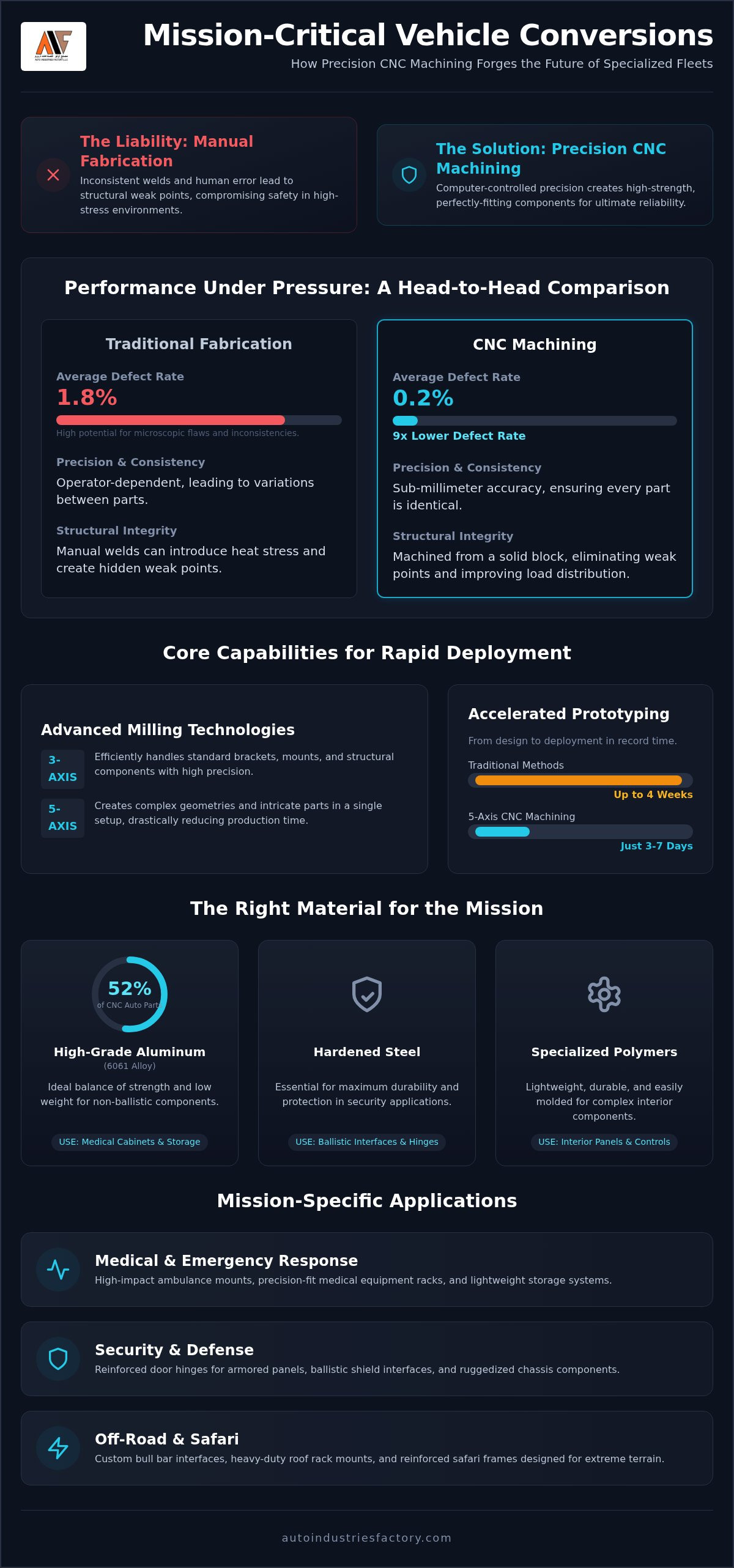
Precision is not just about fit; it's about reliability. The average mass production defect rate for CNC automotive parts is only 0.2%, which is significantly lower than the 1.8% defect rate seen in traditional die casting. When transforming a standard van or truck into a mission-critical unit, this difference in quality is what prevents mechanical failure in the field. It ensures that every component performs exactly as engineered, regardless of the environment.
Bridging the Gap Between Standard and Specialized
Standard chassis like the Toyota Land Cruiser or GMC platforms provide a reliable base, but they lack the factory mounting points for heavy-duty medical racks or ballistic shielding. Bridging this gap requires custom-machined interfaces that distribute weight and stress across the original frame without compromising its structural integrity. CNC allows for the integration of complex systems by creating bespoke components that align with factory specifications. This level of engineering ensures that after-market modifications don't compromise the vehicle's original safety systems or handling characteristics.
Materials Used in Custom Vehicle Machining
The choice of material directly impacts the vehicle's mission capability. We utilize various high-performance materials to achieve the perfect balance of strength and weight. Common materials include:
- High-Grade Aluminum: We frequently use 6061 aluminum alloy, which accounts for over 52% of all CNC automotive parts applications in 2026. It's ideal for lightweight medical cabinets and internal storage systems in Ambulance Conversions.
- Hardened Steel: Essential for security and military applications, we machine hardened steel to create ballistic interfaces and reinforced door hinges that can support the weight of armored panels.
- Specialized Polymers: For interior vehicle panels and ergonomic controls, polymers provide a durable, lightweight solution that stands up to heavy daily use.
By selecting the right material for the right application, we ensure the vehicle remains functional and robust for operators in high-stress environments.
Core CNC Capabilities for Mission-Critical Fleet Conversions
Repeatability is the cornerstone of professional fleet management. When maintaining a fleet of police or medical units, every component must be identical to ensure uniform performance and ease of maintenance. CNC machining for custom vehicles provides this consistency by utilizing 3-axis and 5-axis milling technologies. While 3-axis machines handle standard brackets, 5-axis milling allows our engineers to create complex geometries in a single setup. This advanced capability reduces the prototype delivery cycle from the traditional four weeks down to just 3-7 days, allowing for rapid deployment of specialized units.
The precision required for these conversions often mirrors the standards seen in CNC Machining for Government Vehicles. Whether it's a reinforced chassis for a military scout or a specialized mounting system for an ambulance, the goal is extreme durability. By using automated tool paths and AI-optimized setups, we ensure that every structural mount meets or exceeds original equipment manufacturer (OEM) standards.
Precision Milling for Structural Reinforcements
Modifying a vehicle's original frame requires a deep understanding of its engineering limits. We use precision milling to create bespoke mounting points for heavy-duty roof racks and safari gear that don't compromise the vehicle's integrity. One of the most critical applications is the fabrication of custom bull bar interfaces. These components are engineered to align perfectly with factory crumple zones, ensuring that the added protection doesn't interfere with the vehicle's safety systems during an impact. For organizations requiring specialized fleet solutions, our custom fabrication services provide the necessary bridge between standard factory builds and mission-ready units.
Advanced Turning for High-Performance Components
While milling handles brackets and plates, CNC turning is essential for round, high-strength components. We utilize precision turning to fabricate custom bushings and spacers for off-road safari suspensions that must survive thousands of kilometers of corrugated terrain. In security applications, we engineer heavy-duty door hinges for armored personnel carriers. These hinges are turned from hardened steel to support the massive weight of ballistic plating without sagging or failing over time. Every part is designed to meet the extreme durability requirements of desert environments, where heat and sand quickly expose the weaknesses of inferior parts.
Precision laser cutting rounds out our core capabilities, providing the clean edges needed for vehicle body panels and protective plating. By combining these technologies, we offer a complete in-house solution. This level of automation is increasingly vital in the region, where top industrial robotics suppliers UAE are transforming how complex components are fabricated. It's also a cost-effective approach for fleet managers; increasing a production run from a single prototype to 100 units can reduce the per-part cost by approximately 60%. This efficiency allows for the rapid scaling of specialized fleets without sacrificing the ruggedness that mission-critical applications demand.
CNC Machining vs. Traditional Fabrication: A Safety Comparison
Manual fabrication often introduces human error in welding and alignment, creating invisible weaknesses in a vehicle’s structure. In high-stress environments, these inconsistencies become critical failure points. CNC machining for custom vehicles eliminates these risks by removing the variability of manual cutting and joining. Every component is produced from a digital twin, ensuring that stress points caused by inconsistent manual welds are entirely avoided. When a vehicle undergoes extreme maneuvers or sudden impacts, the structural integrity of these precision-engineered parts can be the difference between a successful mission and a mechanical failure.
Consistency is the primary driver of safety in modern fleet conversions. Repeatability is non-negotiable for a professional ambulance conversion because life-saving medical equipment must remain secured even during a high-impact collision. Precision machining ensures that every mounting bracket and internal frame meets the exact safety ratings and crash performance standards required for medical and security fleets. By maintaining these rigorous tolerances, we guarantee that the final specialized unit is as safe as the original factory build, providing peace of mind for operators and passengers alike.
Strength-to-Weight Optimization
Modern fleet managers prioritize efficiency without sacrificing ruggedness. CNC technology allows for "light-weighting" parts through optimized geometry, removing excess material where it doesn't contribute to structural strength. This design philosophy offers several functional advantages:
- Improved Fuel Efficiency: Lighter conversions reduce the total gross vehicle weight, leading to lower operational costs over the fleet's lifecycle.
- Enhanced Handling: Reducing top-heavy weight improves the vehicle's center of gravity, which is vital for high-speed emergency response and stability in off-road conditions.
- Reduced Mechanical Strain: Lower weight puts less stress on the base vehicle’s engine, transmission, and braking systems, extending the service life of the platform.
Durability in Extreme Conditions
In desert or off-road environments, vibration is a constant threat to vehicle longevity. Manual assemblies often suffer from fatigue at weld joints, whereas components produced via CNC machining for custom vehicles are often milled from solid blocks, offering superior resistance to vibration-induced failure. Additionally, the precision tolerances achieved through CNC prevent dust and sand ingress in safari builds. When components fit together with micron-level accuracy, there's no room for abrasive particles to enter and cause premature wear. Our engineering commitment at Auto Industries Factory ensures that every specialized unit is built to withstand these punishing conditions without compromise.
Applications: From Medical Brackets to Safari Protection
The transition from a standard factory chassis to a mission-ready unit requires specialized hardware that off-the-shelf components can't provide. CNC machining for custom vehicles allows for the creation of these bespoke parts across diverse industries, from life-saving medical transport to high-security armored fleets. While previous sections focused on the technical "how," the real-world value lies in the durability of the final application. Whether it is a bracket holding a ventilator in a moving ambulance or a reinforced hinge on a military scout, the precision of the cut determines the reliability of the mission.
Emergency Service Vehicle Customization
In the back of an ambulance, every second counts and every piece of equipment must remain secure. We utilize CNC precision to manufacture custom medical equipment mounts designed to withstand 10G impacts. This ensures that heavy monitors and life-support systems stay anchored during high-speed maneuvers or sudden stops. Our engineers also focus on the finer details of ambulance conversion, such as machining specialized oxygen tank restraints and medical cabinet latches. These components are engineered to be ergonomic and free of sharp edges, protecting both the paramedics and the patients they serve. For law enforcement, we produce bespoke interior consoles for communication and command systems, ensuring that vital electronics are housed in vibration-resistant, perfectly fitted enclosures. These police vehicle modifications turn a standard SUV into a mobile command center capable of operating in the most demanding urban environments.
Off-Road and Safari Performance
For the tourism and exploration sectors, the Toyota Land Cruiser and Hilux are the gold standards, but they require significant reinforcement for deep-desert duty. We fabricate heavy-duty suspension components and custom bull bars and bumpers using CNC precision to ensure they align perfectly with the vehicle's frame. Beyond exterior protection, we engineer modular roof rack systems that can be adjusted based on specific tour requirements, from carrying extra fuel to mounting specialized photography equipment. Our underbody protection plates are machined to fit specific vehicle geometries, providing a shield for the engine and drivetrain against rocks and debris without obstructing airflow or cooling systems.
Security is another critical application where precision is a life-saving requirement. In car armouring, we machine precision armor plate overlaps. This technique eliminates ballistic gaps that occur with manual cutting, ensuring that the protective envelope remains intact at every joint. This level of detail is why government and private security agencies trust CNC-machined components for their high-risk transport needs. If your fleet requires this level of engineering excellence, you can explore our full range of specialized vehicle solutions to see how we can ruggedize your operations.
The Auto Industries Factory Advantage in CNC Fabrication
Auto Industries Factory LLC doesn't just assemble parts; we engineer solutions. Our facility integrates CNC machining for custom vehicles directly into the fabrication workflow. This ensures that every specialized component, from a reinforced bumper to a complex medical rack, is built to the exact specifications of the mission. We maintain a rugged, pragmatic approach to engineering that prioritizes safety and durability above all else. Our team understands the high stakes of the medical, security, and off-road industries, which is why we apply rigorous quality control to every unit that leaves our floor.
Our mastery over the fabrication process allows us to tackle challenges that third-party upfitters simply can't handle. We don't rely on off-the-shelf components that might fail under stress. Instead, we create bespoke hardware that integrates perfectly with the base vehicle's original engineering. This commitment to precision is why our conversions maintain their integrity through years of heavy use in the field. Similarly, for mission-critical engine reliability on the water, you can discover Marine Asset Management Group for expert overhauling and defect repair.
One of our primary advantages is the seamless collaboration between our CAD designers and CNC machinists. Having these experts under one roof eliminates the communication gaps that often plague the modification industry. It allows us to minimize lead times for specialized fleet orders, ensuring that your units are deployed faster without compromising on quality. We provide custom accessory fabrication for any vehicle type, whether you need bespoke roof racks for a safari fleet or specialized interior housing for police electronics. This integrated model means we can move from a digital concept to a finished, high-precision part in a matter of days. It's a level of agility that keeps your operations moving forward.
Engineering for the Toughest Missions
Our technical expertise is grounded in years of experience with high-performance platforms like Toyota and GMC. This includes specialized knowledge in armoured personnel carrier design, where precision is a life-saving requirement. Regional fleet operators trust us because we understand the nuances of reinforcing a standard chassis for extreme durability. Every part we machine meets international safety standards, ensuring that your vehicles remain operational even in the harshest desert environments. We don't settle for generic modifications; we deliver engineered solutions that protect your personnel and your investment. If you're ready to upgrade your fleet with aerospace-grade precision, you can contact us for a custom fabrication quote today.
Engineering Your Fleet for the Next Mission
Precision engineering is the only way to ensure your specialized fleet survives the rigors of high-stakes environments. We've explored how CNC machining for custom vehicles eliminates the structural risks of manual fabrication while optimizing the strength-to-weight ratio of every component. Whether you're deploying a rapid-response ambulance or a reinforced safari unit; the difference lies in the micron-level accuracy of in-house fabrication. Precision is the priority. This level of technical control turns standard chassis into mission-critical assets that you can trust in the field.
By integrating advanced laser cutting and multi-axis milling, we deliver platforms that outperform standard builds in both durability and safety. Our national UAE service and support ensure that your specialized vehicles remain operational when they're needed most. Safety is non-negotiable. You don't have to settle for "good enough" when lives and expensive equipment are on the line. Our master craftsmen are ready to transform your requirements into high-performance reality.
Ready to ruggedize your operations with expert engineering? Request a Technical Consultation for Your Custom Vehicle Project and let's build a solution that never compromises on performance. Your mission deserves nothing less than absolute reliability.
Frequently Asked Questions
What are the benefits of CNC machining for custom vehicle conversions?
CNC machining for custom vehicles offers unmatched precision and repeatability compared to manual fabrication. It ensures that every bracket and mount fits perfectly without the need for destructive manual adjustments. This technology allows for the creation of high-strength components that maintain the vehicle's structural integrity under extreme stress. By using pre-programmed software, we eliminate the risk of human error in complex geometries, which is essential for mission-critical units like ambulances or military scouts.
Can CNC machining help reduce the weight of an armored vehicle?
Yes, CNC machining is a primary tool for "light-weighting" specialized vehicles. By using advanced software to remove excess material from solid blocks of 6061 aluminum, we create parts that are both lighter and stronger than traditional steel fabrications. This reduction in weight improves fuel efficiency and vehicle handling. It's especially critical for armored platforms where every kilogram saved allows for more ballistic protection or improved braking performance in the field.
Is CNC machining cost-effective for one-off custom vehicle builds?
CNC machining is highly efficient for one-off projects due to the speed of digital prototyping. While traditional methods require weeks of manual trial and error, a CNC prototype can be delivered in just 3-7 days. For fleet operators, the cost-effectiveness increases with volume. Scaling an order from a single prototype to 100 units can reduce the per-part cost by approximately 60%, making it the most economical choice for professional fleet conversions in the UAE.
How does CNC precision improve the safety of ambulances?
Precision machining ensures that life-saving equipment remains anchored during high-speed maneuvers or collisions. We manufacture custom mounts designed to withstand 10G impacts, preventing heavy medical monitors from becoming projectiles. Unlike manual welds that can fail under vibration, CNC-machined parts are often milled from solid material, offering superior durability. This zero-defect approach is vital for meeting international safety standards and protecting both paramedics and patients during emergency transport missions.
Can you machine custom parts for safari and off-road vehicles?
Yes, we specialize in machining rugged components for the Toyota Land Cruiser and Hilux platforms. This includes custom bull bars, suspension spacers, and modular roof rack systems that fit factory mounting points perfectly. Our CNC capabilities allow us to engineer underbody protection plates that shield the drivetrain from rocks and sand without obstructing airflow. These bespoke solutions ensure that safari vehicles can handle thousands of kilometers of corrugated terrain without mechanical failure.
How does CNC machining differ from traditional vehicle metalwork?
Traditional metalwork relies heavily on manual cutting and welding, which introduces risks of misalignment and human fatigue. In contrast, CNC machining is a digital process that achieves a 0.2% defect rate, far lower than the 1.8% seen in traditional die casting. It eliminates the stress points caused by inconsistent manual welds. This shift to software-driven fabrication ensures that every part is a perfect replica of the digital twin, providing a level of reliability that manual labor can't match.


