

A standard emergency van is a liability the moment the pavement ends. While these vehicles serve urban centers well, they often bottom out or suffer structural fatigue in the rugged, off-road environments where critical missions occur. Choosing a professional emergency response pickup truck conversion isn't just about adding sirens to a flatbed. It's about engineering a platform that survives extreme terrain while seamlessly housing complex medical or security equipment. You've likely seen standard fleet units fail under the weight of specialized gear or buckle during high-speed responses. It's a costly risk that compromises safety and mission success.
We understand that reliability is non-negotiable when lives are on the line. This guide helps you master the technical requirements and strategic advantages of transforming heavy-duty platforms like the Toyota Hilux or Land Cruiser into high-performance response units. You'll learn how industrial-grade fabrication and structural reinforcements create a vehicle that handles the toughest landscapes. We'll preview the latest standards, including NFPA 1900 and CAAS GVS V4.0 compliance, to ensure your fleet achieves long-term durability and seamless equipment integration. From custom metal canopies to reinforced bull bars, we're looking at the engineering that makes a vehicle truly mission-ready.
Key Takeaways
- Learn why 4x4 platforms offer superior terrain versatility compared to traditional vans in unpredictable off-road environments.
- Discover how industrial-grade structural reinforcement and custom metal canopies protect specialized equipment during high-speed response.
- Master the specific technical requirements of an emergency response pickup truck conversion to maintain compliance with modern safety standards.
- Evaluate the total cost of ownership (TCO) to understand how pickup platforms reduce long-term maintenance expenses for large fleets.
- Identify the engineering benchmarks for selecting a conversion partner, focusing on the precision of in-house laser cutting and CNC machining.
The Strategic Advantage of Pickup Trucks in Emergency Response
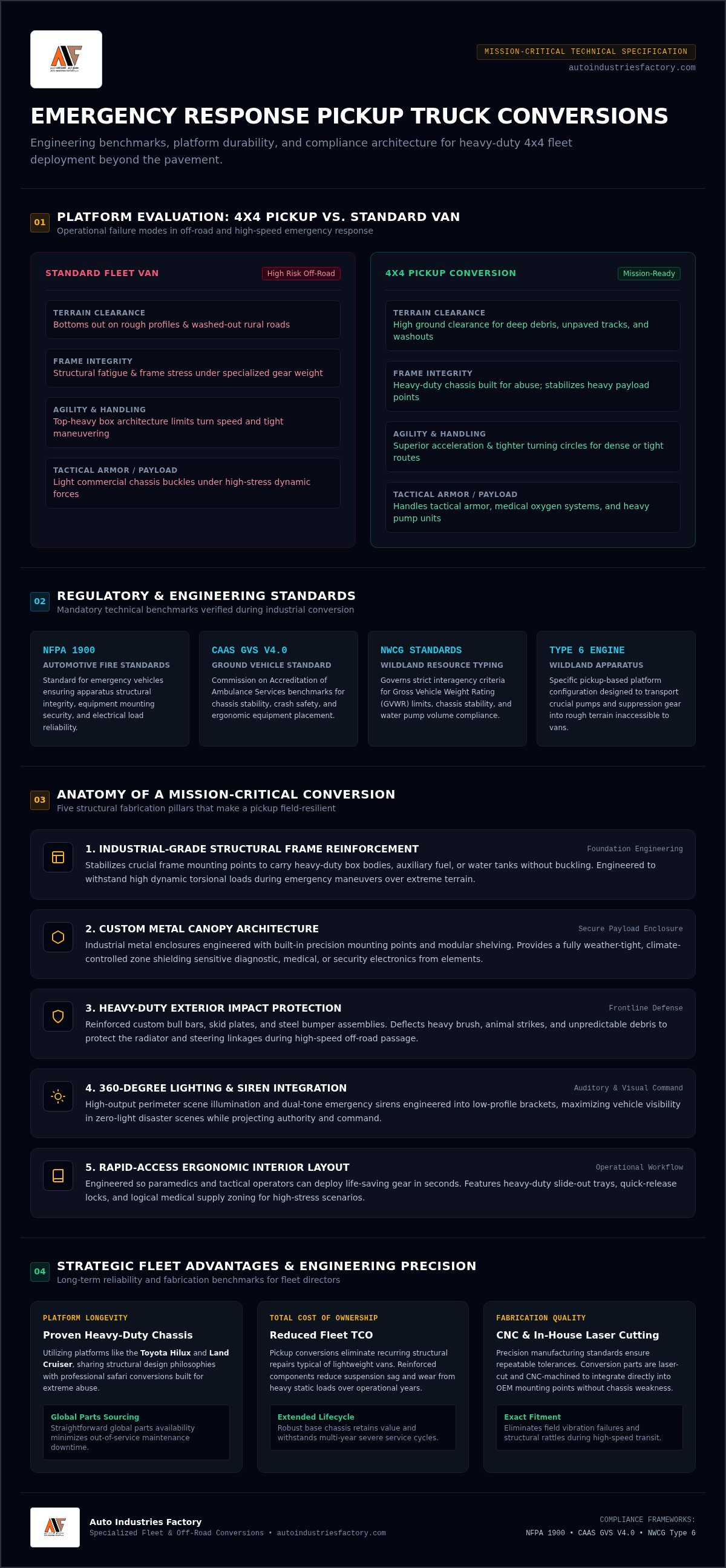
Modern fleet managers are increasingly replacing standard vans with 4x4 pickup platforms. This shift isn't just about aesthetics; it's a calculated move toward mission-critical versatility. An emergency response pickup truck conversion provides the high ground clearance and heavy-duty suspension needed for national response. These units handle heavy medical kits and tactical gear without the mechanical strain that causes premature failure in lighter vehicles. Beyond technical specs, the rugged, authoritative presence of a modified pickup projects confidence and command on the scene. For specialized missions, Type 6 wildland fire engine configurations demonstrate how a pickup chassis can carry significant equipment into areas that would stop a standard ambulance in its tracks.
To see a professional upfit in action, watch this walkthrough of a mission-ready response unit:
Rapid Deployment in Diverse Environments
Maneuverability is a critical factor in disaster-stricken areas where debris or unpaved paths block standard routes. Pickups offer superior acceleration and tighter turning circles compared to top-heavy box-type units. This agility allows drivers to navigate tight urban alleys or washed-out rural roads with equal precision. Because the 4x4 drivetrain provides essential traction on loose soil or flooded tracks, it directly reduces response times in remote areas where every second counts. You don't just arrive; you arrive ready to act.
Platform Longevity and Maintenance
Heavy-duty truck chassis are engineered for high-stress applications and significant payloads. Unlike light commercial vans that often suffer frame stress under the weight of tactical armor or medical oxygen systems, platforms like the Toyota Hilux and Land Cruiser are built for abuse. These vehicles share a design philosophy with professional safari vehicle conversions, utilizing similar structural reinforcement techniques to ensure long-term fleet reliability. Sourcing parts for these global platforms is straightforward, which minimizes downtime for your most critical assets. When the chassis is robust, the entire conversion lasts longer and performs better under pressure.
Core Components of a Mission-Critical Conversion
A successful emergency response pickup truck conversion begins with structural integrity. It's not enough to bolt on accessories; the vehicle's foundation must be engineered to withstand the dynamic forces of high-speed response and heavy payloads. Professional fabricators focus on structural reinforcement to prepare the chassis for mission-specific loads. This includes stabilizing frame points to accommodate heavy-duty box bodies or specialized rescue equipment. Adhering to the NWCG Standards for Wildland Fire Resource Typing ensures that converted units meet strict interagency criteria for Gross Vehicle Weight Rating (GVWR) and pump capacity, protecting the fleet from mechanical failure during critical operations.
Beyond the frame, custom metal canopies provide a secure, climate-controlled environment for sensitive equipment. These aren't standard truck caps; they're industrial-grade enclosures designed with integrated shelving and precision mounting points. High-performance lighting and sirens are then integrated to provide 360-degree visibility, ensuring the vehicle is seen and heard in every environment. Every emergency response pickup truck conversion must also prioritize ergonomic interior layouts to ensure paramedics or tactical officers can access life-saving tools without delay.
Heavy-Duty Exterior Protection
Protection starts at the front line. The installation of custom bull bars and bumpers is essential for shielding the engine and radiator from impact during off-road navigation. These components also serve as primary mounting points for high-capacity winches and external storage solutions. Integrated roof racks extend the vehicle's utility, providing stable platforms for oversized rescue gear or complex communication arrays that require clear lines of sight. If you need robust protection for your fleet, you can explore our specialized modification services to see how we harden vehicles for the field.
Advanced Electrical and Communication Integration
Modern response units function as mobile command centers. Dual-battery systems are a baseline requirement to support high-draw emergency lighting, radio sets, and onboard computers without draining the primary starter battery. Specialized mounting for satellite and radio communication ensures national-scale coordination even when cellular networks fail. In high-temperature regions, integrated climate control solutions are vital for preserving the efficacy of temperature-sensitive medical supplies. We don't just build vehicles; we engineer self-sustaining environments that function when traditional infrastructure doesn't.
Evaluating Your Fleet: Pickup vs. Traditional Van Conversions
Choosing between a van and a pickup platform is a decision that defines your fleet's operational limits. While vans offer superior internal volume for standing treatment, an emergency response pickup truck conversion excels in mission capability and structural durability. The trade-off is simple: vans provide space, but pickups provide access. For national response teams, the ability to reach a scene regardless of road conditions outweighs the benefit of extra interior height. From a safety perspective, pickup chassis are often easier to upfit with ballistic protection for high-risk zones without compromising the vehicle's center of gravity.
A Total Cost of Ownership (TCO) analysis reveals that pickups often outperform vans over a seven to ten-year lifecycle. Truck chassis maintain higher resale values and typically feature more robust drivetrains designed for constant heavy loads. When a chassis reaches its mileage limit, the modular nature of the conversion allows the expensive medical or command module to be transferred to a new vehicle. This adaptability ensures that your emergency response pickup truck conversion remains a long-term asset rather than a disposable one. All modifications must adhere to Federal Motor Vehicle Safety Standards to ensure occupant protection during high-speed transit.
Off-Road Capability and Ground Clearance
Traditional vans often fail in environments featuring deep sand, floodwaters, or rocky inclines. The high ground clearance of a 4x4 pickup is essential for navigating disaster zones where infrastructure has collapsed. Suspension upgrades are a mandatory part of the engineering process, allowing the vehicle to carry heavy fabrication while maintaining stability. In high-security environments, these rugged platforms are the preferred choice for those seeking armored vehicles for sale that can still perform in extreme heat and soft-sand conditions.
Customization Flexibility
Modular bed designs allow fleet managers to swap out equipment packages based on the specific mission, whether it's fire suppression, mobile command, or advanced life support. This flexibility is significantly more difficult to achieve with the fixed, unibody interiors of standard commercial vans. You can easily adapt a single platform for various roles, including specialized police vehicle modifications that require secure prisoner transport or tactical gear storage. Modular upfitting is the future of versatile fleet management. It allows for rapid fleet scaling and ensures that every vehicle in the line-up is optimized for its current task.
The Engineering Process: From Chassis to Mission-Ready
Engineering a mission-ready unit requires more than just adding accessories to a stock vehicle. The process starts with precision 3D modeling tailored to specific fleet requirements. This digital blueprint allows engineers to map out equipment placement, weight distribution, and structural stress points before any physical work begins. An emergency response pickup truck conversion designed through this rigorous methodology avoids the structural compromises and balance issues common in generic upfits. By planning every bolt hole and bracket in a virtual environment, we ensure the final build integrates perfectly with the base chassis, whether it's a Toyota Hilux or a Land Cruiser platform.
In-House Fabrication Excellence
Precision is the hallmark of a professional conversion. Utilizing in-house laser cutting ensures that every metal component features perfect fitment, which significantly reduces rattles and mechanical wear over the vehicle's life. CNC machining provides the repeatability required for national fleet orders, ensuring that the tenth vehicle in a line performs exactly like the first. Structural integrity is further solidified through specialized welding techniques used to assemble custom metal canopies and reinforced frame mounts. This level of master craftsmanship ensures that the vehicle remains a cohesive, robust unit even under the extreme vibrations of off-road response.
Mission-Specific Interior Outfitting
The interior of a response unit must be as durable as its exterior. For a specialized ambulance conversion, this involves installing medical-grade, non-porous surfaces that withstand rigorous cleaning protocols. In police or military configurations, the engineering focus shifts to secure, rapid-access storage for tactical gear and heavy equipment. We also integrate oxygen and power distribution systems that are engineered for 100% reliability. Every wire is loomed and every circuit is protected to prevent failures during critical moments. We don't just fill space; we optimize it for mission efficiency.
The final stage of the engineering process involves high-durability painting and rigorous quality control testing. We subject every emergency response pickup truck conversion to a battery of tests, including electrical load assessments and structural stress checks. This ensures that every light, siren, and specialized tool functions exactly as intended when the vehicle arrives on the scene. If you're looking for a partner that prioritizes technical precision and engineering mastery, you can explore our comprehensive vehicle modification solutions to begin your fleet's transformation.
Selecting a Conversion Partner for National Response Fleets
Selecting the right partner for an emergency response pickup truck conversion is a decision that impacts the safety and efficiency of your entire fleet. You must look beyond simple accessory fitting and evaluate a partner's core technical capabilities. A true engineering partner provides comprehensive solutions that integrate structural reinforcement with advanced electronics. You need a centralized fabrication facility where every stage of the build is controlled under one roof. This centralized approach minimizes the risk of component failure and ensures that every weld and mounting point meets rigorous industrial standards. Without this level of oversight, national fleets face significant downtime when uncertified modifications fail in the field. Compliance with national safety and emergency vehicle standards is non-negotiable. Your partner should demonstrate a deep understanding of current regulations to ensure your vehicles are fully certified for service.
Rugged Solutions for High-Stakes Operations
You need a partner that understands the high stakes of national response operations. "Master Craftsman" expertise isn't just a title; it represents decades of experience in specialized vehicle engineering for platforms like the Toyota Hilux and Land Cruiser. This expertise ensures that your vehicles don't just look the part but perform reliably under extreme stress. We focus on durability because we know that a failure in the field is not an option. If you're ready to upgrade your response capabilities, you can consult our experts for your fleet conversion to ensure your units are mission-ready from day one.
Comprehensive Fleet Support
Reliability doesn't end when the vehicle leaves the factory. Post-conversion support is essential for maintaining mission-critical uptime across your entire organization. A professional partner offers robust warranty programs and technical training for your operators. This ensures they know how to utilize every onboard system, from power distribution to specialized medical gear, effectively. Scalability is also a primary factor. Whether you require a single custom build for a specialized unit or a full-scale national fleet order, your partner must have the infrastructure to deliver consistent quality across every unit. You can learn more about our fabrication standards and how we position ourselves as a regional leader in specialized vehicle manufacturing through engineering precision.
Engineering the Future of Your Emergency Response Fleet
The decision to transition to a pickup platform isn't just about terrain access; it's a strategic move toward long-term fleet resilience. By prioritizing structural reinforcement and modular upfitting, you ensure your units withstand the rigors of national response without mechanical failure. A professional emergency response pickup truck conversion eliminates the vulnerabilities of standard commercial vans, providing a robust foundation for life-saving equipment and personnel.
Success in high-stakes operations requires more than basic accessories. It demands the precision of full in-house CNC and laser cutting capabilities to guarantee perfect fitment and mission-critical reliability. As specialists in rugged Toyota Hilux and Land Cruiser builds, we provide the expert engineering necessary to protect your investment. Choosing a partner that functions as a master craftsman ensures your specialized gear integrates seamlessly into a chassis built for abuse. We understand that in your line of work, dependability is the only metric that matters.
Ready to enhance your mission capability? Request a Technical Consultation for Your Fleet Conversion today. We're here to help you deploy a vehicle that performs when the stakes are highest.
Frequently Asked Questions
What are the best pickup truck models for emergency response conversion?
The Toyota Land Cruiser and Hilux platforms are the primary choices for heavy-duty emergency response pickup truck conversion due to their global parts availability and rugged chassis. These models handle structural reinforcement better than light-duty alternatives. We also specialize in modifying GMC platforms for extended roof applications. These vehicles provide the necessary payload capacity for medical oxygen systems and tactical gear while maintaining off-road agility in national response environments.
How long does a typical emergency response pickup conversion take?
Lead times for a professional emergency response pickup truck conversion typically range from 6 to 12 months. This duration includes initial 3D modeling, precision laser cutting of structural components, and the final integration of electrical and communication systems. Complex builds involving custom metal canopies or ballistic protection may require additional time for rigorous quality control testing. We focus on engineering precision to ensure every unit is mission-ready upon delivery to your fleet.
Can a converted pickup truck be used as a full-service ambulance?
Yes, a pickup chassis is an ideal platform for a full-service Type I or box-type ambulance. These conversions provide the ground clearance needed for rural or disaster-zone medical response where standard vans often fail. By integrating medical-grade surfaces, oxygen distribution, and advanced life support equipment into a reinforced chassis, we create a mobile treatment center. These units offer the perfect balance between internal patient care space and extreme terrain capability.
Is it possible to add ballistic protection to a response pickup?
Ballistic protection is a common requirement for police and military vehicle modifications in high-risk zones. We engineer armored solutions that protect occupants without compromising the vehicle's center of gravity or off-road performance. This process involves reinforcing the doors, glass, and firewall with certified materials. Because we handle structural metalwork in-house, we can integrate these safety features seamlessly into the initial design phase of the conversion for maximum reliability.
What specialized equipment can be integrated into a custom canopy?
Custom metal canopies are engineered to house a wide array of mission-critical equipment. We integrate modular shelving, slide-out command desks, and secure storage for tactical gear or medical supplies. These enclosures also accommodate advanced electrical systems, including dual-battery setups, radio communication arrays, and climate control units. Every canopy is fabricated using precision CNC machining to ensure a weather-sealed environment that protects sensitive electronics from dust, moisture, and extreme temperatures.
How does a custom bull bar improve emergency response safety?
A custom bull bar is a vital safety component that protects the vehicle's radiator and engine from impact during off-road navigation or debris-clearing operations. Beyond structural protection, these bars serve as stable mounting points for high-capacity winches, brush guards, and emergency lighting. By shielding the front end, you reduce the risk of a mechanical failure that could strand a response team in a remote or hostile environment during a critical mission.
Do converted pickup trucks require special suspension upgrades?
Suspension upgrades are mandatory for any high-performance conversion to handle the increased weight of metal canopies, medical gear, or armoring. We reinforce the suspension system to maintain vehicle stability and prevent bottoming out in rugged terrain. This ensures that the truck handles predictably during high-speed responses while carrying a full payload. Professional engineering accounts for these dynamic loads to prevent premature wear on the chassis and drivetrain components.
Are custom conversions compliant with national emergency vehicle regulations?
Compliance with national standards such as NFPA 1900 and CAAS GVS V4.0 is a core requirement of our engineering process. Every build is designed to meet strict safety and performance criteria, including emergency lighting synchronization and occupant crash protection. We ensure that our conversions adhere to all relevant Federal Motor Vehicle Safety Standards to protect your fleet from liability. This commitment to regulation ensures that your units are fully certified for mission-critical service.


