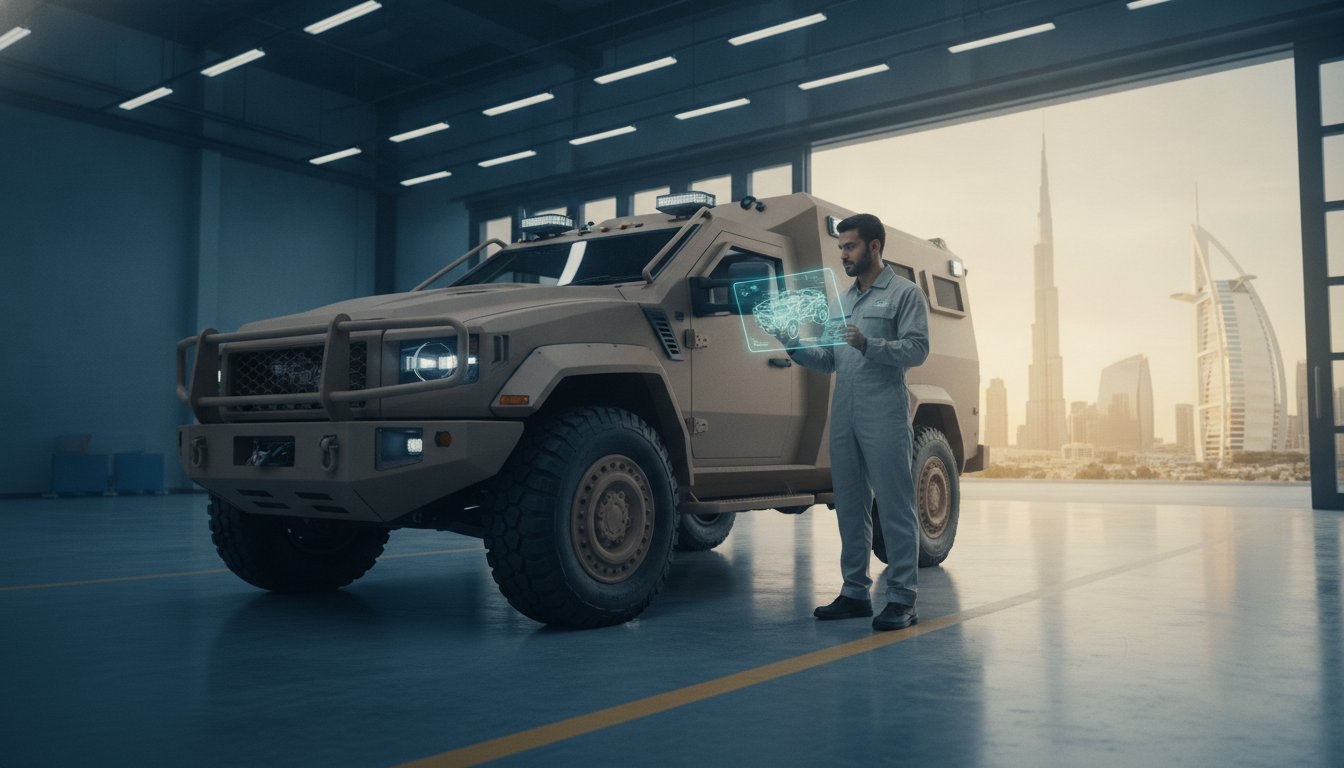
In the relentless heat of the Rub' al Khali, a standard maintenance schedule is a recipe for catastrophic failure. You understand that for emergency and tactical units, reliability isn't a luxury; it's a non-negotiable requirement. When sand ingress compromises a custom medical system or UV exposure degrades structural welds, the mission stops, and the stakes couldn't be higher. The extreme desert environment is unforgiving to even the most robust builds, making specialized engineering oversight essential for survival.
When you're upgrading specialized vehicle fleets UAE, you need a partner who understands the high stakes of emergency and tactical operations. Auto Industries Factory LLC provides the technical depth required to keep your units operational 24/7. Our expert engineering team offers national support across the Emirates, utilizing in-house laser cutting and CNC machining to produce precision replacement parts that meet original CAD specifications, which can be further supported by the Sale of industrial and heavy equipment spare parts for comprehensive fleet maintenance. As specialists in ambulance, police, and military conversions, we're committed to the resilient performance of your specialized assets.
This 2026 guide provides the technical roadmap to ensure your converted units achieve zero operational downtime while maintaining essential safety certifications. We will break down the precise strategies for upgrading specialized vehicle fleets UAE, focusing on desert-hardened reliability and compliance with the latest Euro 6b emission standards. You'll learn how to extend the lifespan of your custom fabrication, navigate the AED 2,500 ECAS certification process, and protect your mission-critical investment against the UAE's unique environmental stressors.
Key Takeaways
- Identify why standard mechanical service is insufficient for custom conversions and how to implement fabrication-focused inspection protocols for chassis reinforcements.
- Master the technical requirements for upgrading specialized vehicle fleets UAE to ensure compliance with 2026 Euro 6b standards and ESMA safety regulations.
- Prevent critical failures in medical and tactical units through specialized electrical load testing and auxiliary power management for mission-critical systems.
- Protect high-value assets from the UAE's extreme UV and sand exposure with advanced filtration and seal maintenance strategies tailored for desert environments.
- Leverage engineering-led fabrication to produce precision replacement parts that maintain the structural integrity and safety certifications of your specialized fleet.
The Strategic Framework for Specialized Vehicle Maintenance
Standard dealership maintenance focuses on the engine and drivetrain. For a Custom car or specialized conversion, this is only half the battle. Specialized maintenance demands a fabrication-first mindset. You aren't just changing oil; you're verifying the integrity of laser-cut brackets, heavy-duty chassis extensions, and complex electrical looms. The intersection of automotive engineering and mission-specific fabrication creates a unique set of failure points that standard diagnostic tools simply can't detect.
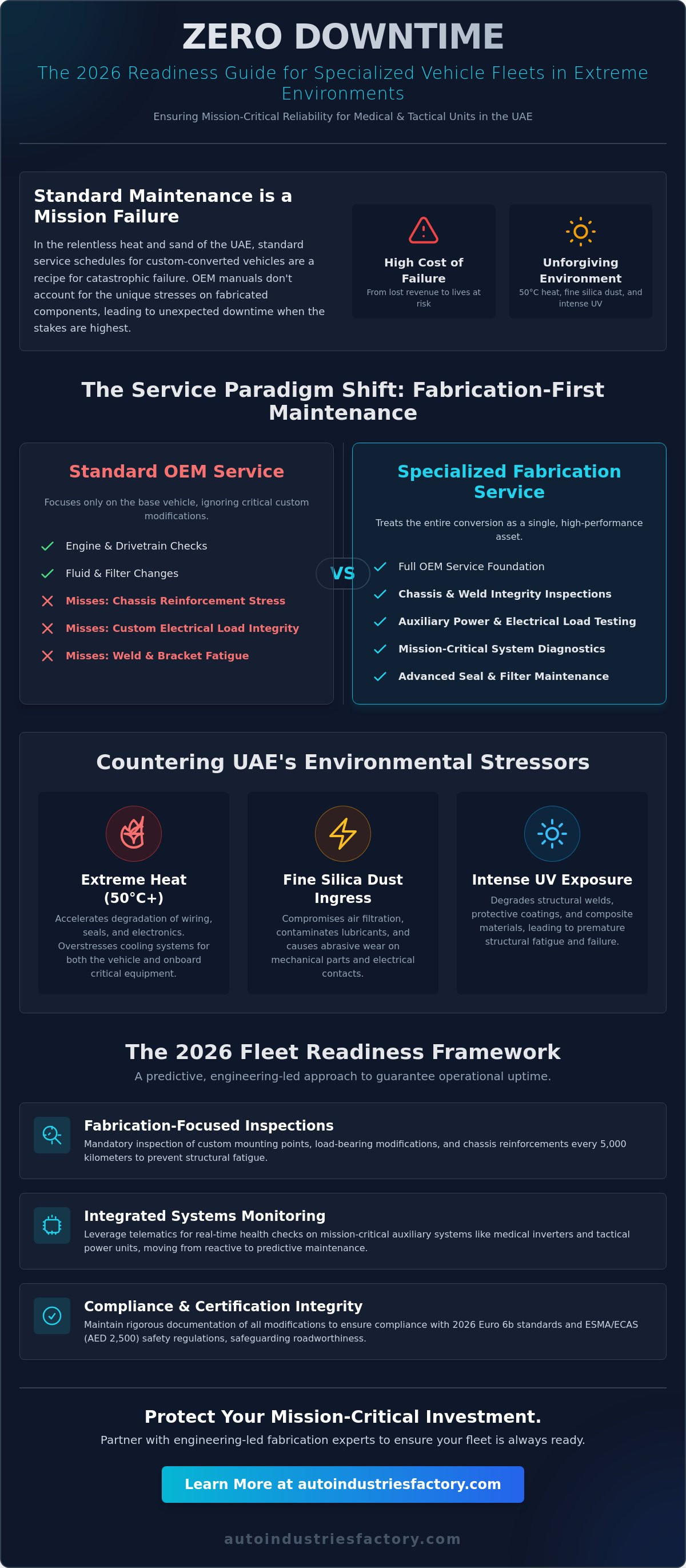
Consider the risk profile. If a commercial delivery van breaks down, you lose a day of revenue. If an ambulance's custom oxygen delivery system fails due to vibration-induced fatigue, you lose a life. This high cost of failure necessitates a lifecycle management plan that accounts for the accelerated wear caused by the UAE's 50°C summers and fine silica dust. By 2026, fleet managers must move beyond reactive repairs to a predictive framework that treats the conversion as a primary engineering asset.
To better understand the nuances of optimizing your operations, watch this helpful video:
Effective 2026 lifecycle management requires a deep understanding of how specialized modifications interact with the base vehicle. When you are upgrading specialized vehicle fleets UAE, you are managing a hybrid machine. One part is mass-produced automotive technology; the other is bespoke engineering designed for extreme performance. Maintaining this balance requires a structured approach to both structural and electronic systems.
Conversion vs. Standard Vehicle Service
OEM service manuals are written for standard road use. They don't account for the added weight of an armored plate or the structural stress of a box-type ambulance conversion. You must inspect custom mounting points and load-bearing modifications every 5,000 kilometers. These components often sit under a secondary warranty layer provided by the fabricator, not the vehicle manufacturer. Ignoring these specific check-points leads to structural fatigue that standard mechanics will overlook until it's too late.
The 2026 Fleet Readiness Standard
Modern fleet management requires more than just a clipboard. When upgrading specialized vehicle fleets UAE, integrating telematics with custom system monitoring is the new baseline. This allows for real-time health checks on auxiliary power units and medical inverters. Proper documentation is also critical for UAE certification; ESMA requires clear records of all aftermarket modifications to maintain roadworthiness. Regular audits are the only way to prevent catastrophic structural failure, especially in high-stress applications like safari vehicle conversions that face daily off-road punishment.
Preserving Structural Integrity in Custom Fabrication
Heavy-duty chassis reinforcements are the physical backbone of any mission-critical conversion. In the UAE's demanding terrain, these structures face extreme torque and vibration that standard vehicles never encounter. Maintaining the physical foundation of your fleet is the most critical aspect of upgrading specialized vehicle fleets UAE, as structural failure in the field is often irreversible. Chassis reinforcements aren't "set and forget" components. The added mass of an extended roof or a box-type ambulance body shifts the vehicle's center of gravity and creates new stress points that require consistent monitoring.
Laser-cut and CNC-machined components provide unmatched precision, but they still require technical oversight. These parts are engineered for high-performance vehicle platforms, yet the constant oscillation of off-road travel can lead to micro-fractures in mounting brackets or sub-frames. Adopting principles of sustainable fleet management helps operators reduce mechanical strain by ensuring every custom component performs at peak efficiency, extending the vehicle's operational life. Structural integrity also extends to external protection systems. Regular checks of custom bull bars and bumpers ensure these components remain securely anchored to the frame, providing the protection they were engineered for during an impact.
Welding and Metalwork Inspection
Weld joints on tactical units or safari vehicles are highly susceptible to vibration fatigue. While visual inspections are a baseline, ultrasonic testing is the professional standard for identifying internal failures before they manifest as a snapped frame. You must also implement aggressive corrosion control for custom-fabricated underbody protection. The fine desert sand is highly abrasive; it strips paint from metal surfaces and invites oxidation. Ensure your team is torque-checking custom mounting bolts for roof racks and canopies at every service interval to prevent hardware loosening under heavy loads.
Bodywork and Painting Preservation
The UAE sun is a silent enemy of structural integrity. High-quality vehicle painting is more than an aesthetic choice; it's a chemical barrier against structural oxidation and UV-induced material degradation. Protective coatings on specialized vehicle exteriors must be inspected for chips or sand-scouring that expose raw metal. If a metal canopy or custom body panel sustains an impact, professional reshaping and repainting are required to maintain its structural rating. If you are managing a conversion that has seen heavy desert use, consulting a specialist for a structural audit is a prudent next step to ensure mission readiness.
Ensuring 24/7 Operational Readiness for Medical and Tactical Systems
Mission success for emergency units depends on the invisible infrastructure of the conversion. While the chassis provides the strength, the electrical system provides the life. In a box-type ambulance or a mobile command center, the power demand exceeds standard automotive capabilities by a significant margin. Standard maintenance often misses the subtle degradation of auxiliary power units. You must implement rigorous electrical load testing to ensure that when the siren is on, the life-support systems don't flicker. Reliability is built through precision, not luck.
When upgrading specialized vehicle fleets UAE, you are managing a sophisticated power grid on wheels. This includes deep-cycle battery management systems and high-wattage medical inverters. These components are sensitive to the UAE's heat, which can drastically reduce battery efficiency during peak summer months. Regular system audits are the only way to ensure the long-term reliability of ambulance conversions. These audits must verify that every medical device is calibrated and that the integrated power supply meets ESMA safety standards to avoid the risks associated with non-compliance.
Auxiliary Power and Electrical Safety
Isolation switches and circuit breakers are your first line of defense against electrical fires. In high-draw environments, these components face significant thermal stress. Inspecting custom wiring harnesses is non-negotiable. The heat under a UAE hood can reach extreme levels, leading to insulation degradation that causes short circuits. For mobile surgical units, UPS and backup power systems must be verified monthly. A failure in the backup loop during a critical procedure is an engineering oversight you cannot afford. This level of technical oversight is mandatory when upgrading specialized vehicle fleets UAE to meet the 2026 reliability standards.
Communication and Tactical Gear Upkeep
Tactical vehicles rely on a constant flow of data. Maintaining signal integrity for police vehicle modifications requires more than just checking antenna connections. You must ensure that the RF shielding remains intact and that the communication racks are dust-proofed. Military vehicles operating in the desert face fine sand that can infiltrate sealed electronics, causing overheating. Beyond the hardware, your maintenance schedule must include software and firmware update protocols. Integrated fleet management systems require current patches to maintain secure, real-time links with central command.
UAE Climate Mitigation: Protecting Assets from Heat and Sand
The UAE's environmental conditions represent the ultimate stress test for specialized vehicle engineering. While standard vehicles struggle, custom conversions face unique vulnerabilities due to their multi-material construction and complex auxiliary systems. UV radiation in the region is intense enough to compromise the chemical bonds of custom seals and gaskets within a single season. When upgrading specialized vehicle fleets UAE, choosing UV-resistant specialized paint and coatings is a functional necessity to prevent the structural oxidation discussed in previous sections. Without these barriers, the integrity of your fabrication is constantly under siege.
Sand ingress management is the second pillar of desert reliability. Fine silica dust acts as an abrasive agent, infiltrating custom-fabricated air intakes and compromising auxiliary engines used for medical power. Standard filtration systems often fail to capture these microscopic particles, leading to premature engine wear. You must implement a rigorous cleaning schedule for all non-OEM vents and intakes to ensure proper airflow. Heat-shielding is equally vital; engine bays in modified units often experience restricted airflow due to added equipment, requiring custom thermal barriers to protect undercarriage components and critical wiring harnesses from radiant heat.
Managing Sand and Dust Ingress
Moving parts are highly susceptible to sand-induced failure. In safari pop-up roofs and sliding equipment trays, dust buildup creates friction that can burn out motors or warp tracks. Your maintenance protocol must include pressurized air cleaning followed by the application of dry-film lubricants. Unlike traditional grease, dry lubricants don't attract sand, keeping the mechanism clear. Regular lubrication of external hinges, winches, and recovery points ensures these mission-critical tools operate when needed most. For precision-engineered components, professional metal cutting and bending services can provide replacement parts that restore the original seal integrity of your fleet.
Extreme Heat and Material Stability
Extreme heat causes materials to expand at different rates. In a multi-material build where steel chassis reinforcements meet aluminum body panels, this thermal expansion can put immense stress on weld joints and fasteners. You must monitor these interfaces for signs of fatigue or warping during the peak summer months when ambient temperatures regularly exceed 45°C. Interior medical-grade linings are also at risk; high cabin temperatures can compromise adhesives, leading to delamination in ambulance conversions. Ensure your cooling system maintenance extends to mission-critical electronic racks. If your fleet lacks sufficient thermal protection, request an estimate for high-performance thermal insulation upgrades to safeguard your cabin climate and sensitive equipment.
Engineering-Led Fleet Support: The Fabrication Partner Advantage
Maintenance for specialized conversions isn't a manual process; it's an engineering one. Standard workshops lack the technical data required to replicate a custom bracket or a reinforced chassis component. When you're upgrading specialized vehicle fleets UAE, the difference between mission success and operational failure often lies in the availability of original CAD designs. A fabrication partner who designs in-house can reproduce an exact component using CNC machining in hours. A general repair shop might spend days on a subpar manual workaround that compromises the vehicle's structural integrity.
Precision engineering is the only way to maintain mission-critical reliability. Auto Industries Factory LLC operates as a specialist for the region's most demanding sectors, from emergency services to tactical units. By leveraging advanced metal cutting and bending technologies, we ensure every replacement part meets the original structural specifications. This engineering-led approach preserves your safety certifications. It also extends the operational lifespan of your investment in the harsh UAE climate, where environmental stress is constant.
In-House Capabilities and Part Availability
Having original CAD designs on file allows for rapid component replacement that matches factory tolerances exactly. Professional finishing, including vehicle color changes and protective coatings, is handled under one roof to ensure the metalwork remains shielded from the elements. Certified welding processes provide the confidence that every repair is as strong as the initial build. This maintains the integrity of everything from front metal bull bars to complex box-type ambulance shells. Consistent quality is only possible through these controlled, in-house manufacturing processes.
Strategic Maintenance Partnerships
Effective fleet management requires moving away from transactional, one-off repairs. A strategic partnership allows for maintenance schedules tailored to your specific mission profile. Your needs differ whether you manage daily urban emergency response units or high-intensity desert patrols. By contacting Auto Industries Factory LLC for comprehensive conversion support, you gain access to a partner that prioritizes zero downtime. We understand the high stakes of your industry. Our team provides the engineering depth required to keep your specialized fleet in peak condition, ensuring mission readiness in 2026 and beyond.
Securing the Future of Your Mission-Critical Fleet
Maintaining long-term reliability requires a shift from standard repairs to engineering-led oversight. You've seen how structural integrity and electrical readiness are the fundamental pillars of performance in the UAE's extreme climate. By prioritizing fabrication-first maintenance, you protect your investment against the relentless degradation caused by intense UV exposure and sand ingress. These proactive measures ensure your units remain roadworthy and compliant with the latest 2026 safety standards.
When you're upgrading specialized vehicle fleets UAE, you need a partner who understands the high stakes of emergency and tactical operations. Auto Industries Factory LLC provides the technical depth required to keep your units operational 24/7. Our expert engineering team offers national support across the Emirates, utilizing in-house laser cutting and CNC machining to produce precision replacement parts that meet original CAD specifications. As specialists in ambulance, police, and military conversions, we're committed to the resilient performance of your specialized assets.
Ensure your specialized fleet stays mission-ready with Auto Industries Factory LLC and secure your operational uptime today.
Frequently Asked Questions
How often should a custom ambulance conversion undergo a full system audit in the UAE?
A full system audit for a custom ambulance conversion should be performed every six months or 10,000 kilometers. This frequency ensures that auxiliary power units, medical inverters, and oxygen delivery systems remain within mission-critical safety tolerances. Given the high stakes of emergency transit, regular audits are the only way to detect vibration-induced fatigue before it leads to a critical system failure during a rescue operation.
Do specialized vehicle modifications affect the original manufacturer warranty?
Specialized vehicle modifications typically void the original manufacturer warranty on the specific systems or components that have been altered. For instance, modifying the chassis for an extended roof or tapping into the electrical loom shifts the warranty responsibility from the OEM to the conversion specialist. You should always verify the secondary warranty layers provided by your fabrication partner to ensure continuous protection for all custom-engineered components.
What are the signs of structural fatigue in a safari vehicle conversion?
Visible signs of structural fatigue in a safari vehicle conversion include hairline fractures in weld joints and persistent rattling from custom roof racks or canopies. You might also notice door misalignment or warping in the sub-frame after heavy off-road use in the desert. These indicators suggest the metal has reached its stress limit and requires immediate engineering intervention to prevent a catastrophic failure in the field.
Can standard automotive workshops service custom medical electrical systems?
Standard automotive workshops aren't equipped to service complex medical electrical systems. These systems involve specialized wiring harnesses and high-wattage inverters that require specific diagnostic tools and original fabrication data. When upgrading specialized vehicle fleets UAE, you must rely on fabrication experts who understand the engineering behind the auxiliary power grid to maintain mission-critical reliability and avoid electrical fires.
How does the UAE heat specifically impact armored vehicle protection levels?
Extreme UAE heat can compromise the adhesive integrity of ballistic glass, leading to delamination over time if the vehicle's interior temperature isn't managed. While the steel armor itself remains stable, the multi-material interfaces and specialized seals can degrade under constant UV exposure. Regular inspections of the glass and thermal barriers are essential to ensure the vehicle maintains its rated protection level against both ballistic threats and environmental stressors.
What maintenance is required for custom-fabricated bull bars and roof racks?
Maintenance for custom-fabricated bull bars and roof racks requires quarterly torque-checking of all mounting hardware to counteract the effects of constant vibration. You must also inspect the finish for sand-scouring or stone chips that could lead to oxidation. Re-coating these components with specialized, UV-resistant paint ensures the underlying metal remains protected from the abrasive desert environment and intense solar radiation common in the Emirates.
How do I ensure sand does not damage sensitive electronics in a mobile clinic?
Protecting sensitive electronics in a mobile clinic requires the use of fine-mesh air filters and maintaining a positive pressure environment within the cabin. You should clean all custom-fabricated air intakes weekly to prevent silica dust buildup. This strategy is vital when upgrading specialized vehicle fleets UAE, as sand ingress is a primary cause of overheating and short circuits in mission-critical medical equipment during transit.
Why is preventive maintenance more critical for converted vehicles than standard fleets?
Preventive maintenance is more critical for converted vehicles because they operate under unique structural and electrical loads that standard fleets never face. The added weight of reinforcements and specialized equipment accelerates wear on the chassis, suspension, and drivetrain. Since these vehicles often serve life-saving or tactical roles, the cost of a mechanical failure is far higher than a simple loss of revenue, demanding a zero-downtime approach.


